No evidence for the Prince’s Syrian refugees theory but plenty that he’s a serial climate alarmist.
Scientists have accused the Prince of Wales of exaggerating the link between climate change and the civil war in Syria, says The Times (via the GWPF).
A new study found no evidence for the widely publicised theory that climate change was a factor in causing the war, in which more than 300,000 people have died and 11 million have been forced to leave their homes.
The researchers said making “overblown claims” based on poor evidence fuelled scepticism about the need for action on climate change, undermining the cause the prince was advancing.
The prince made the claim in November 2015 before the Paris climate change summit at which 194 countries agreed a global deal to cut emissions.
Speaking of the threat from climate change, he said: “There’s very good evidence that one of the major reasons for this terror in Syria was a drought that lasted for five or six years, which meant that huge numbers of people in the end had to leave the land.”
A study by King’s College London and the University of Sussex has debunked the prince’s claim, which was also made by Barack Obama when he was US president.
The researchers found that although northeastern Syria did experience a severe drought from 2007 to 2010, before the civil war started, the drought was not necessarily caused by human influences on global climate.
The scale of migration away from northeastern Syria was “on nothing like the scale which has been claimed”, the study says. Only 40,000 to 60,000 families moved, not the 1.5 million people often quoted by proponents of the climate change link.
The study said that migration was “probably more caused by economic liberalisation than by drought.”
All the models agree that Irma will almost certainly hit Florida directly and that it would take a miracle to divert the storm away.
It’s going to hit.
A number of factors could have prevented Irma from reaching the proportions and magnitudes that it has grown to, but unfortunately luck has played against Floridians and others in the region.
The steering troughs from the High out in the Atlantic and the Low plunging down across the southeast USA could have directed the storm out to sea, if only they had been positioned just a few dozen miles differently.
Shearing could have been stronger and weakened the storm, or the storm might yet track closer to Cuba, causing it to weaken some. But that it is all not to be, and this time the die came up snake eyes. Instead, all factors unfolded in total favor of Irma in almost every way possible. The result: a very powerful hurricane, one we don’t see very often.
Levi Cowan at Tropical Tidbits here explained late Thursday evening the factors driving the storm, and the likely path in the days ahead. It really couldn’t be worse and more unfortunate.
The damage is going to be great. Hurricane conditions could extend up into southern Georgia. High winds and storm surges will be widespread along all coastlines on both sides of the Florida peninsula where many metropolitan areas happen to be sitting.
Map as per 2010 US Census showing cities with a population greater than 150,000, and their respective metro areas. Image by: Comayagua99 at English Wikipedia,CC BY-SA 3.0
Damage per square mile
Florida’s area is some 65,700 square miles and has a population of near 19 million, most of whom living in coastal areas. Property and infrastructure are naturally concentrated there and thus the state’s metropolitan areas will see tens of millions in damage per square mile, with some places possibly seeing damages in the hundreds of millions per square mile. Like Houston did.
Especially the areas along the coast, with their ports, harbors, high-rises, transportation facilities and extensive infrastructure, will see severe damage from high winds and storm surges. Rural areas of course will see less damage per square mile.
If half (conservative) of Florida’s area (32,000 sq mi) gets hit hard by surge and/or wind conditions with an average damage of $20 million per square mile (rough estimate), then we are looking at a potential of more than $600 billion in damage for Florida alone.
Now add the damage already done in the Caribbean and the damage that will happen in Georgia and beyond. We are getting close to the astronomical sum of a trillion dollars.
There is still some time to get property out of harm’s way, but it’s just about run out. Residents need to focus on getting the hell out of the way and saving their lives.
Expect hysterical and irrational demands
Expect global warming alarmists to seize on the final damage tally, no matter what it turns out to be. They’ll be hysterical, and irrationally demand that leaders implement multi-trillion dollar “climate protection” measures mostly aimed at reducing greenhouse gases, especially CO2 emissions from burning fossil fuels.
The problem with these measures, however, is that there is no evidence that they would have any impact on future hurricanes – none! Hurricanes have always occurred, and always will no matter how ecologically pious we might become.
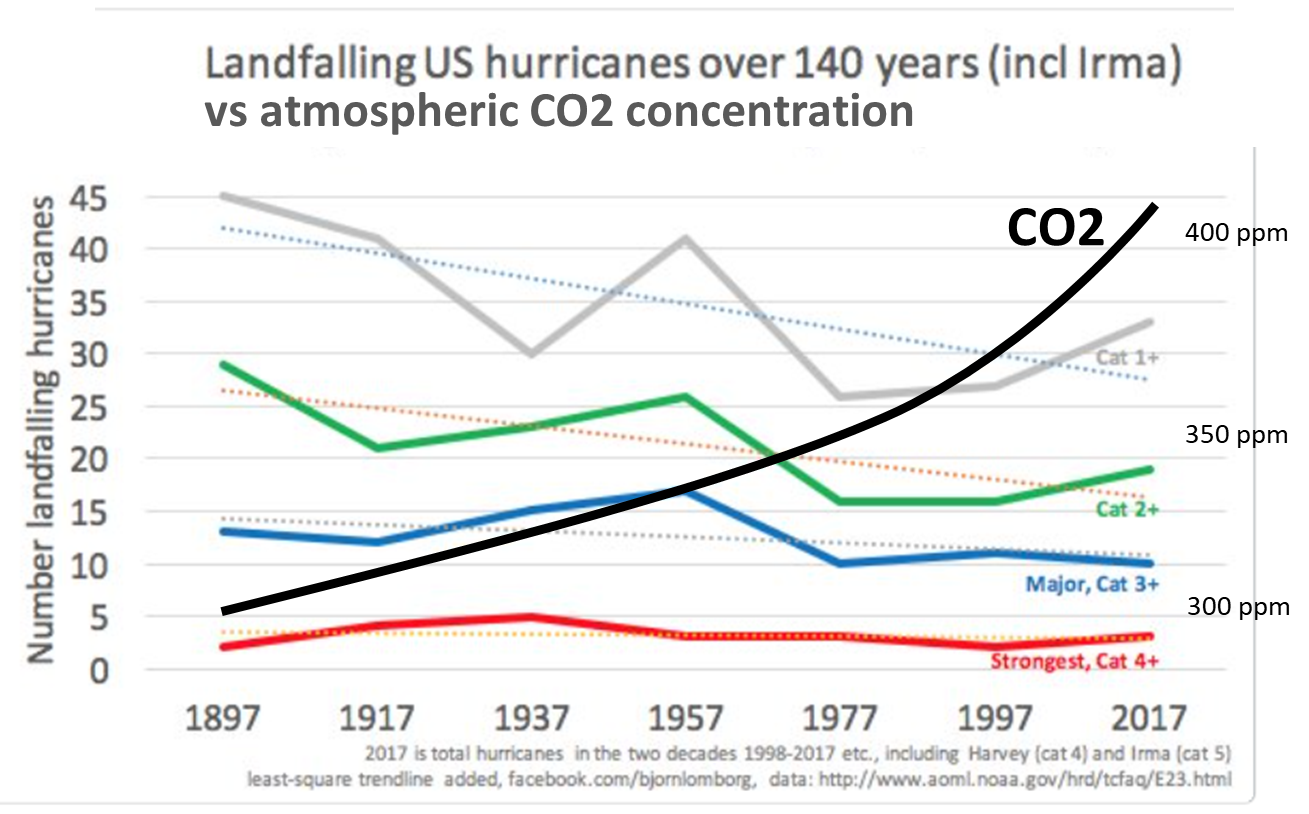
In fact a look at the past shows that hurricane activity trends have in fact been decreasing over the past 140 years while CO2 emissions rose:
Hurricane activity has been falling over the past 140 years. CO2 curve added by NoTricksZone (not necessarily to scale).
If climate and hurricanes are indeed related to CO2, as alarmist and activist scientists like to insist, then the data are telling us to emit more and not less. Of course the CO2-hurricane activity relationship is silly.
Complacency after 12 years of low activity
Hurricanes have always been a problem, and always will be – no matter how much we ride our bicycles and reduce carbon footprints. The best advice here would be to invest the money into better infrastructure and more sensible urban planning. That lesson was learned long ago, but obviously got forgotten along the way.
Twelve years of no major hurricane strikes and decreasing activity likely led to a little complacency.
The BOM’s bad luck never seems to end. Of all the 695 stations in Australia, 693 worked perfectly, but Jen Marohasy and Lance Pidgeon happened to live near, or have a personal random connection to the only two stations that didn’t — Thredbo and Goulburn. Apparently these stations had been flawed (not fit for purpose) for 10 years and 14 years, but the BOM world-class experts hadn’t noticed. I expect they were just about to discover the flaws when (how inconsiderately) Lance and Jen announced the errors to the world and the BOM were forced to do this pointless 77 page report to stop people asking questions they couldn’t answer.
The nub of this fracas is that something called an MSI1 hardware card was installed in cold locations even though it would never report a temperature below minus 10.4C. Awkwardly this doesn’t explain why the 10.4C appeared in the live feed, then was automatically changed to -10C in the long term data sets which are used for climate analysis. Does the BOM think the dumb public don’t know the difference between -10 and -10.4? Implicitly — the BOM installed the wrong type of card, and also accidentally had an error […]
Scientivists and politicians are fond of trying to blame the Syrian crisis on climate change. President Obama and his sidekick John Kerry are among the most prominent figures to repeat the claim, but they are merely at the top of a long list that includes lesser names like Ban-ki Moon and Jean-Claude Juncker and continues right on down to humbler figures like Barry Gardiner MP.
The allegations of a climate-fuelled conflict were originally stoked by a series of papers in the academic literature, and these are now the subject of a response by Jan Selby et al. in the journal Political Geography. The authors are mostly conflict researchers, but there is also a well-known figure from the climate world in the shape of Mike Hulme.
Anyone who has examined the original studies will know already that they are little more than thinly-veiled political propaganda, their claims to a place in the scientific corpus being more about where they were published than anything done by the authors. Conflict researchers have been tiptoeing around this uncomfortable issue ever since and Selby’s new paper is just the latest delicately phrased attempt to set out the facts.
For example, in one of the original studies, by the (ahem) highly controversial scientivist Peter Gleick, there is a claim that we had just witnessed “the worst long-term drought … since agricultural civilizations began in the Fertile Crescent”. One of the other studies, by Colin Kelley called it “the most severe drought in the instrumental record”. Daraa, where the conflict began, was said by Gleick to have been “crippled” by the drought. Which is odd, since as Selby and his colleagues point out “none of the three key studies above provide any data on rainfall patterns in Syria specifically”.
Fortunately for the rest of us, the Selby team have unearthed the relevant data, and have great fun plotting it out for all to see. Amusingly, we learn that far from being “crippled” by drought, Daraa actually experienced average rainfall at the time it all kicked off and perhaps more importantly “there is no evidence of progressive multi-decadal drying either in the Fertile Crescent region as a whole, or in northeast Syria specifically.” As Selby observes, this is a bit of a problem to those trying to prove that multi-decadal drying caused the crisis in Syria. That there was a drought in Syria is not disputed, but at the end of the paper, the authors conclude that it’s not even possible to conclude that climate change had a role in the conflict, let alone that it was the cause.
The whole thing is rather devastating and it certainly deserves publicity at least as wide as the original wild claims received. But let’s not hold our breath.

 Iowa Climate Science Education