Month: September 2017

NOAA Models Project Harsh 2017/18 European Winter…Possibly Coldest This Century

Weather and climate analyst Schneefan here writes that the 2017/18 winter in Europe could be one of the coldest of the last 20 years.

In mid September NOAA’s CFSv2 weather model once again crunched out a cold temperatures across Europe for all three winter months (December (left), January (center), February (right)) for the coming 2017/18 winter:

Meteociel/CFS prognosis dated 1 September 2017 for the temperature deviation from the long-term mean at 850 hPa (approx. 1500 m) in Europe for the 2017/18 winter. Source: http://ift.tt/2esGvO4

Schneefan writes one has to go back to the 1990s to find a negative 2.0°C deviation from the 1961-1990 mean that is projected for Germany. That deviation translates to almost 3°C when compared to the 1981-2010 mean. That would would be awfully cold.

The following chart shows the winter temperature anomalies for Germany for each year since 1901:
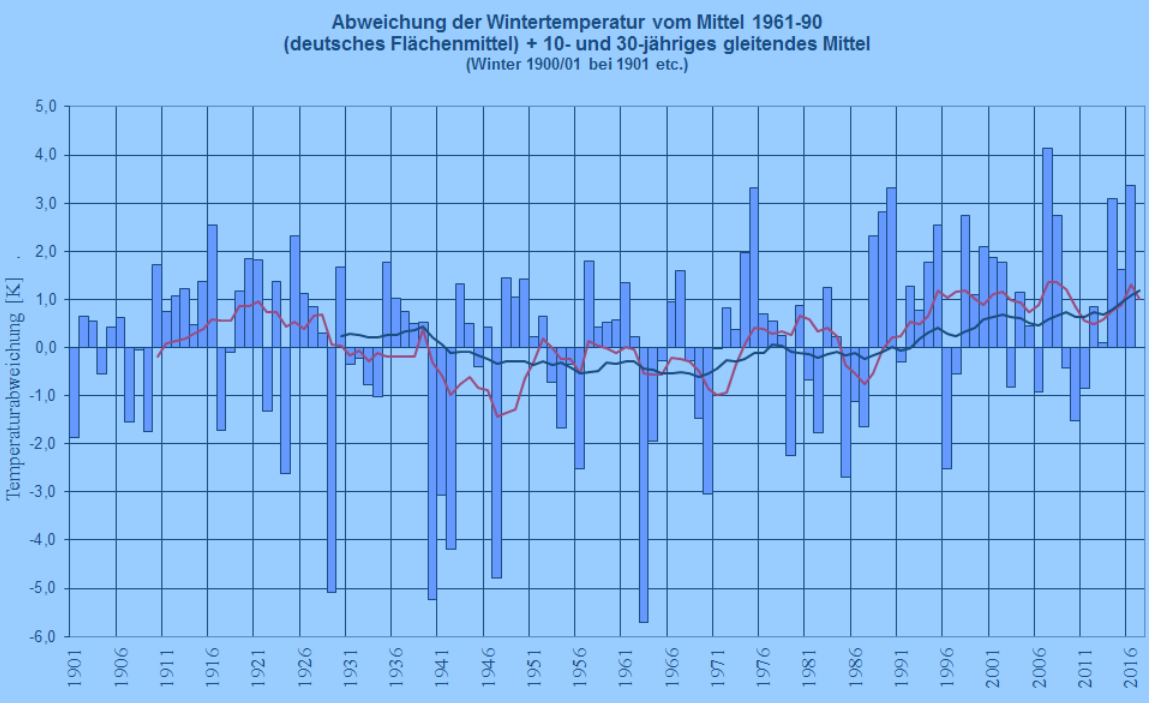
If projections come true, Germany would face one of its coldest winters in the last 50 years. Source: http://ift.tt/2xjm14X

The latest CSFv2 model run confirms the earlier cold projections that have been calculated since mid June, 2017.

Cooler than normal autumn

Projections for this fall (September, October, November) are also on the cool side. An analysis from 17 September shows that Central Europe will see temperatures that are about 1°C below the 1981-2010 mean. So far the first three weeks have been right on the money.

Schneefan warns that it’s still too early to rely on the latest trend and to bank on it, but adds: “If these cold projections for the 2017/18 winter keep appearing in the next model runs this fall, then the probability increases.”

Also Schneefan writes that we should not expect any general warming trend soon after the coming winter, due to the lowest solar activity is 200 years, the cooling La Niña that is beginning to take hold, and the already falling temperatures taking place in the wake of the 2015/15 El-Niño.

There are other signs that change is possibly in the works:

After the ice mass growth in Greenland for the first time in the current century and a new record cold July temperature (-33°C) set in Greenland, no one should be surprised that the 2017/18 winter will be the coldest in Europe and other parts of the northern hemisphere this century.

And to potentially make matters worse, the Bali volcano Agung is now at warning level “orange”. The last eruption was in 1963 with a VEI of 5!. So rapidly could global climate unexpectedly and naturally change.

Readers need to note that the projections involve considerable uncertainty, and the winter of course may develop completely differently. Yet, many meteorologists had projected earlier this year a severe hurricane season this year based on oceanic patterns, and that has come true.


via NoTricksZone

http://ift.tt/2f7Psgg

September 19, 2017 at 07:27AM

Climate change not as threatening to planet as previously thought, new research suggests

By Henry Bodkin

18 September 2017 • 7:15pm

From The Telegraph

TELEMMGLPICT000130526183_trans_NvBQzQNjv4BqpVlberWd9EgFPZtcLiMQfyf2A9a6I9YchsjMeADBa08

The world has warmed less than predicted Credit: AFP

Climate change poses less of an immediate threat to the planet than previously thought because scientists got their modelling wrong, a new study has found. New research by British scientists reveals the world is being polluted and warming up less quickly than 10-year-old forecasts predicted, giving countries more time to get a grip on their carbon output.

An unexpected “revolution” in affordable renewable energy has also contributed to the more positive outlook.

Experts now say there is a two-in-three chance of keeping global temperatures within 1.5 degrees above pre-industrial levels, the ultimate goal of the 2015 Paris Agreement.

They also condemned the “overreaction” to the US’s withdrawal from the Paris Climate Accord, announced by Donald Trump in June, saying it is unlikely to make a significant difference.

According to the models used to draw up the agreement, the world ought now to be 1.3 degrees above the mid-19th-Century average, whereas the most recent observations suggest it is actually between 0.9 to 1 degree above.

The discrepancy means nations could continue emitting carbon dioxide at the current rate for another 20 years before the target was breached, instead of the three to five predicted by the previous model.

“When you are talking about a budget of 1.5 degrees, then a 0.3 degree difference is a big deal”, said Professor Myles Allen, of Oxford University and one of the authors of the new study.

Published in the journal Nature Geoscience, it suggests that if polluting peaks and then declines to below current levels before 2030 and then continue to drop more sharply, there is a 66 per cent chance of global average temperatures staying below 1.5 degrees.

The goal was yesterday described as “very ambitious” but “physically possible”.

Another reason the climate outlook is less bleak than previously thought is stabilising emissions, particularly in China.

Read the full story here.

And here is the original press release.

HT | Pablo an ex Pat

via Watts Up With That?

http://ift.tt/2hfsmoM

September 19, 2017 at 07:19AM

“Climate change not as threatening to planet as previously thought, new research suggests”

Guest post by David Middleton

Eureka!  Gorebal Warming is now not worse than previously thought…

By Henry Bodkin
18 SEPTEMBER 2017 • 7:15PM
Climate change poses less of an immediate threat to the planet than previously thought because scientists got their modelling wrong, a new study has found. New research by British scientists reveals the world is being polluted and warming up less quickly than 10-year-old forecasts predicted, giving countries more time to get a grip on their carbon output.

An unexpected “revolution” in affordable renewable energy has also contributed to the more positive outlook.

Experts now say there is a two-in-three chance of keeping global temperatures within 1.5 degrees above pre-industrial levels, the ultimate goal of the 2015 Paris Agreement.

[…]

According to the models used to draw up the agreement, the world ought now to be 1.3 degrees above the mid-19th-Century average, whereas the most recent observations suggest it is actually between 0.9 to 1 degree above.

[…]

Published in the journal Nature Geoscience, it suggests that if polluting peaks and then declines to below current levels before 2030 and then continue to drop more sharply, there is a 66 per cent chance of global average temperatures staying below 1.5 degrees.

[…]

The Telegraph

While they understate the abject failure of the models and idiotically inflate the nonexistent role of “affordable renewable energy” in the failure of the models, it’s a start… About like an alcoholic recognizing that he might have a problem.

Although… This does make me wonder if they might have been sandbagging us.  Spending 30 years telling us it’s “worse than previously thought” and that “we have only (fill in the blank) years to save the planet”… To now telling us that, if we only give them more money for climate science and greenschist, we can now save the planet.

Of course… Anyone with an IQ that can’t be counted on two hands already knows that climate change has never been. nor will ever be, “threatening to planet”… (Warning: Lots of F-bombs)…

VIDEO


Limiting global warming to 1.5 °C may still be possible

Analysis suggests that researchers have underestimated how much carbon humanity can emit before reaching this level of warming.

Jeff Tollefson
18 September 2017

A team of climate scientists has delivered a rare bit of good news: it could be easier than previously thought to limit global warming to 1.5 °C above pre-industrial levels, as called for in the 2015 Paris climate agreement. But even if the team is right — and some researchers are already questioning the conclusions — heroic efforts to curb greenhouse-gas emissions will still be necessary to limit warming.

Published on 18 September in Nature Geoscience1, the analysis focuses in part on the fact that global climate models used in the 2013 report from the Intergovernmental Panel on Climate Change (IPCC) tend to overestimate the extent of warming that has already occurred. After adjusting for that discrepancy and running further models, the authors of the latest study found that the amount of carbon that humanity can emit from 2015 onward while holding temperatures below 1.5 °C is nearly three times greater than estimated by the IPCC — or even larger if there is aggressive action on greenhouse gases beyond carbon dioxide.

[…]

Nature News

via Watts Up With That?

http://ift.tt/2he2WI7

September 19, 2017 at 07:19AM

Greenland’s Other Famous Glacier Growing Too

Yesterday I showed how the Washington Post was lying about Greenland’s Petermann Glacier, which is growing rapidly.

https://go.nasa.gov/2ylEMDl

Today. let’s look how CNN and the Washington Post are lying about Greenland’s other famous glacier – the Jakobshavn glacier. They recruited a Hollywood actor who is married to someone from Greenland as their expert.

“Game of Thrones” actor: Winter is coming — and the ice is melting (Opinion) – CNN

Scientists just uncovered some troubling news about Greenland’s most enormous glacier – The Washington Post

Just like the Petermann Glacier, the Jakobshavn Glacier has grown over the past five years.

Note the position of the terminus (on the right side) has moved closer to the sea since 2012. The glacier is growing.

https://go.nasa.gov/2ymBH5U

The Jakobshavn Glacier wasn’t always growing though. From 1851 to 1902 the glacier retreated about ten miles.

NASA: “Mega-Canyons” Discovered Beneath Glaciers of Greenland Never Seen by Humans – SnowBrains

In 1939, the glaciers of Greenland were nearing catastrophe.

17 Dec 1939, Page 15 – Harrisburg Sunday Courier

The people behind the global warming scam will say anything to push their big lie on the public.

via The Deplorable Climate Science Blog

http://ift.tt/2wtWUxf

September 19, 2017 at 06:30AM