
By Paul Homewood
Unsurprisingly the BBC has jumped on the latest climate bandwagon:

Open Championship venues such as St Andrews and Royal Troon could be under water by the end of the century if sea levels rise even slightly as a result of climate change, according to a new report.
The Climate Coalition says golf, football and cricket face an “unexpected threat”, with cricket to be the “hardest hit”.
The report predicts “cancelled football matches, flooded cricket grounds and golf courses crumbling into the sea”.
It adds that rising winter temperatures mean the Scottish skiing industry could collapse within 50 years.
The report says six of the UK’s seven wettest years on record have occurred since 2000, with cricket’s County Championship already losing thousands of overs every season.
“Climate change is already impacting our ability to play and watch the sports we love,” said the report, adding that extreme weather is a factor in declining participation and lost revenue.
‘We could lose 5-10 metres in a couple of days’

Last year, Montrose sacrificed the third tee by moving rocks to reinforce the first green and second tee from coastal erosion
The report says “only a small increase in sea-level rise would imperil all of the world’s links courses before the end of the century”.
The Open is the only one of golf’s majors played in the UK and is hosted on links courses, including – as well at St Andrews and Royal Troon – Royal Birkdale, Hoylake, Royal Lytham & St Annes, Muirfield, Sandwich, Turnberry, Portrush and 2018 venue Carnoustie.
It adds that “more than 450 years of golfing history” at Montrose, one of the five oldest courses in the world, is at risk of being washed away by rising seas and coastal erosion linked to climate change.
Research published by Dundee University in 2016 showed the North Sea has crept 70 metres towards Montrose within the past 30 years.
Chris Curnin, director at Montrose Golf Links, said: “As the sea rises and the coast falls away, we’re left with nowhere to go. Climate change is often seen as tomorrow’s problem – but it’s already eating away at our course.
“In a perfect storm we could lose 5-10 metres over just a couple of days and that could happen at pretty much any point.”
There was as much as 20% less playing time for courses across the greater Glasgow area in 2016-17 compared to 10 years earlier, the report suggests.
“It is a fact that increased rainfall and extreme events are causing more disruption in recreational golf,” says Richard Windows of the Sports Turf Research Institute (STRI).
Steve Isaac, director of sustainability for the R&A, golf’s governing body outside the United States and Mexico, agrees the “future threats are very real” for the sport.
‘Grassroots football in decline’
Carlisle United’s Brunton Park was flooded in the storms of winter 2015
The report states “increased rainfall and more extreme weather events associated with climate change may be a defining factor in the viability of grassroots football”.
It adds that:
- Grassroots clubs lose five weeks per season to bad weather;
- More than a third lose two to three months;
- 84% of those highlight facilities as the most pressing issue facing grassroots game;
- Sport England reported a 180,000 drop over 10 years in people playing weekly;
- 25 Football League fixtures postponed during 2015-16 season.
In December 2015, Carlisle United’s Brunton Park was hit by Storm Desmond, forcing the League One club out of their ground for 49 days at a reported cost of nearly £200,000.
“Climate modelling has found that climate change made this storm 59% more likely,” said Kate Sambrook, from the Priestley International Centre for Climate.
In the same season, grassroots club Bromley Heath United were unable to play matches for 12 weeks because of unsuitable pitches.
Longer term, the Football Association will invest £48m in hundreds of new all-weather and specially adapted turf pitches across the country, including new dedicated facilities in 30 cities, in addition to upgrading more than 200 existing pitches nationwide.
Cricket struggles to be ‘commercially viable’
According to the Climate Coalition report, cricket will be “hardest hit” by climate change out of all the major pitch sports, with more rain resulting in more delays and abandonments.
Cardiff-based club Glamorgan have lost 1,300 hours of cricket since 2000 as a result of extreme weather and rainfall.
“Losing so much cricket is a county’s worst nightmare – it affects the club at every level,” said Glamorgan head of operations Dan Cherry. “It’s difficult even for first-class counties to be commercially viable with such an impact.
“T20 Blast is a great way to get new people through the gates and into cricket – but they won’t come back if this keeps happening and it’s damaged the club to the tune of £1m.”
More than a quarter (27%) of England’s home one-day international since 2000 have seen reduced overs because of rain disruptions, while the rate of rain-affected matches has more than doubled since 2011.
The England and Wales Cricket Board (ECB) spent £1m in emergency grants in 2016 and £1.6m in 2017 to support clubs and restore their facilities and have set aside £2.5m a year for small grants to help club sides keep matches on.
There is the risk that increasingly disrupted cricket will lead to people no longer getting involved in the sport. According to the report, nearly 40,000 fewer people played cricket in 2015-16 than in 2005-06, a fall of almost 20%.
“There is clear evidence that climate change has had a huge impact on the game in the form of general wet weather and extreme weather events,” said ECB national participation manager Dan Musson.
http://www.bbc.co.uk/sport/42936199
The first thing to note is that the Climate Coalition, who wrote the report, is not some objective, scientific organisation, but a grouping of activist outfits, such as WWF, Christian Aid, Oxfam, 350.org, and a a whole host of other usual suspects, all of who have their drums to bang.
In other words, not the sort of organisation you could trust to produce an unbiased report.
But what about some of the specific claims?
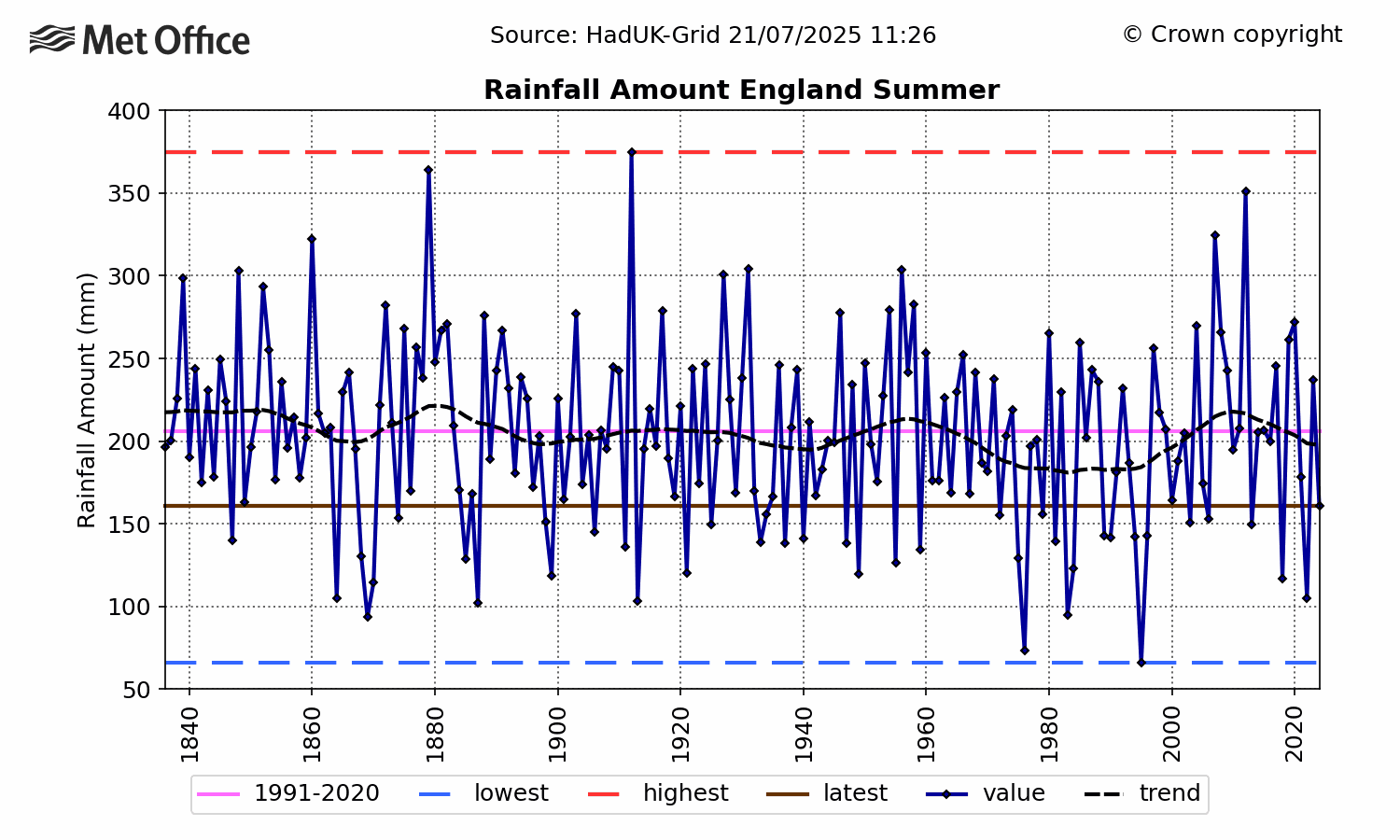
1) The report says six of the UK’s seven wettest years on record have occurred since 2000, with cricket’s County Championship already losing thousands of overs every season.
In fact the long running England & Wales rainfall series shows nothing unusual at all about recent rainfall trends.

https://www.metoffice.gov.uk/hadobs/hadukp/
Given that, apart from Glamorgan, all of the County Championship cricket teams are based in England, and play mainly in summer months, it is probably pertinent to note that most recent summers there have not particularly wet at all.
Even the summer of 2012 was nowhere near as wet as 1912.
https://www.metoffice.gov.uk/climate/uk/summaries/actualmonthly
2) Open Championship venues such as St Andrews and Royal Troon could be under water by the end of the century if sea levels rise even slightly as a result of climate change
Sea levels around the Scottish coast have barely risen at all since the 19thC. The long running tidal gauge at Aberdeen, for instance, shows a rise of only 0.72mm a year since 1862, with no acceleration:

https://tidesandcurrents.noaa.gov/sltrends/sltrends_global_station.htm?stnid=170-011
The reason is very simple – the Scottish landmass is actually rising as a result of GIA:

I somehow don’t believe that 3 inches of sea level rise in the next century will make the slightest difference.
3) It adds that “more than 450 years of golfing history” at Montrose, one of the five oldest courses in the world, is at risk of being washed away by rising seas and coastal erosion linked to climate change…
Research published by Dundee University in 2016 showed the North Sea has crept 70 metres towards Montrose within the past 30 years.
As we have already seen, sea levels at Aberdeen, 40 miles up the coast from Montrose, have barely risen at all in the last century.
The problem of erosion at Montrose, which effectively is built on a sandbar, is a much more complex one then the Climate Coalition con-merchants would like you to believe, as the Scotsman reported in 2015:
One town that has long felt the impact of coastal erosion is Montrose in Angus, where it is estimated the dune system fronting the Montrose Links golf courses receded around 45 metres between 1988 and 2006.
Researchers from Dundee University found that, at its peak, dunes were receding at around eight metres a year. Plans are now in place to realign the Medal course and create a new hole away from the coastline given the ongoing dangers posed by erosion.
Meanwhile, Angus Council continues to work to stem the affects of the tides on the shore side. Mark Davidson, a senior engineer at Angus Council, said: “Montrose Bay has suffered from some quite severe erosion over the years “Here we very much have a case of Mother Nature doing what it is meant to do.”
Key data has been established about the behaviour of the sea and its impact on the bay. Mr Davidson said: “We have been looking back in history and one good example of how to measure the changes is the Second World War pill boxes in the dunes, which now at Montrose have become exposed. “We have also got historic evidence that the beach was way back into Montrose previously. “
What we see is different cycles of Mother Nature at work. Basically, the North Sea is attacking the beach.”

Gullane beach – workers use a tractor to erect a sand wall to prevent erosion in 1964.
A natural and largely unexplained change in the wave climate – such as the height and the direction – in the late 1980s led to the onset of severe erosion at Montrose, researchers found. In the late 1990s, the town’s Glaxo plant, which backs onto the beach at the estuary, installed rock armour to protect the premises from the tides. While it has had some success, tides have been pushed further north making the dunes by the golf course more vulnerable.
Sand dredged out of South Esk Estuary to keep routes clear into Montrose Harbour may also have quickened erosion. A number of new, less intensive protection methods are now being used at Montrose to try and slow down the damage. Fences placed on the beach both provide a resting place for blown sands while catching and falling dune from above, which creates another natural barrier.
Timber groyns, which interrupt water flow, have also been used with some success, Mr Davidson said. Mr Davidson pointed to the beach at Monifieth, around 25 miles south, as an example where conditions had improved. “At one point you couldn’t drive down the road for the dunes and then they started to erode. What we are seeing now is a new cycle and the beach is at the highest it has ever been. That change has happened over 10 to 15 years. “That is due to a combination of two things, the first is that the natural wave cycle is changing and the second is the techniques we have used there. “
We are working with Mother Nature instead of against her. At the end of the day, a battle against Mother Nature is a hard one to win.”
A scientific study by Milne, Dong and Davidson in 2012 confirmed that the two major factors behind the erosion:
a) A shift of the direction of the tides to a more northerly direction, thus impacting the golf course.
b) Dredging of the estuary.
As Davidson points out, erosion of sand dunes is a perfectly natural process, which has been going on for a long time, something which occurs in cycles.
But it is also clear that the dredging of the estuary, estimated at 1.5 million tonnes of sand since the 1980s, has also had a major impact. The dredging really took off when the North Sea oil boom started.
Andrew Cooper, professor of coastal studies at Ulster University certainly believes it has had an effect. “It would seem to me very unlikely it would have no impact,” he said. “That’s a very big volume of sand. In a situation like Montrose where we have this closed system, keeping the sand in the system is the best possible way to prevent long-term effects from taking place.
The cause of the erosion may be anthropogenic, but it has little to do with climate change.
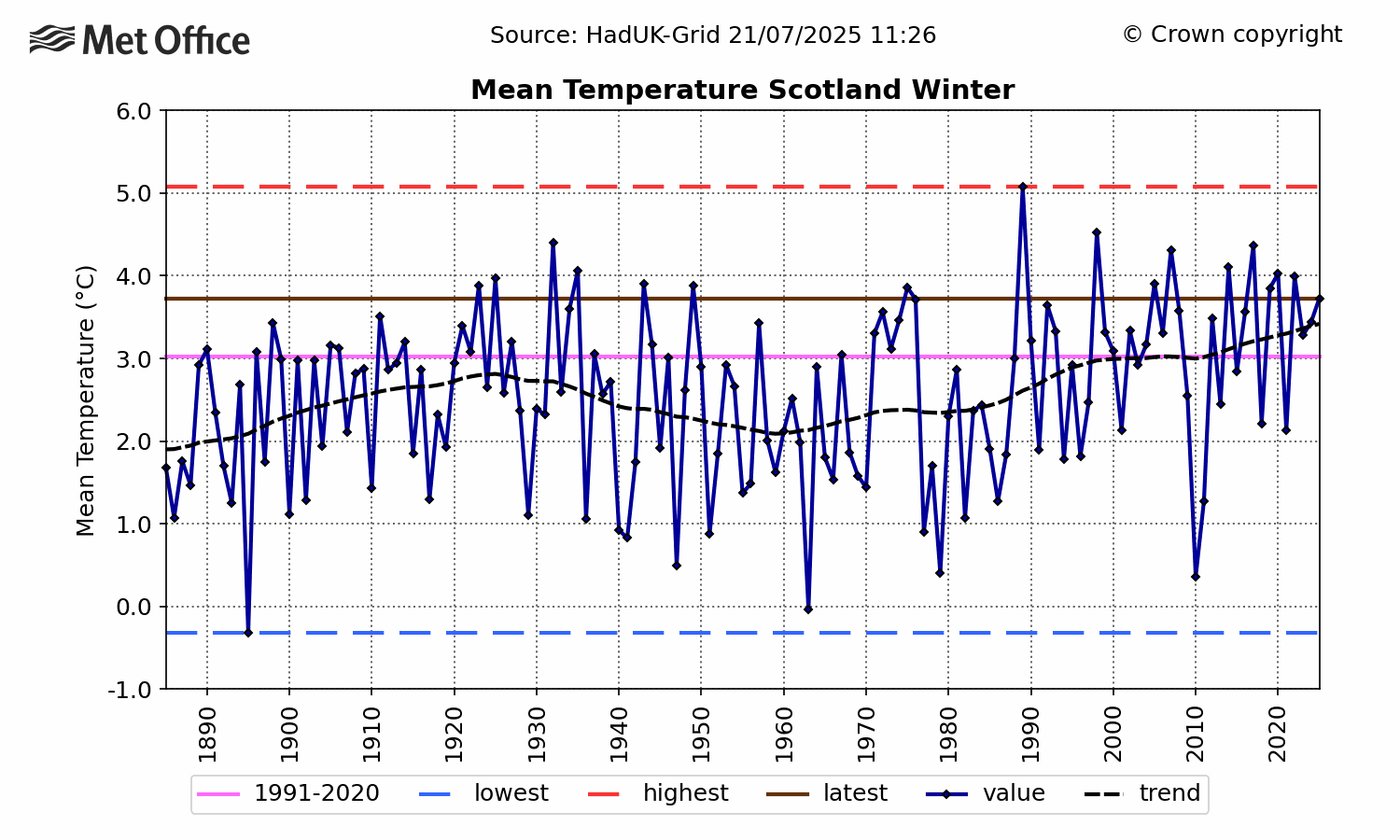
4) There was as much as 20% less playing time for courses across the greater Glasgow area in 2016-17 compared to 10 years earlier, the report suggests.
Comparison between two single years is meaningless. 2006 was of course a hot and dry summer.
The most common cause of closed golf courses is snow and frost. On that basis, golfers in Scotland will enjoy much more playing time now than in the past.
https://www.metoffice.gov.uk/climate/uk/summaries/actualmonthly
5) The report states “increased rainfall and more extreme weather events associated with climate change may be a defining factor in the viability of grassroots football”.
25 Football League fixtures postponed during 2015-16 season
Is there anything unusual about 25 matches being postponed in a season?
Again it is snow and ice that cause most problems.
In January 2013, 14 league matches were postponed on one weekend alone because of frozen pitches.
Three years earlier matters were even worse, when 29 Football league games and another seven Premier League ones were postponed on one weekend due to snow.
Probably no winter saw more postponements than 1962/3:
We often hear managers calling for a winter break in January due to the heavily congested post-Christmas fixture programme, but during the 1962/63 season football enjoyed something of an enforced three-month sabbatical due to freak weather conditions, which threatened not only the national game, but the country as a whole.
When Middlesbrough finally overcame Blackburn Rovers in a replay at Ayresome Park on the 11th March 1963, it ended one of the most chaotic third round weekends in the history of the FA Cup. The round of games, which had begun back on January 5th would take an astonishing 66 days before being completed as the season looked like it might never end.
The winter of 1963 was one of the coldest in living memory. Snow swept across the nation on Boxing Day 1962, and in many places it remained on the ground until late March. The situation wasn’t helped by arctic winds which led to huge snow drifts up to 20 feet feet deep in some places.
Officially it was the coldest month of the 20th century that January, with temperatures of -19 degrees Celsius being recorded in several locations with the average temperature failing to get above freezing; it was that cold that rivers had lumps of ice in them and even the sea froze solid.
Not surprisingly the country was brought to a standstill, while the weather also played havoc with the sporting calendar. Horse racing was was temporarily cancelled with no meetings taking place in England for four months, but football was one of the sports hit most severely and particularly the FA Cup.
Lincoln City’s game with Coventry City was postponed an astonishing 14 times, while in Scotland a cup tie between Stranraer and Airdrie was called-off no fewer than 33 times. Things weren’t much better in Yorkshire either as Barnsley were only able to play two matches between 22nd December and March 12th.
In all there were a total of 261 postponements and half of the 32 ties fell victim to the weather 10 times or more. In the years since nothing has had such a dramatic impact on sport in the British Isles and many will hope it never will again.
So extreme were the conditions that friendly games were hastily arranged in Ireland, where the conditions weren’t quite as bad as teams were desperate to maintain fitness levels. Never one to miss an opportunity, Coventry’s Jimmy Hill excelled in the trying circumstances.

http://www.footballwhispers.com/blog/big-freeze-1963-when-football-was-on-ice
We see an all to depressingly familiar pattern with this report. Activist researchers publish a junk report, warning us of climate apocalypse.
The BBC and the rest of the media broadcast it without any questions asked, as if it were fact.
And virtue signalling organisations tell us we must all wake up to the challenge.
Dame Katherine Grainger, Olympic rower and now chair of UK Sport, sums up the whole scam:
“This report sets out how some of our most iconic British sports are being threatened by a changing climate. Storms and floods are wreaking havoc on football and cricket pitches across the country, historic golf courses are succumbing to higher seas and storm surges, and winter sports are under threat from reducing snow.
It is up to all of us, in all walks of life, to act to address the growing challenge of climate change. There are some excellent examples in this report of how sports and clubs are rising to that challenge – reducing carbon emissions and working to improve the resilience of their sports. Now we need to see this action for sustainability step up a level, and for all sportspeople and sports clubs to play their part.”
http://www.telegraph.co.uk/sport/2018/02/07/climate-change-disrupting-british-sport/
Shame on you Katharine for falling for this nonsense.
via NOT A LOT OF PEOPLE KNOW THAT
February 7, 2018 at 12:43PM
 Iowa Climate Science Education
One thought on “Open venues at risk of disappearing, says Climate Coalition report”