
By Paul Homewood
The Met Office seem to have been stung by media criticisms of their long range warnings about the Beast from the East at the end of February.

Various media reports have been commenting on our longer-range warnings in the run-up to the recent cold snap.
This period of severe weather was very well predicted and the first signs appeared around one month before the start, when we were able to offer broader advice about the likelihood of a cold signal. Our advice to government and the public ramped up in confidence and detail starting from the early signs in late January as events became clearer in our forecasts:
- 26 January: The first indications of a possible cold spell were given in our one-to-three month outlook for contingency planners. On 26 January we said:
‘For February, below-average temperatures are more likely than above-average temperatures. The likelihood of impacts from cold weather during February is greater than normal.’

[Note: that this public outlook is always updated a week later (2nd February), leaving only the three-month view. The one-month outlook reverts to the 30-day forecast at this time.]
So, in summary, the severe cold snap of late February and early March was very well predicted, even from long-range on this occasion. The Met Office provided clear and regular updates on the increasing levels of risk from late January onwards to ensure everyone was aware of how the weather would impact them and they could be prepared for it.
The claim that they saw it coming in late January is based on the 3-Month Outlook, published on 26th January, which stated:
For February, below-average temperatures are more likely than above-average temperatures. The likelihood of impacts from cold weather during February is greater than normal
However, quite shamefully the above response does not show the whole of that 3-Month Outlook, which gives a totally different version of events. Fortunately, although the Met Office don’t archive the old reports for public use, I did keep a copy at the time:

My version no longer includes the reference to February alone, in the first two sentences, but the Met Office explain that this is because it is updated about a week later, which appears reasonable.
But the important thing to note is the penultimate paragraph, enlarged below:

It cannot be any clearer. Not only did they not forecast the extreme cold spell at the end of the month, or the SSW event that led to it, they actually forecast the opposite, a milder spell up to mid March.
Moreover, as well as failing to forecast the Beast, or even a coldish spell of weather, they also failed to predict the cold and snow we have now had twice this month since the Beast.
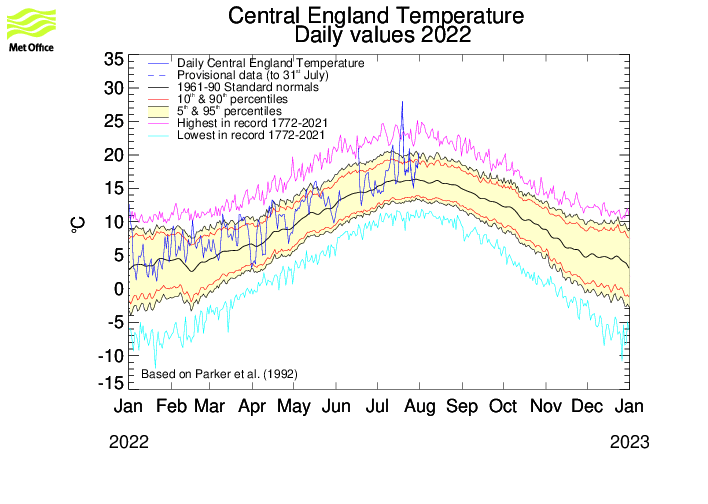
https://www.metoffice.gov.uk/hadobs/hadcet/cet_info_mean.html
So what was the cold weather that they forecast in February?
Again, we can take a closer look at that 3-Month Outlook:


It was in fact the cold spell in early February, which was already well forecast, and did turn up.
Courtesy of the Wayback Machine, we can see what the Met Office’s 30 Day Outlook was saying in Jan 26th:

https://web.archive.org/web/20180126220822/https://www.metoffice.gov.uk/public/weather/forecast
A large degree of uncertainty! Some spells of mild, wet and windy weather. Colder, brighter and drier interludes.
The Met Office’s claim that the severe cold snap of late February and early March was very well predicted, even from long-range on this occasion, simply does not stand up to scrutiny.
It is true that we began to get some indications from them in early February. For instance they offer this link to the Daily Star on 6th February:
Alex Burkill, forecaster for the Met Office, agrees that wintry conditions are expected to continue into the weekend and perhaps into March.
“There are indications of quite a prolonged cold period,” he said.
“Really much of February and perhaps even into March it is going to stay on the cold side, so temperatures generally below average, with further frosts and also the risk of rain, sleet and snow as well.”
But by then, this was common knowledge amongst meteorologists. The same Star report quotes James Madden, forecaster for Exacta Weather, as saying the oncoming assault of heavy snow and freezing temperatures could plague Britain for the rest of February.
He said: “A barrage of snow events awaits us throughout the rest of this month with the first notable snow events expected next week.
“There is a risk for a total whiteout across the country as a number of major snow events hit our shores, this risk really kicks in at the start of next week.”
It is ironic that, when their 3-Month Outlooks are wrong, they claim they are not “forecasts” at all but mere ranges of probabilities.
Yet when they actually get one right, they crow about it!
But to claim that they predicted the Beast from the East, when they actually forecast the opposite, and then attempt to cover up the inconvenient paragraph that proves they were wrong, shows a breathtaking level of dishonesty, even by their standards.
via NOT A LOT OF PEOPLE KNOW THAT
March 18, 2018 at 07:18AM
 Iowa Climate Science Education