

Antarctic sea ice is still expanding [image credit: BBC]
The conclusion offered here is that ‘something must be fundamentally wrong with the climate models, for their predictions to be so far off from the observed sea ice trends’. No wonder climate alarmists focus on the Arctic.
Over the past several years, many researchers have examined the spatial extent of sea ice around Antarctica, says CO2 Science, consistently reporting an increasing trend (see, for example, our reviews on the previously published works of Yuan and Martinson, 2000, Watkins and Simmonds, 2000, Hanna, 2001, Zwally et al., 2002, Vyas et al., 2003, Cavalieri et al., 2003, Liu et al., 2004, Parkinson, 2004, Comiso and Nishio, 2008, Cavalieri and Parkinson, 2008, Turner et al., 2009, Pezza et al., 2012, Reid et al., 2013, Reid et al., 2015, Simmonds, 2015, He et al., 2016 and Comiso et al., 2017).
The latest study to confirm this ongoing expanse comes from the South American research team of De Santis et al. (2017).
Using a sea ice index from the National Snow and Ice data Center (Fetterer et al., 2002), derived from passive microwave satellite data, the three scientists assessed trends in monthly sea ice extent for the Southern Ocean and five sub-regions over the period 1979 to 2016.
Then, they compared their findings with those of other researchers, who calculated trends using similar data and methods, but over shorter time periods.
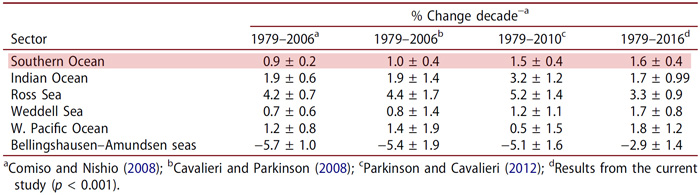
Results of the analysis are presented in the table below, where it is seen that the positive trend (i.e., expansion) in sea ice extent across the whole of the Southern Ocean has been increasing with time — from approximately 1% per decade using data over the period 1979-2006 to 1.5 and 1.6 % per decade using data over the periods 1979-2010 and 1979-2016, respectively.
Regionally, four of the five Southern Ocean regions show positive sea ice trends. The only negative trend witnessed is in the Bellingshausen-Amundsen Seas, where trends have become less negative in recent years due to advancements in sea ice extent occurring there.
Table 1. Trends in sea ice extent for the Southern Ocean and five regions of the Southern Ocean for the period 1979-2016 (this study) and for shorter periods (other studies, as listed below). Source: De Santis et al. (2017).
Continued here.
via Tallbloke’s Talkshop
March 24, 2018 at 08:12AM
 Iowa Climate Science Education