

Years ago, Dr. Roger Pielke Sr. explained why sea surface temperatures (SST) were the best indicator of heat content gained or lost from earth’s climate system. Enthalpy is the thermodynamic term for total heat content in a system, and humidity differences in air parcels greatly affect enthalpy. Measuring water temperature directly avoids this distortion in air measurements. In addition, ocean covers 71% of the planet surface and thus dominates surface temperature estimates.
More recently, Dr. Ole Humlum reported from his research that air temperatures lag 2-3 months behind changes in SST. He also observed that changes in CO2 atmospheric concentrations lag behind SST by 11-12 months. This latter point is addressed in a previous post Who to Blame for Rising CO2?
The April update to HadSST3 will appear later this month, but in the meantime we can look at lower troposphere temperatures (TLT) from UAHv.6 which are already posted. The temperature record is derived from microwave sounding units (MSU) on board satellites like the one pictured above.
The UAH dataset includes temperature results for air above the oceans, and thus should be most comparable to the SSTs. The graph below shows monthly anomalies for ocean temps since January 2015.
 The anomalies have to the same levels as 2015. Taking a longer view, we can look at the record since 1995, that year being an ENSO neutral year and thus a reasonable starting point for considering the past two decades. On that basis we can see the plateau in ocean temps is persisting. Since last October all oceans have cooled, with upward bumps in Feb. 2018, now erased.
The details of UAH ocean temps are provided below. The monthly data make for a noisy picture, but seasonal fluxes between January and July are important.
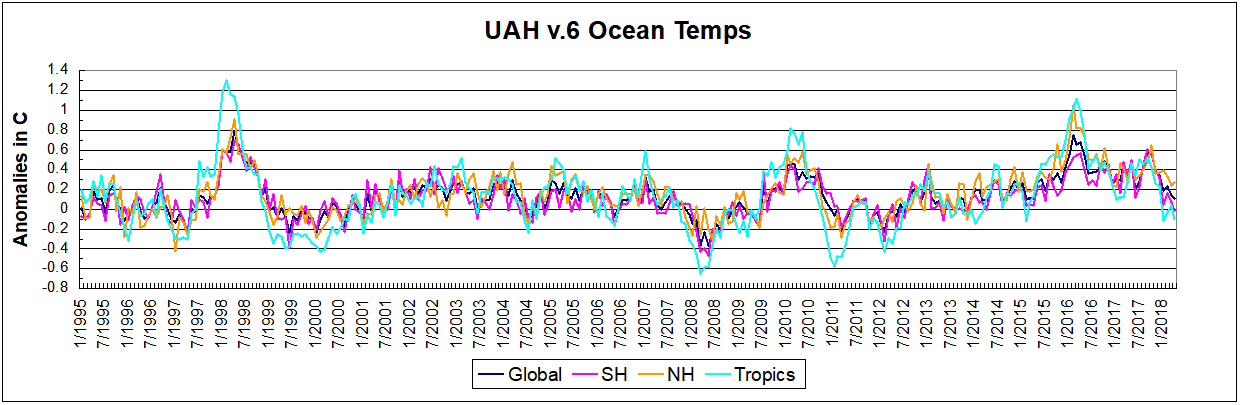
The greater volatility of the Tropics is evident, leading the oceans through three major El Nino events during this period. Note also the flat period between 1/1998 and 1/2010. The latter El Nino was erased by La Ninas in 2008 and 2011 and 2012. Then the record shows a fairly steady rise peaking in 2016, with strong support from warmer NH anomalies, before returning to the 22-year average.
Summary
TLTs include mixing above the oceans and probably some influence from nearby more volatile land temps. They started the recent cooling later than SSTs from HadSST3, but are not showing the same pattern. It seems obvious that despite the three El Ninos, their warming has not persisted, and without them it would probably have cooled since 1995. Of course, the future has not yet been written.
| UAHv.6 TLT Monthly Ocean Anomalies |
Ave. Since 1995 | Ocean 4/2018 |
| Global | 0.13 | 0.11 |
| NH | 0.16 | 0.27 |
| SH | 0.11 | -0.01 |
| Tropics | 0.12 | -0.1 |
As of April 2018, global ocean temps are slightly below the average since 1995. NH remains higher, but not enough to offset much lower temps in SH and Tropics (between 20N and 20S latitudes).
via Science Matters
May 7, 2018 at 01:03PM
 Iowa Climate Science Education