Month: June 2018

Previously unsuspected volcanic activity confirmed under West Antarctic Ice Sheet at Pine Island Glacier

By Paul Homewood


From National Science Foundation:

image

June 27, 2018

Tracing a chemical signature of helium in seawater, an international team of scientists funded by the National Science Foundation (NSF) and the United Kingdom’s (U.K.) Natural Environment Research Council (NERC) has discovered a previously unknown volcanic hotspot beneath the massive West Antarctic Ice Sheet (WAIS).

Researchers say the newly discovered heat source could contribute in ways yet unknown to the potential collapse of the ice sheet.

The scientific consensus is that the rapidly melting Pine Island Glacier, the focal point of the study, would be a significant source of global sea level rise should the melting there continue or accelerate. Glaciers such as Pine Island act as plugs that regulate the speed at which the ice sheet flows into the sea.

The new research was published by an international team, led by Brice Loose of the Graduate School of Oceanography at the University of Rhode Island. His research was supported by an award from NSF’s Office of Polar Programs, which manages the U.S. Antarctic Program.

Researchers from East Anglia and Southampton universities in the U.K., Arizona State University, the Woods Hole Oceanographic Institution, and the British Antarctic Survey contributed to the study.

Their findings were published in the June 22 edition of the journal Nature Communications.

Peter Milne, program director for ocean and atmospheric science in NSF’s Division of Polar Programs, noted that the discovery adds significant information about what controls the stability of the Antarctic ice sheets.

"To model the complex processes of how the ice sheets move is a difficult, but essential thing to do if we are to understand their role in the global climate and their potential for contributing to sea level rise," he said. "This research may add a critical piece of information as we try to assemble that ‘big picture.’"

The researchers first noted the volcanic activity in 2007 and verified its existence again in 2014.

It remains unclear how the newly discovered activity affects knowledge about the glacier, because researchers don’t yet know how volcanic heat is distributed along the bottom of the ice sheet. However, researchers do know that the heat from the volcano is producing melting beneath the ice sheet. This meltwater is leaking across the grounding line where the ice shelf meets the ocean.

The heat source, Loose and team note, is about half that of the active volcano Grímsvötn, in Iceland.

While the effects of volcanic heat on the Antarctic ice sheets is an active topic of research, this study provides the first geochemical evidence of a contemporary volcanic heat source, emphasizing the need to detect and understand volcanism, including in models of ice-sheet behavior. The greater understanding of volcanism could alter scientists’ perception of the mechanics of ice-sheet loss, including in the areas where the glaciers meet the sea.

"Our finding of a substantial heat source beneath a major WAIS glacier highlights the need to understand subglacial volcanism, its interaction with the marine margins and its potential role in the future stability of the WAIS,” they write in the Nature Communications article.

They also note that volcanic activity could be increasing the rate of collapse of the Thwaites Glacier, which is adjacent to the Pine Island Glacier.

A complete collapse of the Thwaites Glacier could significantly affect global sea levels, according to scientists. The Thwaites already drains an area roughly the size of the state of Florida, accounting for about 4 percent of global sea level rise — an amount that has doubled since the mid-1990s.

NSF and NERC announced in April that they would jointly spend $25 million in grants to researchers, and a comparable amount in logistical support, to deploy teams of scientists from U.S. and U.K. institutions to Antarctica to gather the data needed to understand whether the Thwaites glacier could begin to collapse in the next few decades or centuries from now.

The research collaboration, called the International Thwaites Glacier Collaboration (ITGC), was announced at the British Antarctic Survey (BAS) headquarters in Cambridge, England in April. The collaboration’s scientists will begin their first research season in Antarctica in October, establishing a logistical support structure for future work. The collaboration will continue until 2021.

https://www.nsf.gov/news/news_summ.jsp

via NOT A LOT OF PEOPLE KNOW THAT

https://ift.tt/2yUoFRc

June 29, 2018 at 01:10PM

Government’s smart meter roll out ‘will lead to gas and electric surge pricing’

By Paul Homewood


h/t Paul Matthews


Further to the letters to the Telegraph post earlier, it appears that one of the writers, Jerry Fulton, is former head of gas and electric meter meterology at Ofgem, so ought to know his stuff.

The Telegraph have followed up his letter with this article:


image

Smart meters will allow energy firms to introduce "surge pricing" to charge households more for gas and electric at peak times, a former senior Ofgem manager has warned. 

So-called "time of use" tariffs would see households pay more for watching television, charging gadgets and running the washing machine during popular times such as in the mornings and evenings. 

The controversial deals would see energy prices peak on special events like Christmas Day and Easter when millions of households are all using ovens to cooking lunch at the same time.

Under the Government’s £11bn smart meter roll out every home in the UK will be offered a smart meter by 2020, in an effort to help people save money and use less energy. 

Unlike ordinary meters, smart meters transmit information about when households use most energy to suppliers. At present customers will smart meters are charged a flat fee per unit of energy used.

According to Jerry Fulton, former head of gas and electric meter meterology at Ofgem, the energy regulator, the introduction of smart meters will soon give suppliers the power to increase bills at busy times, just like paying off-peak and peak time travel. 

He told the Daily Telegraph: "I believe that the hidden agenda behind smart meters is that they will allow half-hourly charging.

"Instead of having two charge rates (day and night) the price of energy will change every half hour, so when solar and wind generation are low and usage is high the price of electricity will rise steeply.

"What would make more sense than smart meters is smart appliances that could be automatically switched on or off depending on electricity-grid demand. For instance, fridges, freezers and some battery chargers could be switched off at peak demand periods, as could some washing machines and dryers.

"It is claimed that smart meters are safe and secure. Not having one, because they are not needed, is even more safe and secure."

Switching service USwitch has also said that "time of use" energy deals will become commonplace once the Government’s smart meter rollout is complete.

Such deals will begin to dominate the energy market once so-called "second generation" smart meters have been installed in people’s homes, it said.

Energy firms have said they would be open to introducing such tariffs as an option alongside normal tariffs.   

Mr Fulton added that switching to a cheaper deal would become "a complete nightmare" once time of day tariffs have been introduced, as fluctuating prices would be difficult to compare. 

https://www.telegraph.co.uk/news/2018/06/28/governments-smart-meter-roll-will-lead-gas-electric-surge-pricing/


The bottom line is that the total cost of producing the nation’s electricity is not changed by smart metering. If somebody gains by getting up in the middle of the night to do their washing, somebody else will end up paying more.

I checked out the Economy Seven tariffs a couple of years ago, which offers lower prices at night. Because tariffs were higher than standard ones during the day, average bills were actually higher in total. I doubt whether much has changed.

The last sentence is also particularly important. If surge pricing is commonplace, forget about shopping around for the cheapest deal.

via NOT A LOT OF PEOPLE KNOW THAT

https://ift.tt/2tEJ8nZ

June 29, 2018 at 01:10PM

FAIL: California’s expensive global warming law lags in results compared to other states

From Investor’s Business Daily

Governor Brown’s money hole. From 2007 to 2015, California managed to cut its greenhouse gas emissions by 9%. But the rest of the country cut them by more than 10%.

For more than a decade, California has won high praise from environmentalists for its stringent greenhouse gas restrictions.

But a new report shows that despite the enormous costs of this effort, the state is doing a worse job at cutting CO2 emissions than the rest of the country, while badly hurting its working families.

Back in 2007, California became the first state to cap CO2 emissions when then-Gov. Arnold Schwarzenegger signed AB32, which mandated the state cut greenhouse gas emissions back to 1990 levels by 2020. Schwarzenegger called it “a bold new era of environmental protection.”

Not to be outdone, Gov. Jerry Brown signed a bill last year requiring the state to cut emissions 40% below 1990 levels by 2030.

So, what happened? From 2007 to 2015, California managed to cut its greenhouse gas emissions by 9%.

But the rest of the country cut them by more than 10%, according to a new report from the Center for Demographics and Policy at Chapman University in Orange, California.

On a per capita basis, 41 states outperformed California on CO2 cuts over those same years.

Full story here

via Watts Up With That?

https://ift.tt/2yXoAw8

June 29, 2018 at 01:08PM

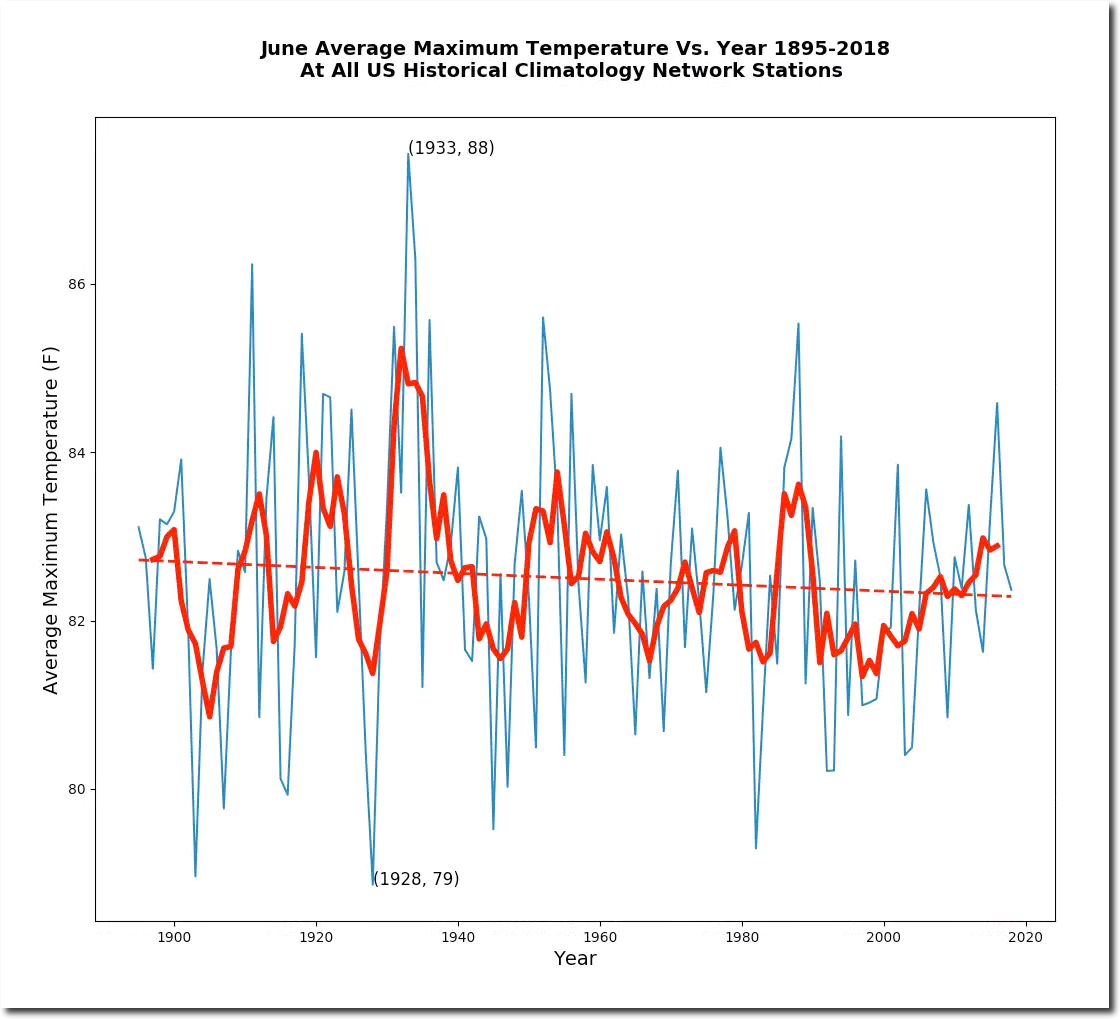
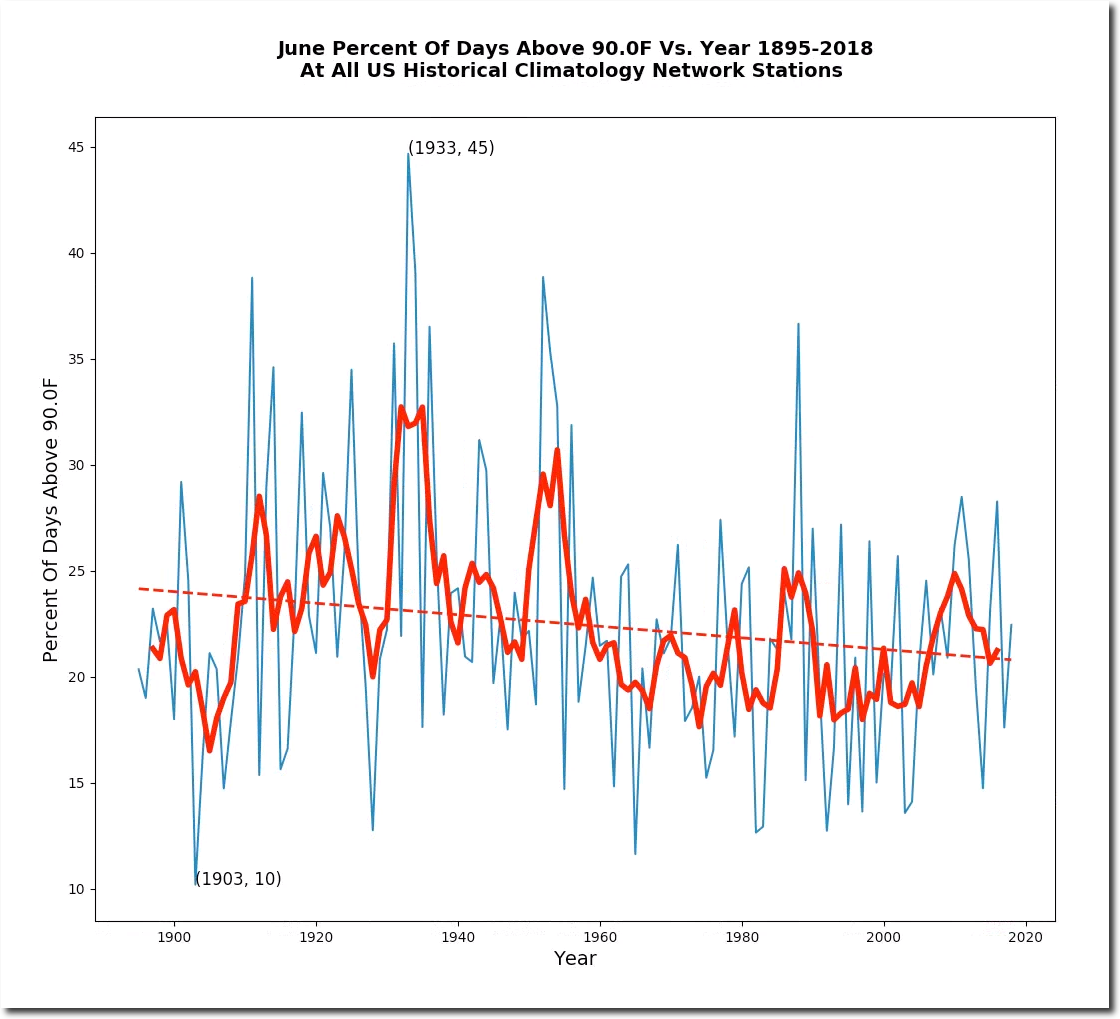
An Average June In The US

Mean temperatures in June have been a little above average since 1895

Maximum temperatures have been a little below average.

The frequency of hot days has been about average.

via The Deplorable Climate Science Blog

https://ift.tt/2ID7hQA

June 29, 2018 at 12:53PM