Month: June 2018

Claim: CO2 Causes Extreme Weather Even Without Global Warming

Guest essay by Eric Worrall

A new study by Professor Myles Allen, David Karoly and others claims that even if CO2 does not cause significant global warming, we still have to cap CO2 to prevent a “direct CO2 effect” from messing up the weather.

Rising CO2 may increase dangerous weather extremes, whatever happens to global temperatures

Press release issued: 11 June 2018

New research from the University of Oxford and collaborators at several other institutions, including the University of Bristol, provides compelling evidence that meeting the global warming target of 1.5°C may not be enough to limit the damage caused by extreme weather.

The paper, published today in Nature Climate Change, demonstrates that higher atmospheric CO2 concentrations directly increase temperature and rainfall extremes, meaning there could be dangerous changes in these extremes even if the global mean temperature rise remains within 1.5°C. The research highlights the need for climate policy to complement temperature goals with explicit limits on CO2 concentrations.

Much of the focus of climate change mitigation has been on the goal of limiting warming to 1.5°C warming agreed at the 2015 United Nations climate summit in Paris. However, the atmospheric CO2 concentrations required to limit warming to 1.5oC depend on the climate response. Researchers from Oxford and other institutions participating in the HAPPI-MIP project (Half a degree Additional warming, Prognosis and Projected Impacts Model Intercomparison Project) simulated future climate under the range of CO2 concentrations that all might be consistent with 1.5°C of global warming.

In the models, CO2 levels at the higher end of this range were shown to directly increase Northern Hemisphere summer temperature, heat stress, and tropical precipitation extremes. This means that even if a low temperature response helps us to meet the temperature target, there may still be ‘dangerous’ changes in extremes – in other words, severe weather impacts beyond those currently expected at 1.5°C.

The research points up the need to set explicit CO2 concentration goals to limit the adverse effects of high-impact weather extremes. It also supports existing findings that proposed geo-engineering solutions aimed at reducing global warming impacts without reducing CO2 concentrations may not be effective at counteracting changes in extremes.

Hugh Baker, DPhil student at Oxford’s Department of Physics and lead author of the research, said: “Future work is needed to confirm exactly why we see this direct CO2 effect, but current research points to a combination of circulation and cloud cover changes, and an increase in the amount of direct radiation on the Earth’s surface due to simply having more CO2 in the atmosphere.”

Oxford’s Professor Myles Allen adds: “This puts paid to the Pollyanna argument that we should wait and see before reducing emissions in case the global temperature response to rising CO2 turns out to be lower than current models predict. Hugh’s paper shows that the accumulation of CO2 in the atmosphere itself increases the risk of key damaging weather extremes, regardless of the global temperature response. It’s not enough to get lucky.”

Dr Dann Mitchell, a co-author of the paper from the University of Bristol’s School of Geographical Sciences, said: “Geo-engineering techniques that reduce the amount of sunlight hitting the Earth’s surface are increasingly thought of as a way of achieving the Paris Goals because they decrease surface temperature. However, our results show that for extreme climate such as heatwaves, changing the global mean temperature is not enough, you need to reduce CO2 concentrations themselves.”

The research was carried out in collaboration with researchers at the University of Melbourne, ETH Zurich, the University of Bristol and the National Institute for Environmental Studies in Tsukuba, Japan.

Source: http://www.bris.ac.uk/news/2018/june/rising-co2.html

The abstract of the study;

Higher CO2 concentrations increase extreme event risk in a 1.5 °C world

Hugh S. Baker, Richard J. Millar, David J. Karoly, Urs Beyerle, Benoit P. Guillod, Dann Mitchell, Hideo Shiogama, Sarah Sparrow, Tim Woollings & Myles R. Allen

The Paris Agreement aims to ‘pursue efforts to limit the temperature increase to 1.5 °C above pre-industrial levels.’ However, it has been suggested that temperature targets alone are insufficient to limit the risks associated with anthropogenic emissions2,3. Here, using an ensemble of model simulations, we show that atmospheric CO2 increase—an even more predictable consequence of emissions than global temperature increase—has a significant direct impact on Northern Hemisphere summer temperature, heat stress, and tropical precipitation extremes. Hence in an iterative climate mitigation regime aiming solely for a specific temperature goal, an unexpectedly low climate response may have corresponding ‘dangerous’ changes in extreme events. The direct impact of higher CO2 concentrations on climate extremes therefore substantially reduces the upper bound of the carbon budget, and highlights the need to explicitly limit atmospheric CO2 concentration when formulating allowable emissions. Thus, complementing global mean temperature goals with explicit limits on atmospheric CO2 concentrations in future climate policy would limit the adverse effects of high-impact weather extremes.

Read more: https://www.nature.com/articles/s41558-018-0190-1

Sadly the full study is paywalled, but my guess is what we are seeing is a response to Lord Monckton’s proof that climate sensitivity to CO2 has been massively overcooked.

How do you perpetuate the terror, when you can no longer claim with a straight face that anthropogenic CO2 will cause substantial global warming? I guess we now have our answer – the solution is to claim that even if CO2 does not cause substantial warming, a “direct CO2 effect” will still mess up the weather.

via Watts Up With That?

https://ift.tt/2yaoroQ

June 13, 2018 at 10:08AM

Settled Science In Japan

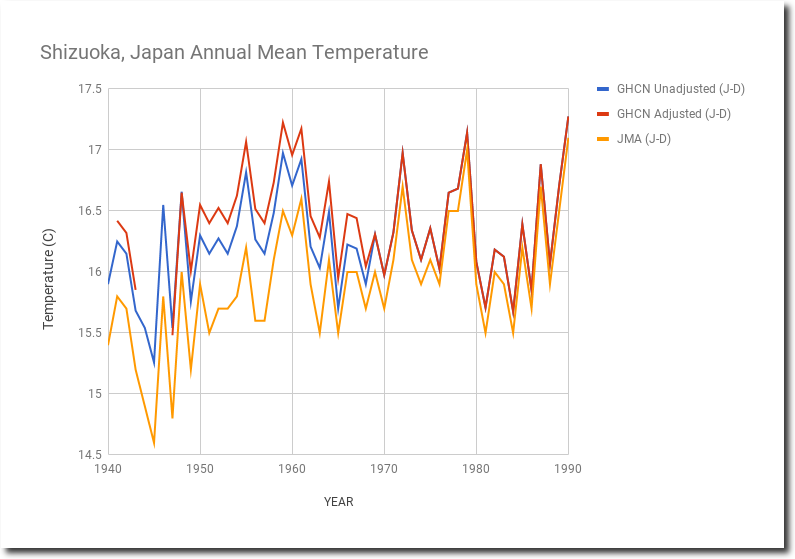
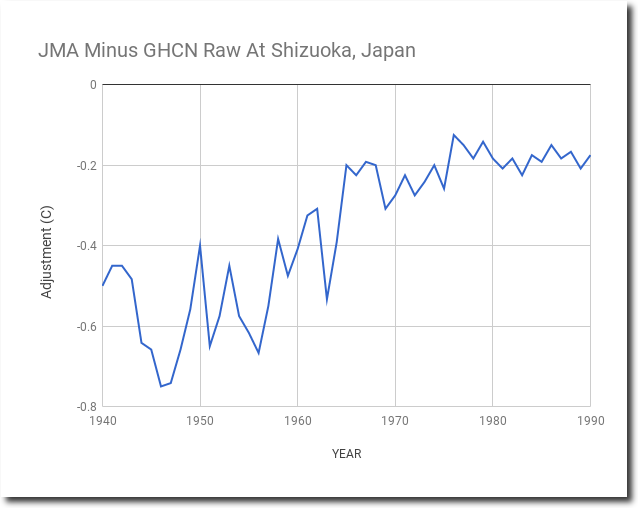
Depending on which (fake) government data set you use at Shizuoka, Japan – you get a completely different temperature history. Climate scientists want to control global energy policy, yet appear to be unable to do basic mathematics like averaging.

  JMA  NASA Unadjusted   NASA Adjusted  Spreadsheet

h/t to Kirye

via The Deplorable Climate Science Blog

https://ift.tt/2HKK4eU

June 13, 2018 at 09:59AM

Head, Heart and Science Updated

A man who has not been a socialist before 25 has no heart. If he remains one after 25 he has no head.—King Oscar II of Sweden

H/T to American Elephants for linking to this Jordan Peterson video:  The Fatal Flaw in Leftist Thought.  He has an outstanding balance between head and heart, and also applies scientific analysis to issues, in this case the problem of identity politics and leftist ideology.

As usual Peterson makes many persuasive points in this talk.  I was struck by his point that we have established the boundary of extremism on the right, but no such boundary exists on the left.  Our society rejects right wingers who cross the line and assert racial superiority.  Conservative voices condemn that position along with the rest.

We know from the Soviet excesses that the left can go too far, but what is the marker?  Left wingers have the responsibility to set the boundary and sanction the extremists.  Peterson suggests that the fatal flaw is the attempt to ensure equality of outcomes for identity groups, and explains why that campaign is impossible.

From Previous Post on Head, Heart and Science

Recently I had an interchange with a friend from high school days, and he got quite upset with this video by Richard Lindzen. So much so, that he looked up attack pieces in order to dismiss Lindzen as a source.  This experience impressed some things upon me.

Climate Change is Now Mostly a Political Football (at least in USA)

My friend attributed his ill humor to the current political environment. He readily bought into slanderous claims, and references to being bought and paid for by the Koch brothers. At this point, Bernie and Hilliary only disagree about who is the truest believer in Global Warming. Once we get into the general election process, “Fighting Climate Change” will intensify as a wedge issue, wielded by smug righteous believers on the left against the anti-science neanderthals on the right.

So it is a hot label for social-media driven types to identify who is in the tribe (who can be trusted) and the others who can not.  For many, it is not any deeper than that.

The Warming Consensus is a Timesaver

My friend acknowledged that his mind was made up on the issue because 95+% of scientists agreed. It was extremely important for him to discredit Lindzen as untrustworthy to maintain the unanimity. When a Warmist uses: “The Scientists say: ______” , it is much the same as a Christian reference: “The Bible says: _______.” In both cases, you can fill in the blank with whatever you like, and attribute your idea to the Authority. And most importantly, you can keep the issue safely parked in a No Thinking Zone. There are plenty of confusing things going on around us, and no one wants one more ambiguity requiring time and energy.

Science Could Lose the Delicate Balance Between Head and Heart

Decades ago Arthur Eddington wrote about the tension between attitudes of artists and scientists in their regarding nature. On the one hand are people filled with the human impulse to respect, adore and celebrate the beauty of life and the world. On the other are people driven by the equally human need to analyze, understand and know what to expect from the world. These are Yin and Yang, not mutually exclusive, and all of us have some of each.

Most of us can recall the visceral response in the high school biology lab when assigned to dissect a frog. Later on, crayfish were preferred (less disturbing to artistic sensibilities). For all I know, recent generations have been spared this right of passage, to their detriment. For in the conflict between appreciating things as they are, and the need to know why and how they are, we are exposed to deeper reaches of the human experience. If you have ever witnessed, as I have, a human body laid open on an autopsy table, then you know what I mean.

Anyone, scientist or artist, can find awe in contemplating the mysteries of life. There was a time when it was feared that the march of science was so advancing the boundaries of knowledge that the shrinking domain of the unexplained left ever less room for God and religion. Practicing scientists knew better. Knowing more leads to discovering more unknowns; answers produce cascades of new questions. The mystery abounds, and the discovery continues. Eddington:

It is pertinent to remember that the concept of substance has disappeared from fundamental physics; what we ultimately come down to is form. Waves! Waves!! Waves!!! Or for a change — if we turn to relativity theory — curvature! Energy which, since it is conserved, might be looked upon as the modern successor of substance, is in relativity theory a curvature of space-time, and in quantum theory a periodicity of waves. I do not suggest that either the curvature or the waves are to be taken in a literal objective sense; but the two great theories, in their efforts to reduce what is known about energy to a comprehensible picture, both find what they require in a conception of “form”.

What do we really observe? Relativity theory has returned one answer — we only observe relations. Quantum theory returns another answer — we only observe probabilities.

It is impossible to trap modern physics into predicting anything with perfect determinism because it deals with probabilities from the outset.
― Arthur Stanley Eddington

Works by Eddington on Science and the Natural World are here.

Summary

The science problem today is not the scientists themselves, but with those attempting to halt its progress for the sake of political power and wealth.

Eddington:
Religious creeds are a great obstacle to any full sympathy between the outlook of the scientist and the outlook which religion is so often supposed to require … The spirit of seeking which animates us refuses to regard any kind of creed as its goal. It would be a shock to come across a university where it was the practice of the students to recite adherence to Newton’s laws of motion, to Maxwell’s equations and to the electromagnetic theory of light. We should not deplore it the less if our own pet theory happened to be included, or if the list were brought up to date every few years. We should say that the students cannot possibly realise the intention of scientific training if they are taught to look on these results as things to be recited and subscribed to. Science may fall short of its ideal, and although the peril scarcely takes this extreme form, it is not always easy, particularly in popular science, to maintain our stand against creed and dogma.
― Arthur Stanley Eddington

But enough about science. It’s politicians we need to worry about:

Footnote:

“Asked in 1919 whether it was true that only three people in the world understood the theory of general relativity, [Eddington] allegedly replied: ‘Who’s the third?”

via Science Matters

https://ift.tt/2y6ODRg

June 13, 2018 at 08:16AM

Hopeful news for us from the Horse Manure Crisis of 1894


Summary: We can better prepare for future threats by seeing how we defeated past ones. Here we compare a certain doom from the past with one in our future.

“We’re going to become extinct. Whatever we do now is too late.”
— Frank Fenner in The Australian, 10 June 2010. He is a Prof Emeritus in biology at the Australian National U; see his great accomplishments.

A future historian’s perspective on the Great Climate Crisis of 2018

The Great Horse Manure Crisis of 1894The Great Horse Manure Crisis of 1894

“In 50 years, every street in London will be buried under nine feet of manure.”
— Headline in The Times from 1894. Famous but fake, accurately describing the views of that time.

In 1880, New York City had over 150,000 horses, a number which would rise in the next few decades. A horse produces 20+ pounds of manure and ~2 pints of urine per day. The manure flooded the market, so that farmers were paid to take it. Piles of manure were 50+ feet high. Dead and rotting horses littered the streets. All this attracted massive numbers of flies which spread typhoid fever and other diseases. Horse-drawn vehicles killed people at far higher rates than today’s vehicles. The first International Urban Planning Conference convened in New York in 1898 to solve this problem. Scheduled for 10 days, they gave up on the third day and went home. (See this article for more information.)

Change came as new energy sources replaced horses, powering subways, trolleys, buses, trucks, and cars. For example, the first electrified underground urban railway opened in 1890 in London. This technology became more useful with the invention of the multiple-unit train control in 1897. In a few decades, cities were far cleaner. The solutions were being invented while people were despairing about the impossibility of solutions.

These energy sources were not invented as a response to the inadequacies of horses but as part of the 1870-1950 industrial revolution. Their success does not mean we should expect new tech to meet critical needs without conscious effort on our part. Nor plan on solutions appearing just because we need them.

The lesson from this history is that people often assume problems are intractable – ignoring contrary evidence already visible.

Forecasts of doom from climate change

“In 2002, as I edited a book about global climate change

, I concluded we had set events in motion that would cause our own extinction, probably by 2030. I mourned for months …”

— From “Apocalypse or extinction?” by Guy McPherson (Prof Emeritus of Natural Resources and Ecology, U AZ) in October 2009. In 2017 he predicted that our species will be extinct by 2026. He is the author of Extinction Dialogs: How to Live with Death in Mind

(2014).

I have documented the increasing focus during the past three decades on doomster scenarios about climate change. See Ignoring science to convince the public that we’re doomed by climate change and Manufacturing climate nightmares: misusing science to create horrific predictions. These doomsters assume that only massive government action can prevent horrific outcomes. Their confidence comes from misrepresenting or exaggerating the underlying science (e.g., regarding the worst-case scenario in the IPCC’s AR5).

They also make a second error: ignoring other solutions. Most obviously, the development of new energy sources (or large improvements to existing sources, such as solar). That is an odd oversight, since rapid tech innovation has been the story of the past 3 centuries. It is especially odd since there are indications today that a new solution might come soon.

Fusion, at last

Robert L. Hirsch ran the US fusion program in the 1970s, walking away from it after he realized that success was not 20 years away (as commonly said), but beyond the foreseeable future. Scientists relying on government grants have continued to promise results soon, without delivering on them. So climate change gurus “know” that fusion will not save us. They say that just as smart and experienced people conclude the opposite. See the following, showing increasing investments in fusion from private sources.

One mega-corp is investing in fusion: Lockheed Martin’s Skunk Works began building a compact fusion system in 2010. See their website and the Wikipedia entry. From their October 2014 press release

“{Lockheed} is working on a new compact fusion reactor (CFR) that can be developed and deployed in as little as ten years. …The smaller size will allow us to design, build and test the CFR in less than a year. After completing several of these design-build-test cycles, the team anticipates being able to produce a prototype in five years.”

Most of these companies issue exciting press releases and videos about breakthroughs and timetables. Most are falling behind on their initial promises. The sums spent are small, as such things go. But the increasing interest of private investors – especially professional venture capitalists – marks the start of a new phase in the development of fusion power. Just like the inventors of modern urban transit systems a century ago, they pursue private profits and want quick results. But in the few decades they might – might – solve several major problems threatening the planet.

Mr. FusionMr. Fusion

Looking to our future

HORATIO: O day and night, but this is wondrous strange!
HAMLET: And therefore as a stranger give it welcome. There are more things in heaven and earth, Horatio, than are dreamt of in your philosophy {i.e., science}.

Pundits and scientists gives us absurdly confident forecasts about the distant future, things decades or generations away. Often about certain doom, usually based on mathematical models looking at only a tiny sliver of the countless factors affecting our world. Humility about our ability to see the future too seldom appears in these. The darkest predictions are those that deliberately ignore possible non-political solutions. The shrillest calls for political action are those that see only one threat and ignore the many other dangers that threaten us.

Scary press releases make easily written clickbait stories for journalists. A steady diet of them makes well-entertained but ignorant and passive citizens, overwhelmed by the daily tsunami of doomster stories and awareness that all have proven false in the past. We can do better. See The first step to protecting the world from its many dangers.

For More Information

Another often-told story about natural resources is about the replacement of whale oil by petroleum. The reality was much more complex, with no obvious lessons for us. See an analysis by Bill Kovarik, Professor of Communication at Radford University; also see the discussion in the comments.
For more information see The keys to understanding climate change, all posts about shockwaves, and especially these about some of the many large threats to our world…

  1. Is our certain fate a coal-burning climate apocalypse? No!
  2. Manufacturing climate nightmares: misusing science to create horrific predictions.
  3. Important: The oceans are dying. See their condition on World Oceans Day!
  4. How good are our global senses, watching our changing world? — About solar storms.
  5. California’s past megafloods – and the coming ARkStorm.
  6. It’s the Anthropocene! But natural threats will still kill millions unless we act soon.
  7. Three things to know about asteroids, certain death from the sky (eventually).
  8. Geologists warn us about dangerous volcanoes. Will we spend pennies for warnings?

via Watts Up With That?

https://ift.tt/2JykOhI

June 13, 2018 at 07:36AM