A few days ago I had mentioned that the climate debate happening today at the University of Virginia would be available on “pay per view” via a web feed.
I subscribed, because I’m charged with carrying the news of climate here at WUWT. Unfortunately, whoever setup the web feed had no clue as to how to do so. The audio was full of echoes and distorted (probably because they positioned a microphone rather than tap directly into the PA system audio), and the video camera was so poorly placed that you couldn’t even make out people’s faces, much less the postage stamp sized slides on the projection screen. The person who setup the camera foolishly let the stage lights into the shot, and that screwed up the camera iris.
Poor Michael Mann (at the podium) has no face as a result.
Here is a screencap from the web feed:


While I applaud the idea of a web feed, the execution was a complete failure IMHO. Fortunately, I have people in the audience that will file a report, and hopefully have photos with more clarity.
Dr. Judith Curry posted her presentation on her website just before the even went live, so since I can’t get anything useful from the web feed, here it is in entirety.
1 Cover
Good evening everyone. Thank you very much for coming, I look forward to our conversation this evening.
2 Agreement/disagreement
There is widespread agreement on these basic tenets:
- Surface temperatures have increased since 1880
- Humans are adding carbon dioxide to the atmosphere
- Carbon dioxide and other greenhouse gases have a warming effect on the planet
However, there is substantial disagreement about the issues of greatest consequence:
- Whether the recent warming has been dominated by human causes
- How much the planet will warm in the 21stcentury
- Whether warming is ‘dangerous’
- How we should respond to the warming
I have bolded the two issues that are the focus of this conversation.
Now there is nothing wrong or bad about scientific disagreement. In fact, the scientific process thrives in the face of disagreement, which motivates research in new directions.
3 Disagreement: causes of climate change
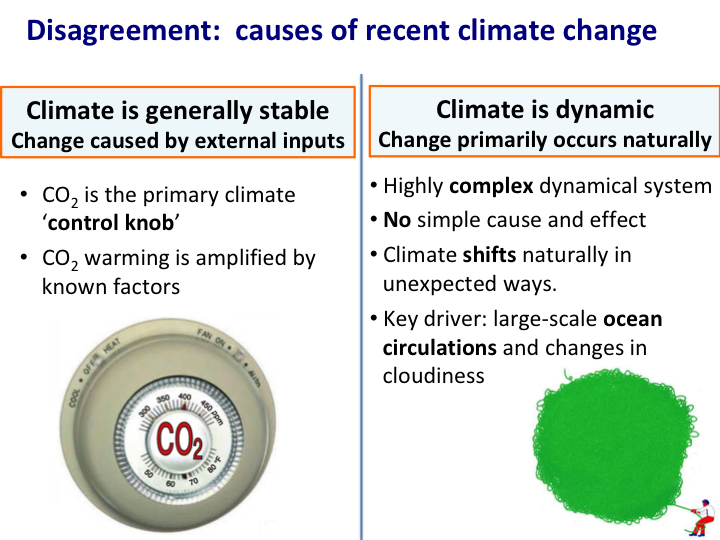
On the left hand side is the perspective of a stable climate that changes in response to changes in atmospheric CO2. In other words, carbon dioxide as the climate control knob. It’s a simple and seductive idea.
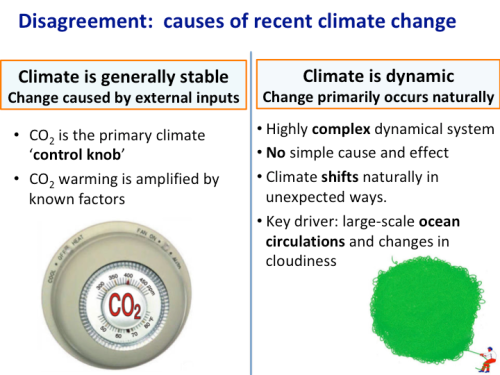
However some scientists think that this is a misleading oversimplification. They regard climate as a complex nonlinear dynamical system, with no simple cause and effect. Climate can shift naturally in unexpected ways, owing to natural internal variability associated with large-scale ocean circulations.
4 Elephant
Now these two perspectives are not mutually exclusive. Proponents of the CO2as control knob idea acknowledge the existence natural variability but dismiss it as noise that averages out. Proponents of the natural variability arguments acknowledge the impact of CO2, but consider it to be a modest wedge that projects onto the natural modes of climate variability.
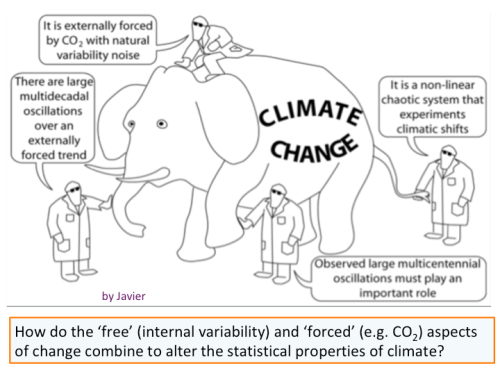
The point of this cartoon is that if you only look at one part of the elephant, you will misdiagnose. You need to look at the entire elephant.
The bottom line is that we don’t yet have a unified theory of climate variability and change that integrates all this.
5 Disagreement: cause of climate change
So does this rather arcane scientific debate actually matter? Well, yes it does.
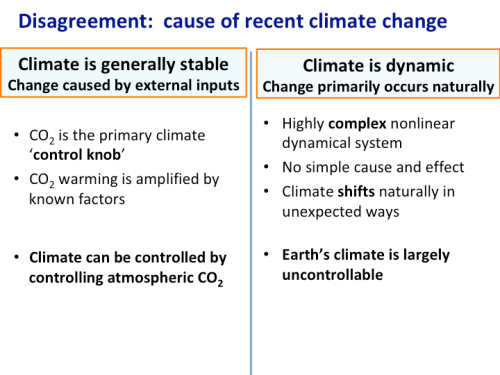
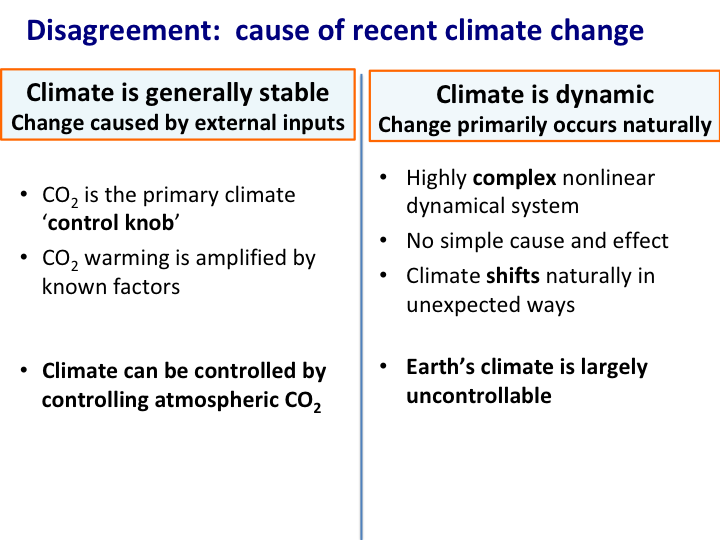
If you assume that carbon dioxide is the control knob for climate, than you can control climate by reducing CO2emissions.
If you assume that climate change primarily occurs naturally, then the Earth’s climate is largely uncontrollable, and reducing CO2emissions will do little or nothing to change the climate.
My personal assessment aligns with the right-hand side, emphasizing natural variability. However, the IPCC and the so-called consensus aligns with the left hand side. About 10 years ago, I also aligned with left hand side, because I thought supporting the IPCC consensus was the responsible thing to do.
Here is how and why I changed my mind.
6 Policy cart before scientific horse
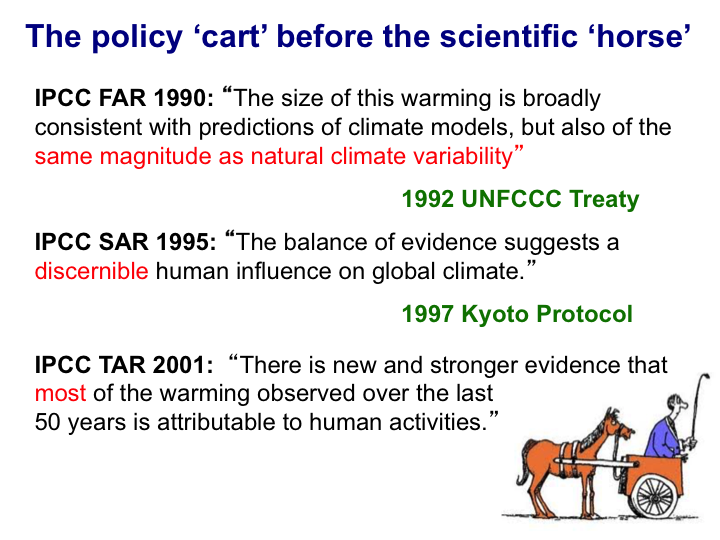
In 2010, I started digging deeper, both into the science itself and the politics that were shaping the science. I came to realize that the policy cart was way out in front of the scientific horse.
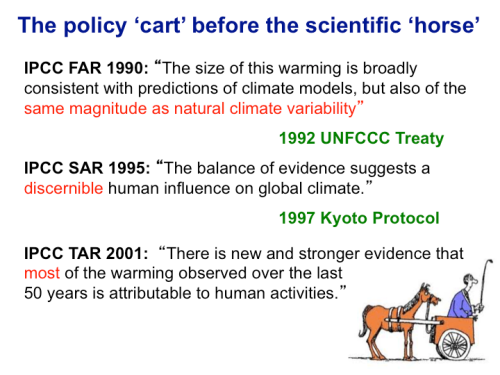
The 1992 UN Climate Change treaty was signed by 190 countries before the balance of scientific evidence suggested even a discernible human influence on global climate. The 1997 Kyoto Protocol was implemented before we had any confidence that most of the warming was caused by humans. There was tremendous political pressure on the IPCC scientists to present findings that would support these treaties, which resulted in a manufactured consensus.
7 You find what you shine a light on
Here is how the so-called consensus and increasing confidence in human-caused global warming became a self-fulfilling prophesy.
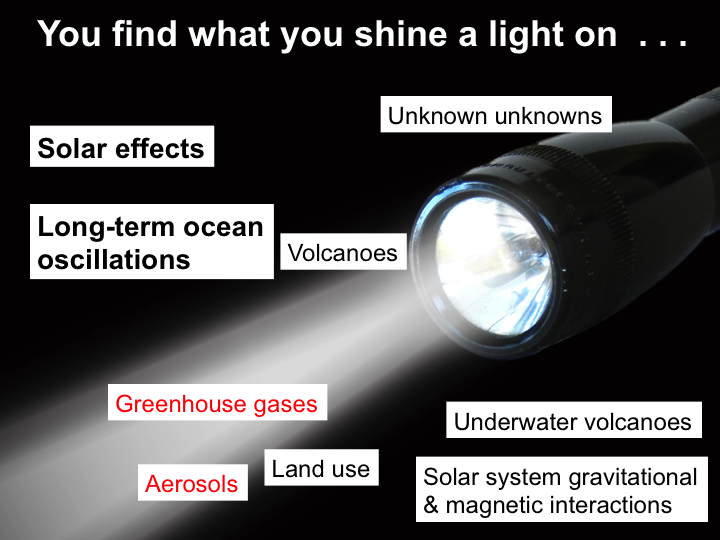
You find what you shine a light on. In other words, we have only been looking at one part of the elephant.
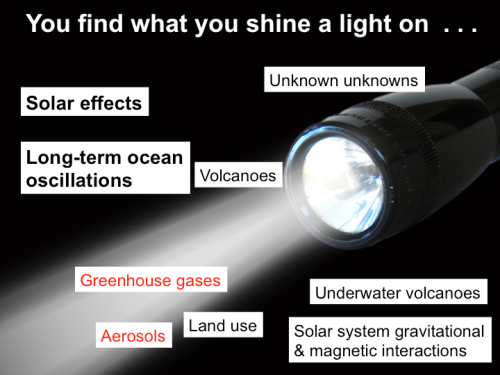
Motivated by the UN Climate treaty and the IPCC and government funding, climate scientists have focused primarily on human-caused climate change. Other factors important for understanding climate variability and change have been relatively neglected. I have highlighted long-term ocean oscillations and solar indirect effects, since I think that these are potentially very important on decadal to century timescales.
8 The sea level rise alarm
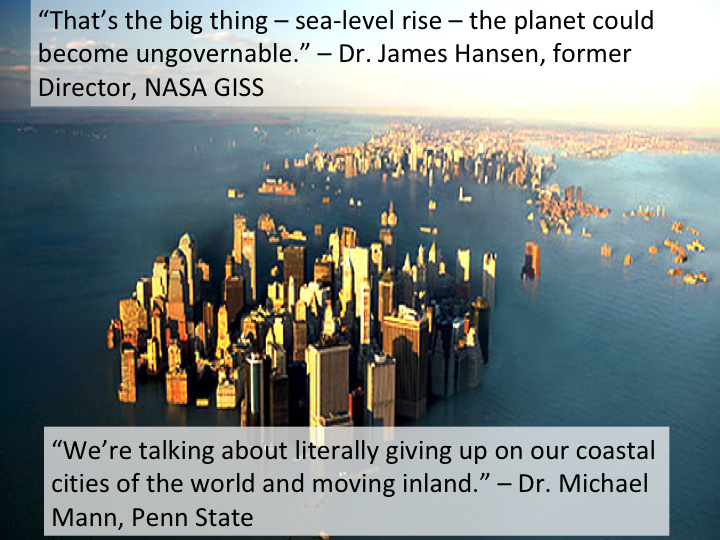
One of the most consequential impacts of a warming climate is sea level rise. These two statements by climate scientists typify the alarm over sea level rise:
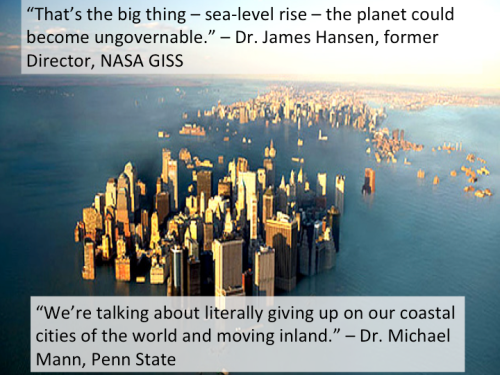
Is this alarm justified by the scientific evidence?
9 Is CO2 the control knob for global sea level rise?
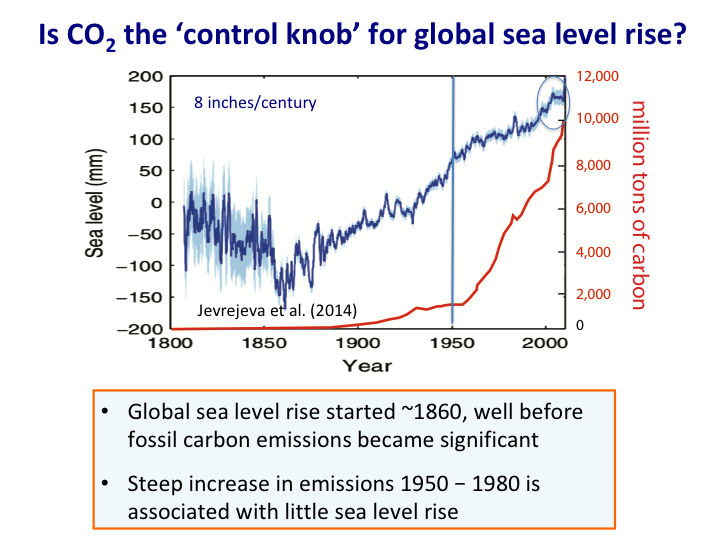
This figure illustrates the challenge of attributing long-term sea level rise to CO2emissions. The blue curve shows sea level change since 1800, measured from tide gauges.
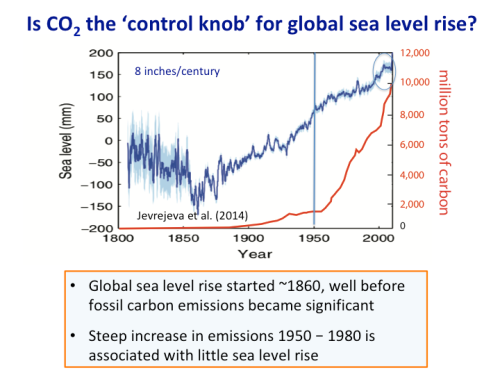
The red curve shows global emissions of carbon dioxide from burning of fossil fuels. You can see that global sea levels were rising steadily long before fossil fuels emissions became substantial. You can also see that the steep increase in emissions following 1950 is associated with very little sea level rise between 1950 and 1990.
An uptick in sea level rise occurred in the 1990’s, which is circled. Lets take a closer look to see what is causing this.
10 What is causing recent sea level rise?
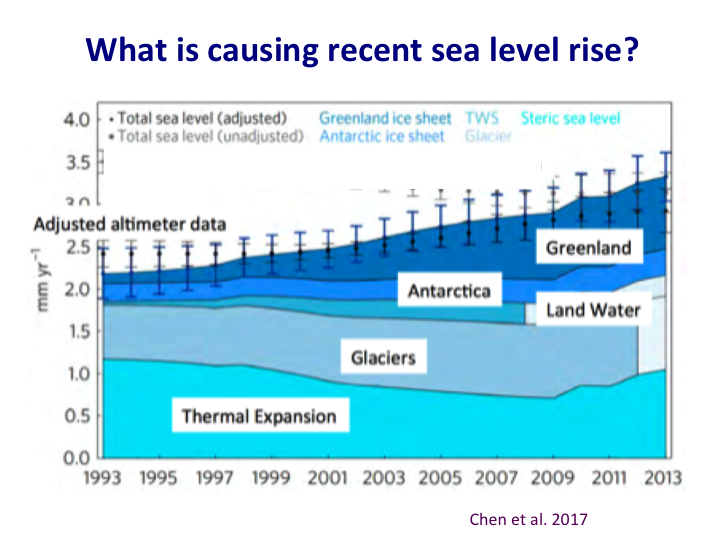
Since 1993, global satellite data have provided valuable information about sea level variations and glacier mass balance. This figure shows a recent analysis of the budget of sea level rise since 1993. You can see that overall the rate of sea level rise has increased since 1993.
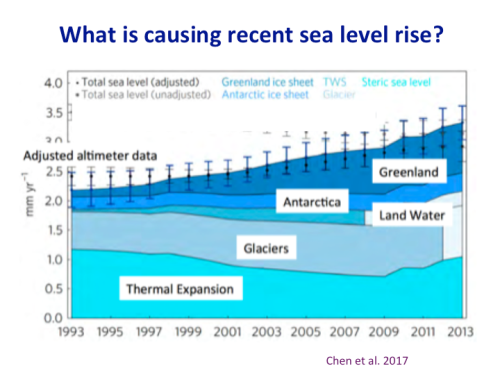
What is causing this increase? The turquoise region on the bottom of the diagram relates directly to expansion from warming. You actually see a decrease until about 2009, which has been attributed to the cooling impact following the eruption of Mount Pinatubo in 1992.
What stands out as causing the increase in the rate of sea level rise is the growing contribution from Greenland, which is the dark blue area on top. Hence the recent increase in the rate of sea level rise is caused by Greenland melting.
11 Variations in Greenland glacier mass balance
So, is the Greenland melting caused by increasing CO2 emissions?
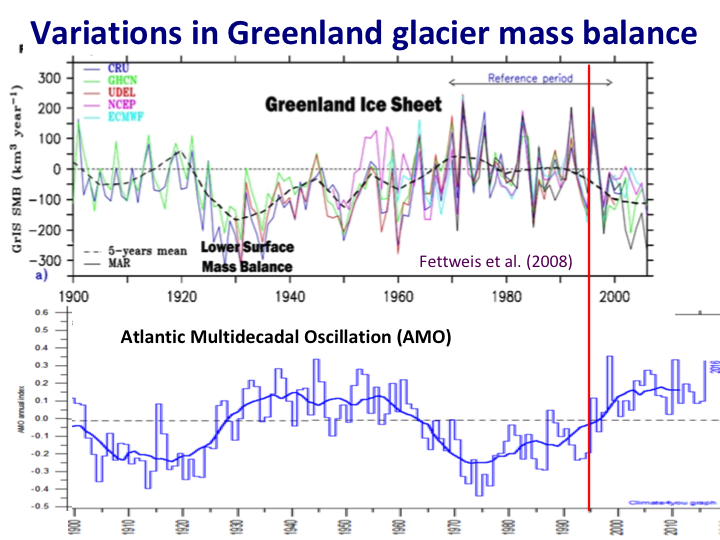
This figure shows the Greenland mass balance for the 20th century. Ice sheet mass balance is defined as increase from snowfall, minus the decrease from melting. You can see the negative mass balance values after 1995, reflecting mass loss that raises sea level. If you look earlier in the record, you see even larger negative values particularly in the 1920’s and 1930’s. Clearly, the high surface mass loss rates of recent years are not unprecedented, even in the 20thcentury.
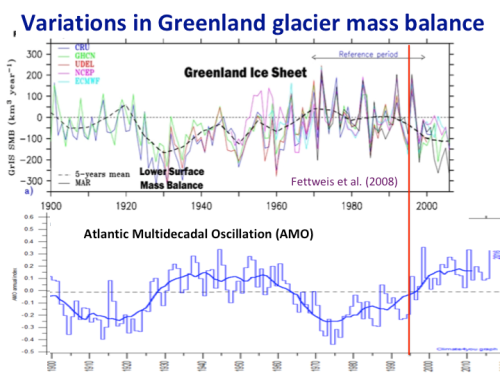
Greenland was anomalously warm in the 1930’s and 1940’s. What caused this?
The bottom figure shows variations in the Atlantic Multidecadal Oscillation, which is an important mode of natural internal climate variability. The AMO is a powerful control on the climate of Greenland.
Ingeneral, years with positive AMO index are associated with a mass loss for Greenland, whereas negative AMO index is associated with a mass gain.
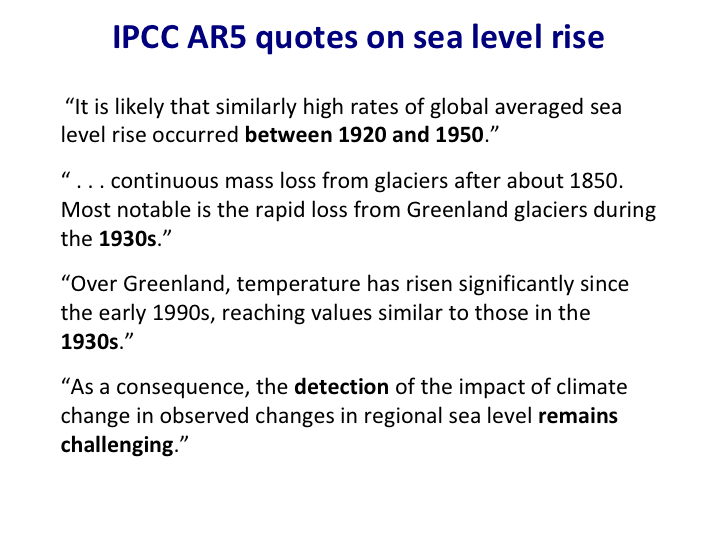
12 IPCC AR5 quotes on sea level rise
From this analysis, I can only conclude that CO2 emissions are not the main cause of sea level rise since the mid 19thcentury.
The scientific evidence that I’ve shown you on the preceding slides is well known to the IPCC. Here are some statements that the most recent IPCC report made on sea level change and Greenland: 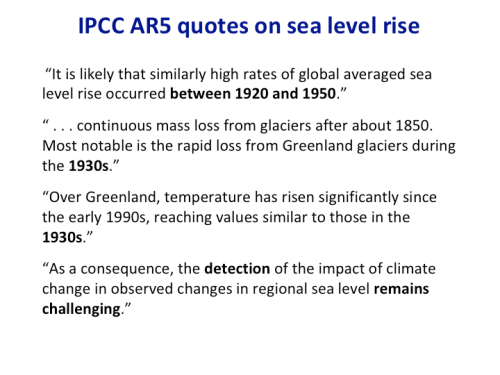
13 To what extent are man-made CO2 emissions contributing to climate change?
I’ve been asked to respond to the question “To what extent are man-made CO2 emissions contributing to climate change?”
The short answer is: ‘we don’t know.’ The reason is that we don’t know how to disentangle natural internal variability from the effects of CO2–driven warming
Even the IPCC doesn’t claim to know exactly. The most recent IPCC assessment report says it is ‘extremely likely’ to be ‘more than half.’ ‘More than half’ is not very precise.
Given the IPCC’s neglect of multi-decadal and longer time scales of natural internal variability, I regard the extreme confidence of their conclusion to be unjustified
So here is my personal assessment, using the jargon of the IPCC: Man-made CO2emissions are as likely as not to contribute less than 50% of the recent warming
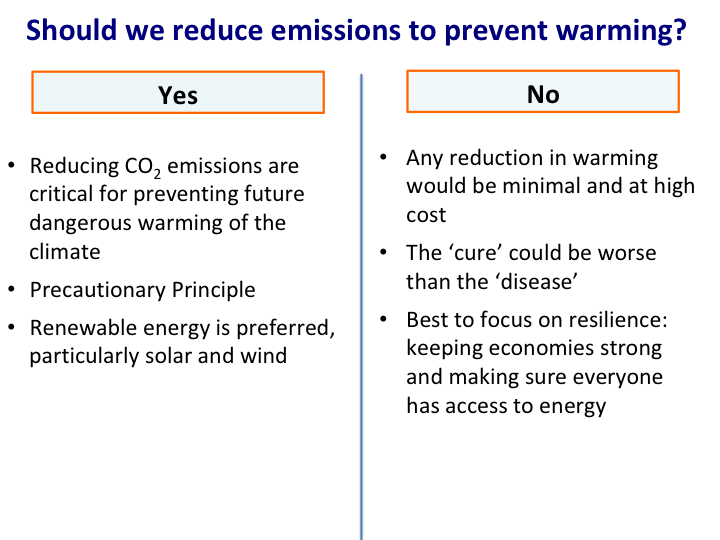
14 Should we reduce emissions to prevent warming?
Even if you believe the climate model projections, there is still genuine disagreement regarding whether a rapid acceleration away from fossil fuels is the appropriate policy response.
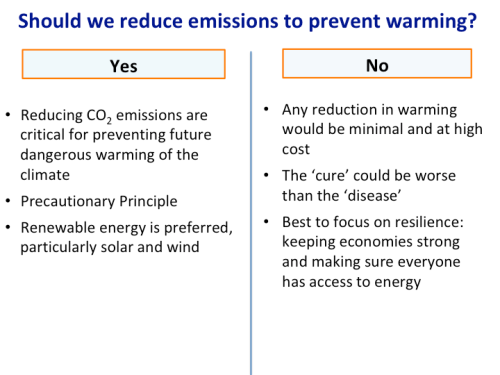
One side argues that reducing CO2emissions are critical for preventing future dangerous warming of the climate. The other side argues that any reduction in warming would be minimal and at high cost, and that the ‘cure’ could be worse than the ‘disease’.
15 Climate pragmatism
What makes most sense to me is Climate Pragmatism, which has been formulated by the Hartwell group. Climate pragmatism has 3 pillars:
- Accelerate energy innovation
- Build resilience to extreme weather
- No regrets pollution reduction
These policies provide near-term socioeconomic & environmental benefits and have justifications independent of climate mitigation & adaptation
These are no regrets policies that do not require agreement about climate science or the risks of uncontrolled greenhouse gases
16 Madhouse effect
I would like to make a few comments on the state of the scientific and public debate on climate change.
Here is my take on the Madhouse effect. The madhouse that concerns me is one that has been created by climate scientists. The madhouse is characterized by
- Rampant overconfidence in an overly simplistic theory of climate change
- Enforcement of a politically-motivated, manufactured ‘consensus’
- Attempts to stifle scientific and policy debates
- Activism and advocacy for their preferred politics and policy
- Self-promotion and ‘cashing in’
- Public attacks on other scientists that do not support the ‘consensus’
Hmmm . . . maybe I should write a book.
17 Personal statement
In closing, I would like to make a personal statement, to clarify my motives
I regard my job as a scientist to critically evaluate evidence and to continually challenge and reassess conclusions drawn from the evidence.
A year ago I resigned my tenured faculty position because of academic political pressures that interfered with doing my job. My resignation was a direct result of ‘science madhouse effect’ discussed on the previous slide.
I am now working in the private sector as President of Climate Forecast Applications Network
My direct engagement with public is via my blog Climate Etc. where we discuss a broad range of topics related to climate science and policy. I hope you’ll join us at judithcurry.com.





 Iowa Climate Science Education