Month: June 2018

Software Expert Exposes 30 Years Of ‘Totally Messed Up’ Climate Forecasts, Embarrassing NASA Scientists

A video released by software expert Tony Heller exposes 30 years of completely false predictions made by NASA “climate experts” and how the predictions have no more value than what one could expect from crystal ball fortune-tellers.

When it comes to the climate debate, one could say he “floats like a butterfly, stings like a bee.”

Few skeptics are as hated and vilified by climate alarmists and global warming fraudsters as Tony Heller of Real Science.

One reason for the hatred is Tony’s voluminous stream of inconvenient climate facts and climate science fraud he exposes day after day at his Real Science blog.

Exposing false predictions and inconvenient climate history

Again and again Heller, a software and programming expert, effectively and convincingly points out that none of the scary predictions made by climate alarmists and media have come true, and that today’s often claimed unprecedented weather extremes have in fact happened many times and long before – even 100 years ago or more when CO2 was low.

As you are about to see, very often the OPPOSITE of what global warming alarmist scientists predicted years ago has in fact occurred. The degree to which the alarmist predictions have been wrong is nothing short of stunning.

Video viewed tens of thousands of times in just days

The latest is a 14-minute video that looks back at the past 30 years of totally failed climate predictions. Many were made by NASA scientist James Hansen when he testified before Congress in 1988 to warn the world of a coming climate disaster.

The video is a must-see if you haven’t viewed it already, and is certainly one that ought to be sent to your political representatives, or friends and relatives.

So far the video has viewed more than 33,000 views, and shows no signs of slowing down.

Hansen warned in 1988 of huge droughts and heat waves plaguing the US soon in the future, but in the video Heller shows how temperatures and drought conditions were in reality far worse back in the 1930s and in 1988 than they are today.

Hansen “dead wrong” about his drought forecast

For example in 1988 NASA’s Hansen warned that his climate models (primitive compared to today’s models which still don’t work at all) showed the US Midwest would get drier and droughts more and more severe as time went on.

Yet, Heller presents a chart in the video that tells us the exact opposite has in fact happened since!
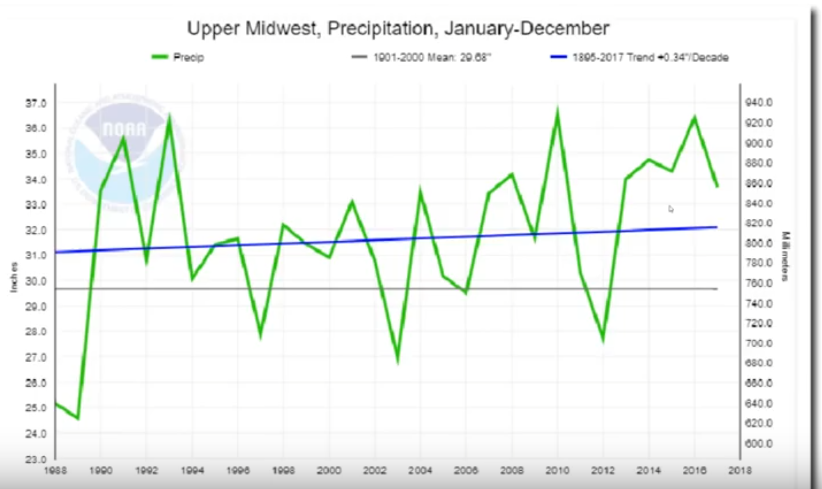
Source: Cropped here.

As Heller’s chart above shows, in the late 1980s it was very dry, but then right after Hansen’s testimony warning of more drought it suddenly got wet again. Moreover the last 5 years have been particularly moist. The exact opposite of what Hansen predicted is in fact occurring today.

Hot days have FALLEN

Hansen also warned that the number of hot days above 90°F (32°C) would increase dramatically to 85 days a year in Omaha. Nebraska and Washington D.C.

But in the chart that Heller presents at the 7:30 mark of the video, we see that the opposite has happened (arrows in all charts added by author):
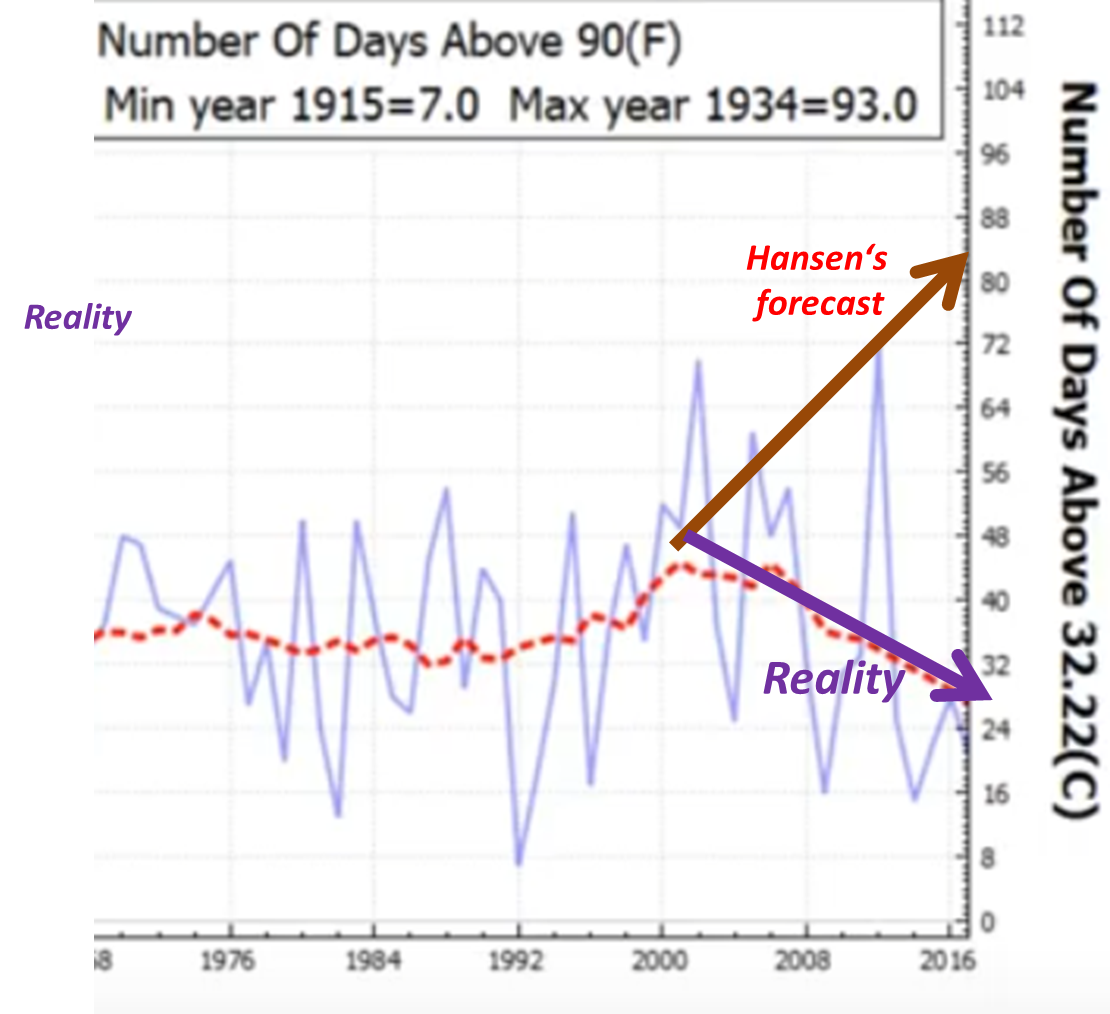
Source: Cropped here.

The number of days above 32°C for Ashland, Nebraska (near Omaha) have fallen over the past 20 years, and not risen as NASA’s James Hansen had forecast in 1988.

Hansen also “completely messed up” his forecast of 38°C+ days for Ashland (7:52), Heller shows:
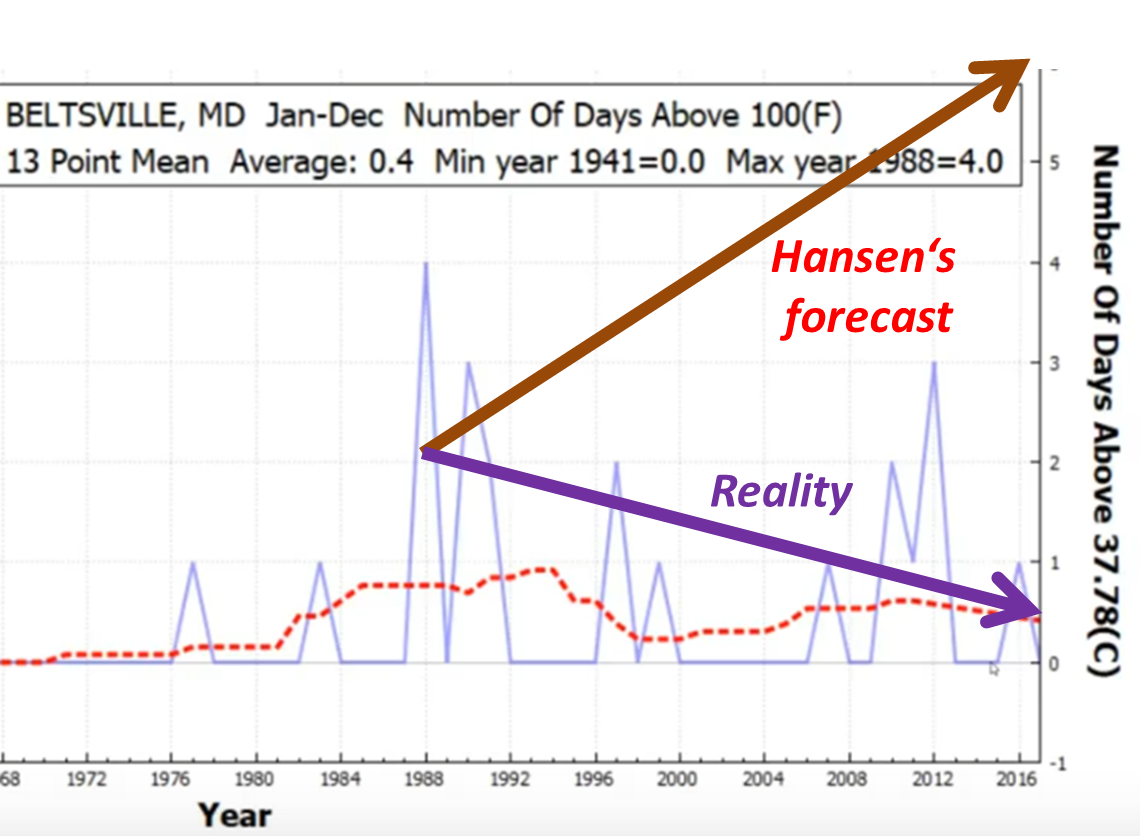
The number of very hot days (38°C or higher) for the Washington D.C. area each year has declined instead of rapidly rising as NASA’s GISS Head James Hansen projected in 1988. Source: Cropped here.

“Arctic ice has gotten much thicker over the past decade”

Hansen’s predictions concerning the Arctic have turned out to be equally awful. Though the Arctic saw ice loss until about 2010, it has since rebounded robustly, which means that it has nothing to do with CO2 concentrations in the atmosphere and more to do with natural cycles.

Totally messed up forecast

The chart he presents at the 9:00 minute mark shows a comparison between 2008 and today. Heller notes: “Instead of getting much thinner, the ice has gotten much thicker over the past decade. [….] Arctic sea ice volume is the thickest since 2005. […] Hansen totally messed up that forecast.”

Lake levels higher instead of lower

Next the experienced software expert looks at the levels of major lakes, which James Hansen said would drop to possibly dramatic levels. The reality today, however, is that they are higher!

The Great Lakes did not dry up and see their levels sink. They increased instead. Source: Cropped here.

The Great Lakes in the US are not drying out as Hansen predicted.

Sea level forecast totally botched

Next NASA’s Hansen warned in 1988 that melting polar and glacial ice would lead to rapidly rising sea levels and so New York City would be partially under water by now (2018). Al Gore also made a similar prediction in his movie, An Inconvenient Truth.

But as Heller points out, “Hansen completely messed up that forecast.” Nothing could be further from the truth, as the following chart vividly illustrates:
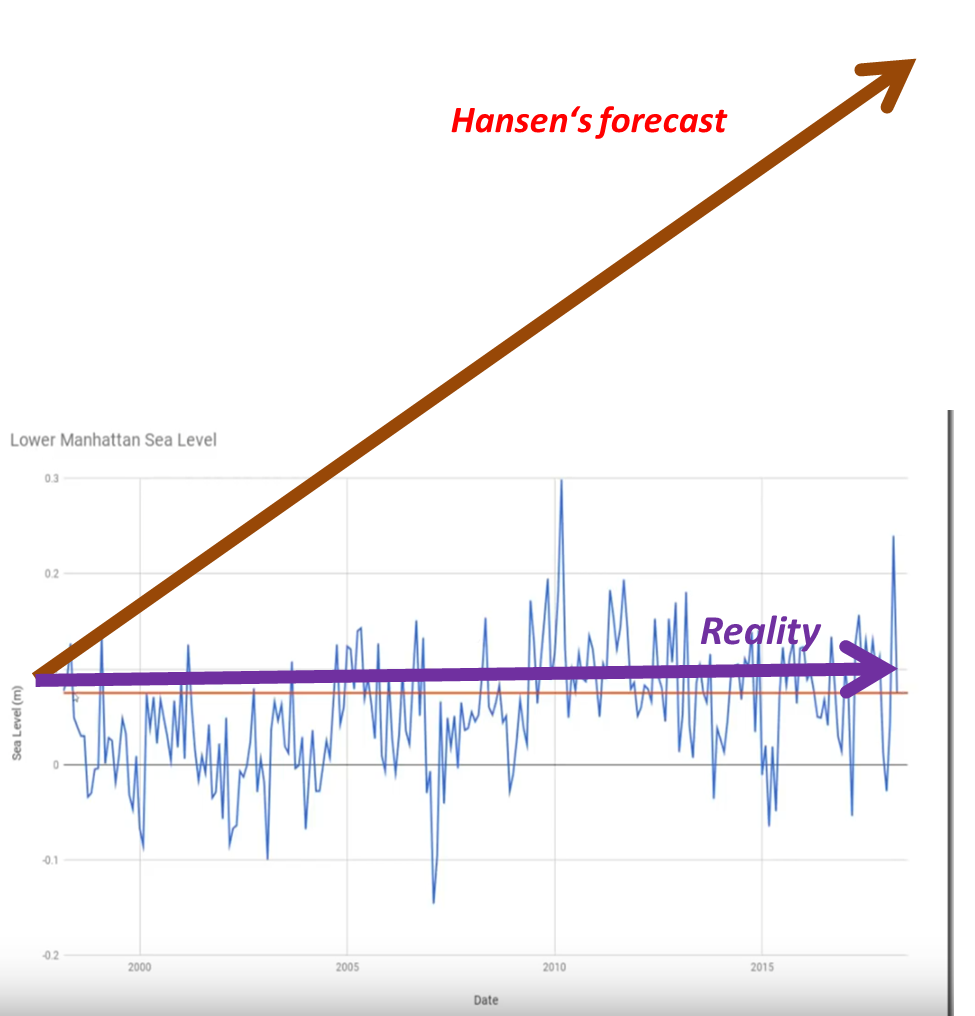
Tide gauges for Lower Manhattan show sea level has barely risen since NASA’s Dr. James Hansen warned in 1988 the area would be under water by now. Source: Cropped here.

NASA forecasts no better than fortune telling by swindling gypsies

In a nutshell, these NASA forecasts have turned out to be no better than the junk fortunes peddled by swindling gypsies of a traveling sideshow. Any meteorologist with that kind of dismal forecasting track-record would have long found himself employed as a taxi driver.

It’s time for NASA’s incompetent and fraudulent scientists to start looking for new careers and to stop wasting money and resources.

Taxpayer’s deserve far better for their hard-earned tax dollars.


via NoTricksZone

https://ift.tt/2yU6VFB

June 29, 2018 at 09:56AM

Basic Physics For Climate Dummies

Basic Physics For Climate Dummies

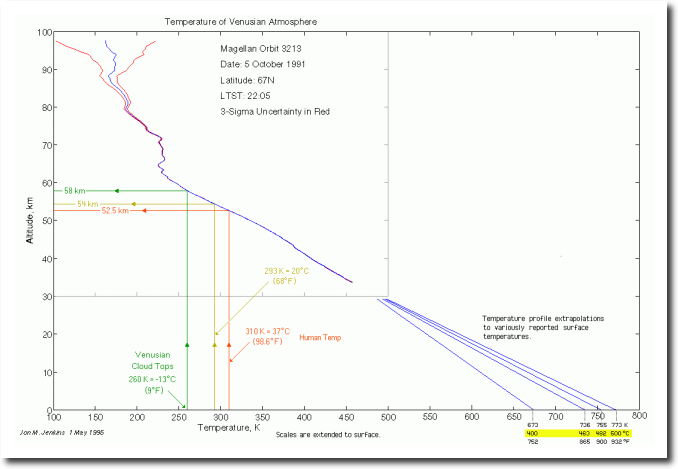
Temperature in the Venusian troposphere increases linearly with altitude. At an altitude of 50km in the Venusian atmosphere, the temperature is about the same as at Earth’s surface.

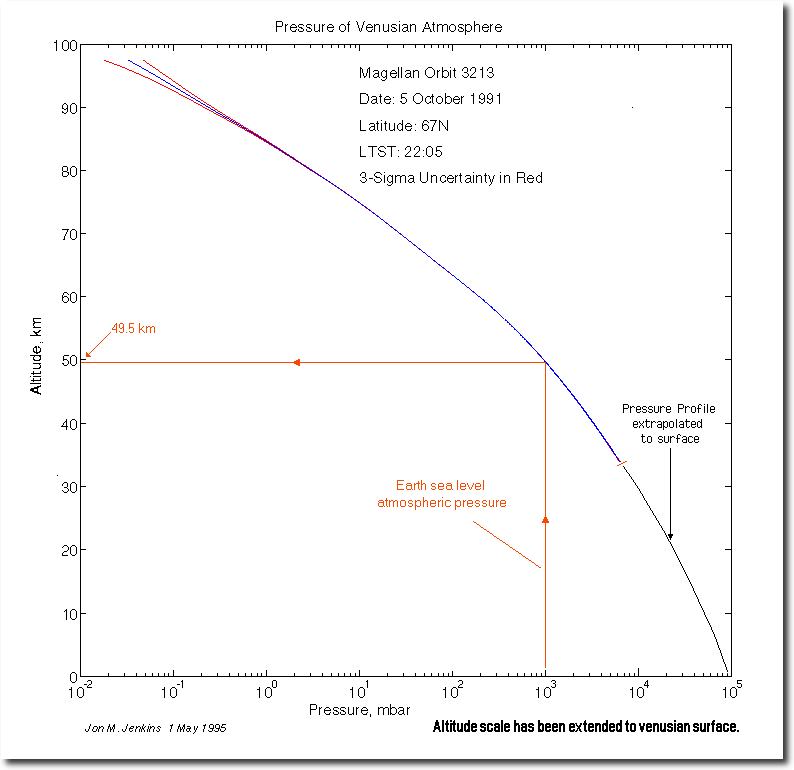
At an altitude of 50km in the Venusian atmosphere, the pressure is also about the same as the earth’s surface.

http://www.datasync.com/~rsf1/vel/1918vpt.htm

What this demonstrates is that planetary temperature correlates with atmospheric pressure, not atmospheric composition. Venus’ atmosphere has 95% CO2, Earth’s atmosphere has 0.04% CO2.  Incredible that an entire field of (junk) science could be based on such a fundamental misunderstanding of basic physics.

This entry was posted in

Uncategorized

. Bookmark the

permalink

.

via The Deplorable Climate Science Blog

https://ift.tt/2N8S3q1

June 29, 2018 at 07:22AM

The Texas Well That Started A Revolution & Changed The World Forever

Two decades ago, an engineer tried a new way to get gas out of the ground. Energy markets and global politics would never be the same.

DISH, Texas – Twenty years ago this month, a well was drilled here that changed the world.

Nothing at the time suggested the unassuming well in this rural town north of Fort Worth would hobble OPEC, the powerful oil cartel that had governed prices of the world’s most important commodity for more than a generation. Or that it would help turn the U.S. into a global energy exporter, or shuffle the geopolitical deck.

But it did all of that – and more. The well used hydraulic fracturing to crack the incredibly tight shale rocks below. It fired the first shot in the fracking revolution–a blast soon felt in Riyadh, Tehran and Moscow.

“I had no idea it would cause so much change. I was just trying to keep my job,” said Nick Steinsberger on a recent visit to the well pad. He was the engineer who obtained permission to try a new approach to completing the well that had been drilling a mile and a half deep into a thick grey wedge of rock known as the Barnett Shale.

Mr. Steinsberger, now 54, called the experiment “my slick-water frack.” It was the first commercially successful use of sand, water and chemicals, pumped into the shale under high pressure, to break open the rock and unleash the natural gas trapped inside. It was the beginning of modern fracking.

“It was a good well, cost $600,000 or $700,000,” Mr. Steinsberger said, walking over the pad to the chain-link fence that surrounds the well. A sign identifies it as the S. H Griffin Estate 4.

Today, most wells drilled in the U.S. use some variation of Mr. Steinsberger’s fracking technique. It has unleashed an unimaginable wealth of natural gas, gas liquids and crude oil, turning the U.S. from an energy pauper into a muscular exporter. It also started an often acrimonious environmental debate about the potential impacts and trade offs of fracking.

“It is one of the most extraordinarily important, disruptive, technologically driven changes in the history of energy,” said Ed Morse, global head of commodity research at Citigroup. “It was revolutionary for the U.S. economy and it was revolutionary geopolitically.”

Mr. Steinsberger’s modest experiment demonstrated that the oil and gas industry had the tools to fracture the rocks where fossil fuels were slowly baked over the millennia. A huge trove of natural gas was accessible at an economical cost.

It was such a novel idea that it spread slowly at first, as doubters couldn’t believe that anyone could successfully tap the source rocks. After a few years, more companies began to copy the wells drilled by Mr. Steinsberger’s employer,Mitchell Energy , the firm founded by the late George P. Mitchell.

It started in the Barnett Shale. Then other gas-bearing shales were discovered. The Marcellus Shale in Appalachia turned out to be larger and more fecund than the Barnett.

via The Global Warming Policy Forum (GWPF)

https://ift.tt/2MzNV1j

June 29, 2018 at 07:20AM

Stranded Assets Boom: Fossil Fuels Topple Tech As Top Sector

Energy stocks have rallied 12%—and are poised for the biggest quarterly gain since 2011

Given the highs in oil prices, analysts expect a strong earnings season from energy companies. PHOTO: JAMES DURBIN FOR THE WALL STREET JOURNAL

Energy stocks are on pace to be the best-performing group in the S&P 500 this quarter after oil prices broke through $70 a barrel, a level they have struggled to reach and stay above for almost four years.

Energy companies have rallied 12%—and are poised for the biggest quarterly gain since 2011 and to be the top sector out of the 11 in the S&P 500. The broader equity gauge is on course to eke out a 2.9% gain in the second quarter.

Oil prices have jumped amid signs of falling global supply. This week’s move higher in crude comes after the Organization of the Petroleum Exporting Countries reached an agreement last Friday to increase global production by an amount below what many had expected. The decision sent oil prices surging 6.1% over four days.

Harsh rhetoric from the Trump administration on Iran sanctions also lifted prices this week, while production from Venezuela has been plummeting for months as the country sinks deeper into economic turmoil. Stockpiles in the U.S. have also drained. On Wednesday, the U.S. Energy Information Administration reported a 9.9-million-barrel decline in crude inventories last week, the biggest weekly drop since September 2016 and more than triple the amount that analysts had predicted.

West Texas Intermediate, the benchmark for U.S. crude, rose 0.9% to settle Thursday at $73.45 a barrel, the highest level since November 2014. Brent, the global benchmark, climbed 0.3% to $77.85. The energy sector’s performance has historically been linked to the price of oil.

“The pendulum has swung,” said Bill Costello, senior portfolio manager at Westwood Holdings Group. Investors went from being “not willing to touch [energy] to being bullish.”

Energy hasn’t been the S&P 500’s top sector since the second quarter of 2016, when energy companies were recovering from a two-year rout triggered by shale producers in Texas and North Dakota unleashing supply into the market. Oil prices plunged starting in 2014 from a high of over $100 a barrel to below $30 in a span of months. Meanwhile, technology companies, favored by investors in recent years, have been harder hit recently by rising trade tensions between the U.S. and China.

China is targeting crude oil in its retaliatory tariffs on U.S. imports, but the broader ramifications for energy demand are a bigger concern for investors, said Quincy Krosby, chief market strategist at Prudential Financial Inc.

“The question becomes how much of a slowdown we’re going to see, if any,” Ms. Krosby said. “That also translates into how much energy use we’ll see.”

Oil producers and pipeline operators are considered cyclical companies, meaning they are sensitive to economic conditions and their businesses tend to ramp up when growth is robust. A trade war between the U.S. and China, the world’s two biggest economies, could hurt global energy demand. […]

Nonetheless, given the fresh highs in oil prices, analysts expect a strong earnings season from energy companies. The group has seen the largest increase in earnings estimates out of any sector since the start of the quarter, according to analysts surveyed by FactSet. Twenty-two of the 31 companies in the group had an increase in their average earnings estimate.

Full post

via The Global Warming Policy Forum (GWPF)

https://ift.tt/2lIRarE

June 29, 2018 at 06:50AM