Month: June 2018

Winds of Change

“The story of Hänsel and Gretel is a fairy tale about famine, destitute parents, being lost in the woods, being lured by false promises, and survival through intelligence and cooperation.”
– Dr. Klaus L.E. Kaiser 

__________________

Winds of Change

Occasional squalls of sudden and strong winds can create havoc anywhere and anytime
By Dr. Klaus L.E. Kaiser
10 June 2018

In Grimm brothers’ world-famous mythical story about “Hänsel and Gretel” in the forest, their answer to the witch’s question about the strange sound she heard, was “Der Wind, der Wind, das himmlische Kind” (the wind, the wind, the heavenly child).

The story of Hänsel and Gretel is a fairy tale about famine, destitute parents, being lost in the woods, being lured by false promises, and survival through intelligence and cooperation.

The children’s parents were intent on abandoning them deep in the forest after recognizing that they could no longer take care of them. Indeed, there are numerous historical records of terrible famines, all over the world.

Famines and Winds

The interplay of famines and winds may not be very obvious but they do exist. The most important aspect of that is the degree of saturation with water vapour of the wind.

When I was studying chemistry, decades ago, we also had mandatory lectures and exams in “technical chemistry”, meaning the processes and principle control mechanisms to run large-scale chemical manufacturing systems. The rumor was that the professor liked to ask a simple question” “How long do you dry a material?” The answer he wanted to hear was NOT “until it is dry” but rather “until your drying agent is saturated.”

Of course, he was absolutely right. Whether your material that is to be dried is nearly dry or wet as a soaked sponge makes no difference at that point in the process. If your, say air-stream, is saturated with moisture, you can continue to dry your wet material until the cows come home, without any effect. Once the air is saturated, there is no more drying effect to be had. Folks who study famines ought to understand that.

Of course, not all famines are caused by lack of moisture in the prevailing winds; there are many additional causes. Still, the humidity and water vapor content of winds is a major determinant of crop failures or bumper crops. As with so many things in nature, periods of excess can be alternating with periods of lack, without advance warning or any explanation.

Winds of Nature

As you can see from the example above, the drying effect of winds really depends on the ability of air to accept more water vapor. The ratio (gradient) of the water vapor pressure between the water (or land) surface and in the air is critical. Perhaps surprisingly to many people, that gradient is generally much higher in dry winter air than in more humid summer air. As a consequence, the rate of evaporation from a water surface is mostly lower in summer than in winter. Very simply, the low humidity of dry winter air is the driving force, i.e. the difference in vapor pressure between the water molecules on the lake or land surface and in the air. The higher that gradient (difference) is the higher is the rate of evaporation.

Don’t think that this effect is of no consequence. For example the North American Great lakes Huron/Michigan (at the same water level because of a wide connection at the Strait of Mackinac), together having a surface of nearly 115,000 km^2, can easily drop by 0.5 m in the winter months (say November to February). That’s not because of a suddenly increased outflow via the Detroit River but strictly due to massive evaporation from dry northern winds. To give you an idea of the magnitude of water involved, one half meter (a bit less than 2 ft.) difference in water level for this surface, equates to 0.5 [m] x 115,000 (km^2) x 10^6 [m^2/km^2] = 55,000 x 10^6 [m^3] = 55 cubic kilometers of water, clearly, a helluva lot of bath tubs filled to the brim.

Occasional squalls of sudden and strong winds can create havoc anywhere and anytime, I’ve experienced such myself: from a dead calm to five minutes of horizontally driving rain only to be followed a by more sunshine, blue sky and another dead calm a few minutes later. You wonder whether you were dreaming.

Winds of 1812

Such squalls are bad enough during daylight hours but even more dangerous at night time. There are two well-known examples on the bottom of Lake Ontario: the Hamilton and the Scourge, two merchant schooners that were pressed into service for the U.S. Navy during the War of 1812. They got caught in a sudden night-time squall on Lake Ontario and went down with all hands on board. The ships’ hulls were discovered several decades ago.

Apropos, about the War of 1812. It was between the British (trying to maintain and regain control) and the U.S. (independence-minded) forces. Much of the action took place on and around Lake Ontario. In the end, its biggest tributary, its Niagara River became part of the boundary between the U.S. and what later became Canada.

Winds of 2018

As the sun keeps shining and the earth rotating, the winds never stop. The temperature gradient between areas warming and those that are cooling create pressure differences that cause the air to move from higher pressure zones to those with lower pressure in order to equalize. Somehow though, good ol’ Mother Nature can never keep up fast enough to have just a gentle breeze. Instead, she serves tornados, hurricanes, typhoons, blizzards and associated downpours of liquid and solid precipitation.

Parallel to all such natural changes also the political landscapes are in regular flux. The recent rout of the long-time governing (majority) party in the legislature of Ontario is a prime example; it even lost its official “party status.”

On the world scene, winds are causing changes too.

What will be the outcome of current political pressure gradients?

Perhaps the story of Hänsel and Gretel can provide some guidance.

________________________________________

Dr Klaus L E KaiserDr. Klaus L.E. Kaiser is a professional scientist with a Ph.D. in chemistry from the Technical University, Munich, Germany. He has worked as a research scientist and project chief at Environment Canada‘s Canada Centre for Inland Waters for over 30 years and is currently Director of Research at TerraBase Inc. He is author of nearly 300 publications in scientific journals, government and agency reports, books, computer programs, trade magazines, and newspaper articles.

Dr. Kaiser has been president of the International Association for Great Lakes Research, a peer reviewer of numerous scientific papers for several journals, Editor-in-Chief of the Water Quality Research Journal of Canada for nearly a decade, and an adjunct professor. He has contributed to a variety of scientific projects and reports and has made many presentations at national and international conferences.

Dr. Kaiser is author of CONVENIENT MYTHS, the green revolution – perceptions, politics, and facts
convenientmyths.com

Dr. Kaiser can be reached at: mail@convenientmyths.com

The post Winds of Change appeared first on Ice Age Now.

via Ice Age Now

https://ift.tt/2sNfjBj

June 10, 2018 at 07:42PM

Remember when the massive California wildfires of 2017 were blamed on global warming? Never mind.

On June 8th, the California Department of Forestry and Fire Protection (Cal Fire) made its first official announcement via press release that 12 big Northern California wildfires in October 2017 were caused by problems associated with electric utility power lines.

The October 2017 Fire Siege involved more than 170 fires and burned at least 245,000 acres in Northern California. About 11,000 firefighters from 17 states and Australia helped battle the blazes. They concluded that 12 Wildfires in Mendocino, Humboldt, Butte, Sonoma, Lake, and Napa Counties were caused by Pacific Gas & Electric (PG&E) “power and distribution lines, conductors and the failure of power poles.”

The words “global warming” and “climate change” were conspicuously absent from the announcement even through screeching environmentalists and Governor Brown blamed the fires directly on that universal boogeyman based on nothing more than speculation.

CAL FIRE’s investigations have been referred to the appropriate county District Attorney’s offices for review in eight of the 12 fires – Sulphur, Blue, Norrbom, Partrick, Pythian, Adobe, Pocket and Atlas – due to evidence of alleged violations of state law.

Read it all here: http://calfire.ca.gov/communications/downloads/newsreleases/2018/2017_WildfireSiege_Cause.pdf

Told you so.  It was a change in the Pacific Ocean patterns.

via Watts Up With That?

https://ift.tt/2LFJaCG

June 10, 2018 at 07:13PM

G7 Hypocrisy

Diplomacy has become the art of talking as though something is agreed and will happen, when in fact nothing has changed and nothing different will ensue. Trump did indeed blow up the G7 meeting because he insists on facing the facts of trade imbalances and the emptiness of virtue signaling. By not making the gesture of signing some insipid joint communique, he exposed the whole charade.

Liz Peek at the Hill explains in article Hypocritical France and Germany scold Trump; how dare they  Excerpts below in italics with my bolds

Emmanuel Macron is having a “crise de colere;” that’s French for hissy fit.

In the run-up to the Group of Seven (G-7) meeting, the French president joined with Germany’s Angela Merkel in warning that he would refuse to sign a joint statement from the G-7 unless the U.S. demonstrates a willingness to shift its position on the Iran nuclear agreement, the Paris Agreement and on tariffs. The nerve!

Let’s start with tariffs. As Commerce Secretary Wilbur Ross has written, the EU is quick to criticize the United States for not pursuing free trade, but at the same time, they charge higher tariffs than the U.S. in 17 of 22 major consumer goods categories.

On dairy products, fruits and vegetables, cereals, sugar, fish, chemicals, electrical machinery and many other goods, the EU charges import fees far above those levied by the U.S. What is the rationale for that imbalance? There is none. Europe is simply protecting its interests.

On autos, the EU imposes a 10-percent fee on imports from the U.S. while we reciprocate with a 2.5-percent charge. Again, why the difference? Why shouldn’t we help out our car manufacturers and workers just as the French and Germans help theirs?

It isn’t as though the U.S. has a built-in advantage. As Ross wrote, “Today Europe exports 1.14 million automobiles to the U.S., nearly four times as many as the U.S. exports to Europe.”

And, of course, the EU doesn’t rely on tariffs alone to jack up their trade surplus with the U.S. They also give their exporters enormous help with financing and impose other kinds of barriers to American goods, like obscure health standards and regulations.

In short, over the years they have tilted the playing field in their favor, and we have let them get away with it. Today, their protectionist measures help earn them a roughly $150 billion annual trade surplus; there is no plausible excuse for that.

As for the Iran deal, France and Germany are incensed that a seriously flawed agreement will be abandoned. They do not care, apparently, that Tehran’s mullahs have not lived up to the spirit of the deal, instead spending the billions received as part of the pact to foment unrest across the region.

Their pique is not because they believe that in return for being freed from sanctions, Tehran was about to emerge as a reliable actor for peace in the Middle East. No, they are miffed that their scramble to do business with Iran will have to wait.

Given the EU’s sluggish growth track, brought on in large part by dysfunctional work rules and regulations of the sort that President Trump has worked to eliminate in the U.S., they are desperate for access to new markets.

Even as President Trump ditched the Iran deal and threatened to re-impose sanctions, EU officials encouraged companies to power forward with commercial ties, so greedy are they for growth.

Already, however, many firms have decided the risk of running afoul of U.S. prohibitions is simply too great and have started to leave the country.

French company Total, the only major oil firm to re-engage in Iran, signed a $5 billion, 20-year agreement last year to develop a large natural gas field. It has announced it is withdrawing from the deal.

The Danish shipping company Moller-Maersk announced it would cease shipping Iranian oil; the company’s CEO said in a statement that its business with the U.S. was more important than operating in Iran. Peugeot and Siemens, similarly, have announced they would withdraw from Iran.

Germany and France are unhappy, too, about President Trump’s withdrawal from the Paris treaty. But their outrage is undeserved. In 2017, the U.S. reported the largest year-to-year drop in carbon emissions of any advanced economy, according to a report from the International Energy Agency.

In the same year, the EU saw emissions rise 1.5 percent. Greenhouse gases also rose in Asia. In fact, the only country making progress toward emissions reductions at this time is the U.S. So, bemoaning the decision by President Trump to withdraw from the cherished Paris Agreement would appear to be little more than diplomatic theater.

While berating the U.S., the French allowed their own carbon dioxide emissions to rise 3.6 percent over their targeted level last year. France has decided to mothball its clean nuclear power industry, which of course makes any progress on emissions reductions all but impossible.

Meanwhile, last fall, French officials pledged to phase out all oil and gas production by 2040; they notably did not promise to stop importing and refining fossil fuels from other countries. It is consumption of course that is key to global carbon output, not where the production takes place.

Meanwhile, the Germans have set lofty targets for using renewables to generate electricity, only to find that the wind doesn’t always blow and the sun doesn’t always shine. Consequently, they have had to burn lignite, one of the dirtiest fuels on the planet, to satisfy their demand for power. Needless to say, like the French, the Germans have missed their emission goals.

It is tiresome to be lectured by the EU, a region that is facing serious, ongoing tensions. The Brussels wizards who readily criticize U.S. policies have not faced up to the block’s structural problems revealed during the financial crisis.

Just last week, anti-EU election results in Italy caused market turbulence; voter impatience with Europe’s bureaucrats is unlikely to disappear.

President Trump has upset conventions in some areas that should have been challenged decades ago. That is uncomfortable for those reliant on U.S. largesse, but should be cheered by Americans.

Summary

It is really remarkable to see a non-politician businessman operate with instincts for finding leverage and using it to strike new arrangements.  And Trump also shows how peer pressure and disapproval, so effective in cowing those who care, rolls off his back like nothing.  They truly don’t know what game he is playing because he is not wired like them, and they have seriously underestimated his capacities and determination.  Those who accuse him of polarizing the situation are mistaken; he is revealing the conflicts of interest that have been papered over and never challenged by previous Presidents.  As they say, “You can’t change until you first acknowledge the problem.”


via Science Matters

https://ift.tt/2JAALQC

June 10, 2018 at 06:48PM

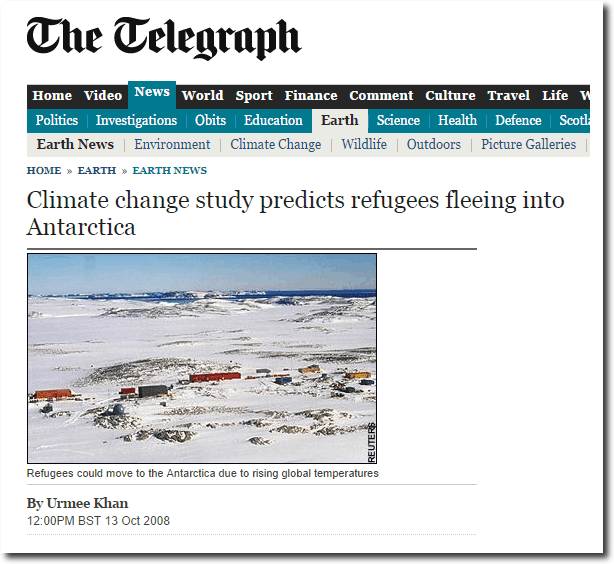
Pack Your Bags For Antarctica

Ten years ago, our top climate scientists predicted climate refugees fleeing to Antarctica – where it is currently -95F

Climate change study predicts refugees fleeing into Antarctica – Telegraph

Climate Reanalyzer

via The Deplorable Climate Science Blog

https://ift.tt/2JKARbs

June 10, 2018 at 06:13PM