via climate science
June 10, 2018 at 09:21AM
via climate science
June 10, 2018 at 09:21AM
by Judith Curry
A recent and worthy attempt to redefine the ‘front’ in the ‘climate wars’, which could lead to a truce and possibly pave the way for rational progress.
Matt Nisbet has published a provocative new paper:
A good article on this at western wire. Excerpts:
The study analyzed $556.7 million in “behind-the-scenes” grants distributed by 19 major environmental foundations from 2011-2015 in the immediate aftermath of the failure to pass cap-and-trade legislation in 2010.
Nisbet found that more than 80 percent of those funds were devoted to promoting renewable energy, communicating about and limiting climate change and opposing fossil fuels, while only two percent, or $10.5 million, was invested in technologies that would lower carbon emissions like carbon capture storage or nuclear energy. The donations themselves were also very concentrated; more than half of the money disbursed by the philanthropies was directed to 20 organizations in total.
“One of the conclusions that I think is probably the most important from the Nisbet study is that there’s not a lot of support for intellectual diversity on the climate issue, which is a shame because what the world’s doing isn’t working,” Pielke, a professor at the University of Colorado Center for Science & Technology Policy Research, told Western Wire. “So you’d think that there’d be at least some resources going into looking at new approaches, alternatives, even if they’re contingency plans.”
But according to Nisbet’s research, that is not where the vast majority of environmental grants are being applied. Funding for non-profit journalism, communications plans, and political campaigns dwarfs that of developing new technologies for carbon abatement. And yet, despite more than $150 million being invested in messaging, polls show that the push has failed to register climate change as a top-tier policy concern for Americans.
“If we’re worried about the accumulating amount of CO2 in the atmosphere, then for all the politics, for all the noise, for all the heat, it is ultimately a technology problem,” said Pielke..”
The key in doing so will be to shift the characterization of climate change from that of a political football to a question of innovation, according to Pielke.
One of the major reasons for the stagnation in climate progress can be attributed to the extreme polarization of the issue over the past few decades. Nisbet notes in his study that environmental causes began partnering with other grassroots organizations seeking “social justice-oriented solutions to climate change” and employed an “intersectional” strategy which connected the issue to other causes more aligned with the liberal ideology in order to build a larger movement. Nisbet says this strategy “likely contributed to deepening political polarization, serving as potent symbols for Republican donors and activists to rally around.”
In an absence of legislative action and failure to cultivate broad, bipartisan support for long term solutions, policy has been relegated to executive action, which can be reversed once another administration enters the White House.
“The problem is, that the climate issue has for 20 years been owned, taken over, by some of the most far-left activists, who have the leading voices on the issue,” Pielke said. “The politics inside of the climate movement such as it is, tend to favor progressively getting more extreme… if Ted Nordhaus and Michael Shellenberger and me—aren’t considered acceptable company in the climate movement – they’re never going to get to [Republican Senator from Oklahoma Jim] Inhofe.”
Ultimately, according to Pielke, there is an argument to be made on both sides of the spectrum that acting on climate change will be beneficial in the long term. Market forces can be powerful, as witnessed with the rapid adoption of shale gas once it was established as a cheaper, cleaner fuel source.
“Until the community embraces the idea that we don’t know everything about how to solve this issue, politically, technologically, policy-wise, then there is really not a lot of motivation for engaging in that difficult process of building bridges, searching for policies that might work,” Pielke said.
Cue the twitter attacks on Nisbet and Pielke Jr.(too numerous and boring to recount here).
Ted Nordhaus of The Breakthrough Institute responded with this twitter thread:
1. Going to engage this against my better judgement. The issue at bottom is not about differing theories of change, it is about how we negotiate both the uncertainties associated with climate change and differing values about how we orient toward those uncertainties.
2. The effort to remove Roger from 538 was culmination of years of effort at CAP &elsewhere to delegitimize his work &ours. Strategy was to a) conflate the green climate agenda with climate science and b) reduce the debate to a zero sum conflict between climate advocates &deniers
3. As I wrote last year, if you questioned the green agenda, you were a “delayer” and if you questioned climate castastrophism you were a “denier.” https://thebreakthrough.org/index.php/voices/ted-nordhaus/demons-under-every-rock …
4. Roger’s particular sin was questioning claims that natural disaster trends could be attributed to AGW, which undermined longstanding efforts by advocates to raise the political salience of the issue, a strategy that dates to the mid-90’s use of TV weathermen to advocate Kyoto
5. There was never any particularly compelling evidence that strategy worked. As early as 2000, research by the Frameworks Institute suggested it was more likely to backfire. But it served a range of other discursive needs so climate advocates remain deeply committed to it.
6. For similar reasons, challenging green policy orthodoxy has been treated as more than a simple policy dispute. From very early on, advocates conflated climate science with green policy formula of international treaty + regulate emissions + soft energy
7. Questioning the agenda was treated as defacto climate denial. Any alternative framing of problem or solution had to be squashed, And while it hasn’t made the politics any easier, it achieved other goals, as Matt Nisbet’s report has demonstrated.
8. The constant ad hominem, guilt by association, and misrepresentation wears you down and changes you. Without naming names, some of us handled that better than others and that is the case across the political spectrum. Being demonized in these ways often radicalizes people.
9. And it has also radicalized the climate debate. Catastrophism on the Left and know-nothingism on Right beget one another. As @atrembath and I wrote in Foreign Affairs last year, the benefits of doing so accrue primarily to opponents of action.
10. Can we put the polarization genie back in the bottle, on climate or anything else? I really don’t know. But I do wonder how those advocating further radicalization of climate advocacy imagine any of this ends.
11. Making ever more radical demands might be a fine strategy were there someone to negotiate with. But by the reckoning of most prominent climate hawks, there isn’t.
12. Nor does it appear that a more inclusive climate coalition is likely to bring larger congressional majorities. Any Democrat-only climate strategy has to be predicated on not only winning but holding purple/red districts over multiple elections.
13. These are precisely the districts that radicalized climate rhetoric alienates culturally and the green policy agenda punishes economically. Since the failure of cap and trade in 2010, climate activists have taken rhetoric to 11, and what it got them was Trump.
14. I don’t imagine I am going to convince many proponents of these strategies. But I do hope we might figure out how to have a more civil conversation about our differences.
15. In my view, that starts with how we talk about science. Is/Ought distinction matters. Climate scientists are also engaged citizens. And they bring important expert judgement that deserves consideration. But that is not the same thing as science, much less consensus science.
16. Climate activists, similarly, have every right to be alarmed about potential for catastrophic climate impacts. But that is not consensus science. There is no consensus science inconsistent with lukewarmist views. They are legitimate and should be engaged respectfully.
17. Finally, mitigation is hard not easy, and brings trade-offs for real people, not just the Koch brothers and other corporate demons. No one knows feasibility various sociotechnological pathways. More humility about solutions would serve climate mitigation efforts well. END
JC reflections: Well, there are certainly some sane voices out there. One can only hope that the extremists on both sides would stop demonizing them an actually listen to them.
via Climate Etc.
June 10, 2018 at 08:27AM
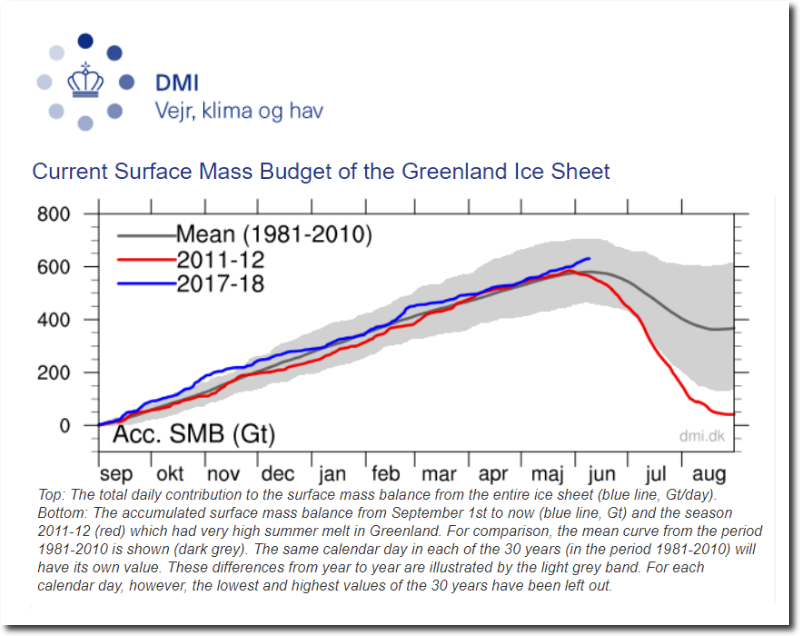
For the second year in a row, Greenland’s surface is gaining well above average amounts of ice.
Greenland Ice Sheet Surface Mass Budget: DMI
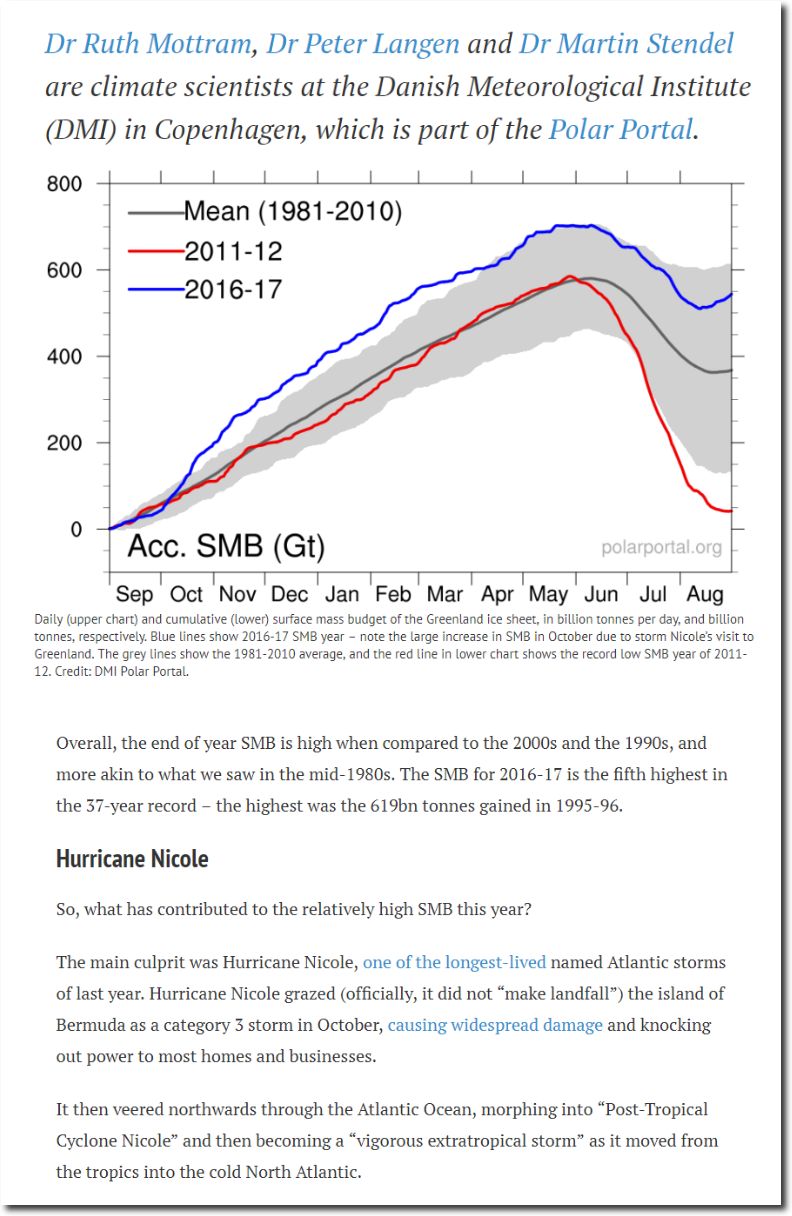
Last year, DMI tried to blame the record growth on a 2016 hurricane. What is going to be their excuse this year?
Guest post: How the Greenland ice sheet fared in 2017 | Carbon Brief
via The Deplorable Climate Science Blog
June 10, 2018 at 07:41AM
Religion comes up with an all new, improved Hell
As enlightenment over the past decades and centuries have led the masses to doubt the once colorful concept of Hell — that fire-filled place reserved for the incorrigibly unvirtuous and run by reptilian demons — spiritual leaders have seen their clout in modern society erode. No longer is it so easy for them to control people’s behavior with feelings of guilt and threats of eternal damnation.
Recently, however, spiritual leaders have uncovered a new instrument to gain back some control over the masses: climate change – the new, and this time real Hell – yes, that’s been confirmed by 97% of the climate prophets – so disbelieve at your own risk!
Holy Words
This was demonstrated not long ago by Pope Francis’s Laudato si, His second encyclical. According to Wikipedia: “In it, the Pope critiques consumerism and irresponsible development, laments environmental degradation and global warming, and calls all people of the world to take ‘swift and unified global action’.”
The new Hell certified by “leading scientists”!
In a nutshell, do as they say or perish in climate hell. Laudato si was authored in large part by the Pope of Climate Doom himself, Prof. Hans-Joachim Schellnhuber of the ultra-alarmist Potsdam Institute for Climate Impact Research (PIK).
And just earlier this week, according to the online thecourier.com here now the orthodox Christians are getting in on the act too. Once again Orthodox leaders too can let themselves stand morally above all others and preach to us on our sinful ways. And should we, the masses, not heed their Holy Science-Certified Words, then the new Hell (climate change) will ferociously engulf us as never seen before.
Hat-tip: a reader
Frustrated scientists: message “not reaching people”
According to The Courier, leading climate change experts and campaigners gathered in Greece so that they could “work with the leaders of the Orthodox Church and other religions to fight global warming”.
Apparently activists and scientists are frustrated that their message is not reaching people fast enough. The two-day conference was inaugurated by “Green Patriarch” Bartholomew.
If science fails – then move on to faith!
Of course in attendance was the former PIK director and now accepted prophet Hans-Joachim (John) Schellnhuber. He told those in attendance:
Faith can help us because we scientists have tried everything. We can’t say what’s happening in a more compelling way when we warn about the end of civilization.”
According to the Courier, “hundreds of islanders” greeted Bartholomew “upon his arrival by boat”. The conference also included “long-breaded Orthodox priests” who got around in “golf carts and horse-drawn carriages”.
Climate visionaries and dignitaries
Also in attendance was a climate adviser to the Pope: Bill McKibben of 350.org; Jane Lubchenco, former NOAA head under Obama; Patricia Espinosa, UNFCC replacement for Christiana Figueres; Christiana Figueres herself, now Mission 2020; WAPO journalist Juliet Eilperin; and Jeffrey Sachs, economist, Columbia Earth Institute and climate adviser to the Pope.
No word if they came in on row boats, or horse-drawn carriages.
via NoTricksZone
June 10, 2018 at 07:01AM