Month: June 2018

From Russia With Climate Love

Sputnik News spins climate alarmism in this current article New Climate Change Report Says We’re Screwed Even if Paris Accord Goals Met Text in italics with my bolds and titles.

A recently published study on climate change predicts catastrophic changes to the planet’s ecology, even if global temperatures rise by only 1.5 degrees Celsius, a cap on warming the Paris Climate Accord aims to secure.

Foretelling the Future

The new study, performed by an international research group and published in the journal Nature on June 7, predicts catastrophic changes to the planet even if Paris Accord emission targets are met.

According to Phys.org, many studies predict that a 2 degree increase would lead to massive climatic and ecological changes, but few have examined what would happen if the temperature rose by only 1.5 degrees instead. While this fraction of a degree might seem unimportant, it actually means a lot on a global scale, researchers say.

If today’s temperature trend continues until 2100, then many inhabited islands as well as many coastal cities will be swallowed by the sea, with the Maldives being just one example. The Paris Agreement was signed with the stated aim of preventing this catastrophe by limiting global warming to only 1.5 C.

However, the new study says that while a hard limit keeping the temperature increase fewer than 2 C would avert drastic changes, such as the Mediterranean drying up or US cities getting 5 C hotter than they are now, the exact character of the global warming curve is more important to overall climate change effects than most people understand. For example, if global temperature even briefly increases by 2 C overall but then falls back, that would also cause irreparable damage.

“The extinction of species during a phase of excess temperatures couldn’t be undone, even if the level of warming was then reduced and limited to a 1.5 C increase,” says ETH Zurich (Swiss Federal Institute of Technology) professor Sonia Seneviratne, one of the lead authors of the study.

According to Seneviratne, many existing scenarios on climate change mitigation actually allow for a temporary 2 C degree increase and also involve vast CO2-reducing measures, which include reforestation, carbon capture and storage operations (CCS). However, CCS is not yet a viable option, as humanity does not have any effective and scalable means to return carbon from the air to the ground for good. Even the much-advertised “negative emissions” power plant in Iceland is not as great in reality as it looks on paper. Besides, even in theory, CCS needs so much space to work that it’s comparable to the world’s food production operations.

Therefore, Seneviratne says, the only way to save the world now is to immediately and dramatically cut CO2 emissions.

“It’s clear that we must urgently reduce emissions if we want to stand a chance of meeting the 1.5 C goal and keeping any temperature overshoot as low as possible,” Seneviratne emphasized.

In 2015, China was the number one carbon dioxide-emitting country, with almost 30 percent of the world’s fossil fuel CO2 emissions, according to the data from the EU’s Emissions Database for Global Atmospheric Research. The US took second place, emitting almost half as much as China does, slightly below 15 percent of the world’s total. Despite all their efforts, the European Union as a whole takes proud third place with 9.6 percent, followed by India, which produces 6.8 percent of the world’s fossil fuel carbon emissions.

Unfortunately, drastic carbon emission cuts will also mean drastic changes to modern social and economic life, consequences the US has recently and notably refused to countenance by backing out of the global climate accord.


via Science Matters

https://ift.tt/2JtkGMj

June 9, 2018 at 08:32AM

Weekend Unthreaded

Weekend Unthreaded

VN:F [1.9.22_1171]

Rating: 0.0/10 (0 votes cast)

Tiny Url for this post: http://tinyurl.com/y8uthpeo

via JoNova

https://ift.tt/2HAjO6V

June 9, 2018 at 08:26AM

Record Slow Arctic Melt Continues

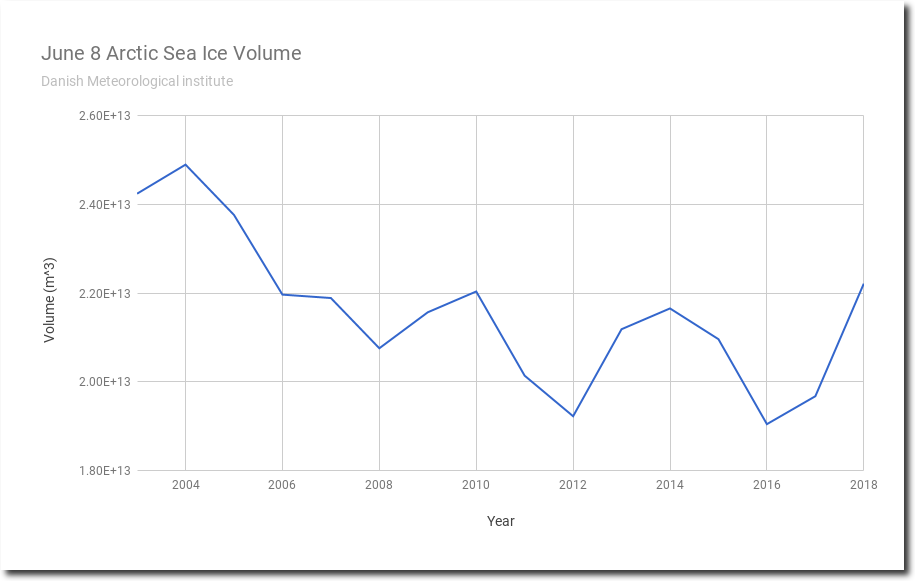
Arctic sea ice volume is highest for the date in fifteen years.

June melt so far is the slowest on record, less than half of the average since 2003, and less than a third of 2012.

Spreadsheet    Data

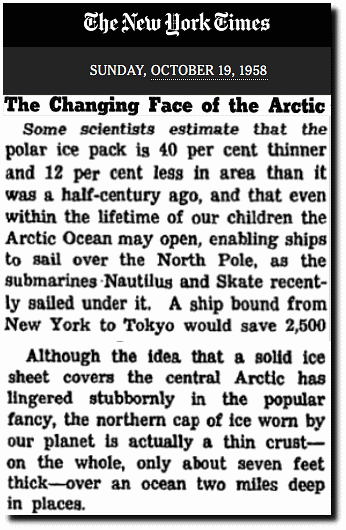
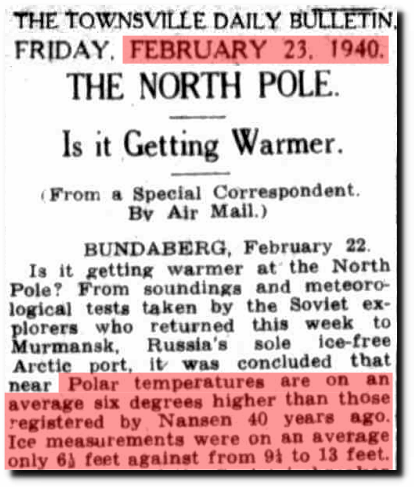
The interior of the Arctic is covered with 1.5-5 meter thick ice, generally thicker than it was 60 years ago and 80 years ago.

FullSize_CICE_combine_thick_SM_EN_20180608.png (1337×1113)

The Changing Face of the Arctic; The Changing Face of the Arctic – The New York Times

23 Feb 1940 – THE NORTH POLE

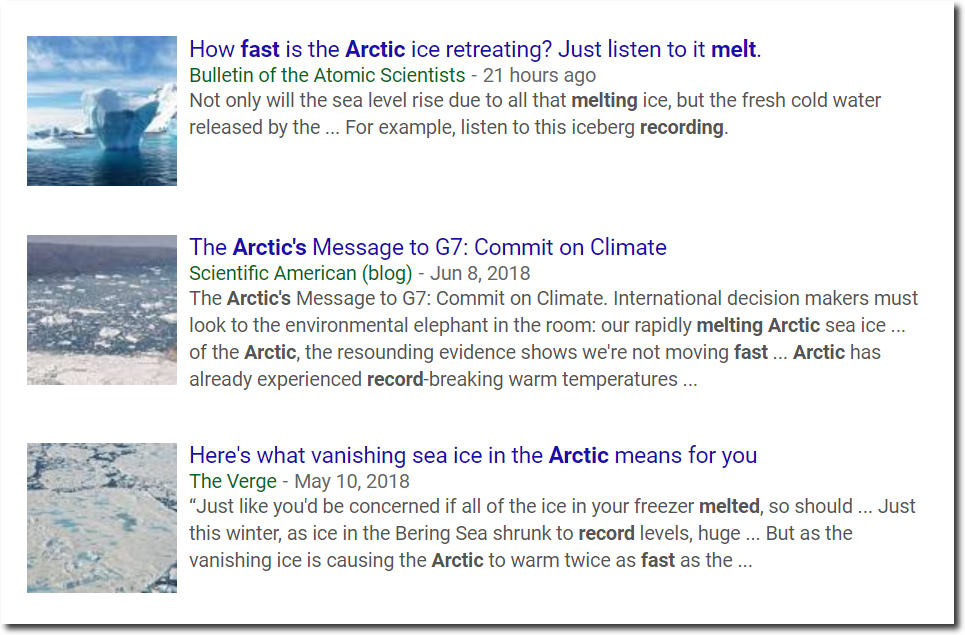
Climate scientists describe the record slow Arctic melt as “record fast” – because their funding depends on maintaining alarm about the climate.

via The Deplorable Climate Science Blog

https://ift.tt/2M9sDrQ

June 9, 2018 at 08:06AM

100-Year Russian Arctic Temperature Reconstruction Shows 1930s Just As Warm As Today!

Russian Arctic in 1920-1940 was warmer than today

By Dr. Sebastian Lüning and Prof. Fritz Vahrenholt
(German text translated/edited by P. Gosselin)

The topic today is the temperature trend in the Arctic. Of special interest are the hard facts. At Climate4You we find the satellite measured temperature development (UAH) of the Arctic:

 Figure 1: Temperature chart of the Arctic over the past 40 years (satellite measurement). Data: UAH. Chart: Climate4You

Arctic temperatures today “similar” to 1980

We do see a warming over the past 4 decades. Since the El Nino-induced peak of 2016, the temperature has fallen gradually. The coldest temperatures were recorded at the end of the 1980s and early 1990s.

At around 1980 similar temperatures as those of today were measured. Unfortunately there is no satellite data for the time before 1979, and so not even a full 60-year ocean cycle is covered, and thus this makes it really difficult to assign warming to man or to natural causes over the recent decades.

Russian Arctic just as warm in the 1930s as today!

But of course there were weather stations before 1979, and these showed a warming phase in the Arctic already in the 1930s and 1940s, a time when it was just as warm as it is today. Example: Opel et al. 2009 reconstructed the temperature history in the Russian Arctic for the last 100 years using ice cores. The warm maximum occurred in the 1930s and not today:

115 year ice-core data from Akademii Nauk ice cap, Severnaya Zemlya: high-resolution record of Eurasian Arctic climate change
From 1999 to 2001 a 724 m deep ice core was drilled on Akademii Nauk ice cap, Severnaya Zemlya, to gain high-resolution proxy data from the central Russian Arctic. Despite strong summertime meltwater percolation, this ice core provides valuable information on the regional climate and environmental history. We present data of stable water isotopes, melt-layer content and major ions from the uppermost 57 m of this core, covering the period 1883–1998. Dating was achieved by counting seasonal isotopic cycles and using reference horizons. Multi-annual δ18O values reflect Eurasian sub-Arctic and Arctic surface air-temperature variations. We found strong correlations to instrumental temperature data from some stations (e.g. r = 0.62 for Vardø, northern Norway). The δ18O values show pronounced 20th-century temperature changes, with a strong rise about 1920 and the absolute temperature maximum in the 1930s. A recent decrease in the deuterium-excess time series indicates an increasing role of the Kara Sea as a regional moisture source. From the multi-annual ion variations we deduced decreasing sea-salt aerosol trends in the 20th century, as reflected by sodium and chloride, whereas sulphate and nitrate are strongly affected by anthropogenic pollution.”

Figure 2: Temperature chart Severnaya Zemlya (Russian Arctic) over the past 130 years. Upper peaks = warm. Source: Opel et al. 2009

A part of the warming by the way, has to do with measures that keep the air clean in Europe. The anthropogenic sulfate particle kept the Arctic cool for many years, so reports that University of Stockholm (via Science Daily). Should we get back to being dirty for reasons of climate change?

European clean air policies unmask Arctic warming by greenhouse gases

[…] The drastic cut in sulfate particle emissions in Europe partly explains the amplified Arctic warming since the 1980s, shows a new study published in Nature Geoscience. The team, which consists of scientists from Stockholm University and the Norwegian Meteorological Institute, say that their surprising finding highlights an even more urgent need for reducing greenhouse gas emissions to mitigate Arctic climate change. Human activities, such as industrial production, transport, power generation, and wood burning emit large amounts of tiny pollutant particles containing, for example, soot and sulfate, into the atmosphere. High airborne amounts of these particles, also known as aerosol particles, cause about 400,000 premature deaths every year in Europe and can be transported over long distances. Aerosol particles have different sizes, as well as chemical and physical properties, all of which determine their climate effects.

“Soot particles absorb solar radiation and warm the climate, in a similar way as greenhouse gases, such as carbon dioxide, do. Sulfate particles, on the other hand, reflect solar radiation and act as seeds for cloud droplet formation, cooling the climate as a result,” says Juan Acosta Navarro, PhD student at the Department of Environmental Science and Analytical Chemistry (ACES) and the Bolin Center for Climate Research, Stockholm University, and co-author of the study. He continues: “The overall effect of aerosol particles of human origin on climate has been a cooling one during the last century, which has partially masked the warming caused by the increase in greenhouse gas emissions.” […]

J. C. Acosta Navarro, V. Varma, I. Riipinen, Ø. Seland, A. Kirkevåg, H. Struthers, T. Iversen, H.-C. Hansson, A. M. L. Ekman. Amplification of Arctic warming by past air pollution reductions in Europe. Nature Geoscience, 2016; DOI: 10.1038/ngeo2673

But also later alterations to the measurement data make the Arctic look warmer today than it actually is (see here and here). A nice summary of climate change in the Arctic can be found at Judith Curry’s site.

via NoTricksZone

https://ift.tt/2LDvh7Z

June 9, 2018 at 07:57AM