Month: June 2018

Notable & Quotable: Academic Groupthink

‘He expected everyone else in his department would sign it, so it would look really bad if he didn’t.’

From “Can Things Be Both Popular and Silenced?” by Scott Alexander at SlateStarCodex.com, May 23:

Here is a story I heard from a friend, which I will alter slightly to protect the innocent. A prestigious psychology professor signed an open letter in which psychologists condemned belief in innate sex differences. My friend knew that this professor believed such differences existed, and asked him why he signed the letter. He said that he expected everyone else in his department would sign it, so it would look really bad if he didn’t. My friend asked why he expected everyone else in his department to sign it, and he said “Probably for the same reason I did.”

Wall Street Journal, 7 June 2018

via The Global Warming Policy Forum (GWPF)

https://ift.tt/2xUeFa6

June 8, 2018 at 09:26AM

FAIL: Wealthy organizations sunk $150 million to sway U.S. climate opinion

Despite more than $150 million being invested in messaging, polls show that the push has failed to register climate change as a top-tier policy concern for Americans.

A recent study detailing how and where environmental philanthropic grants are allocated shows a lack of “intellectual diversity on the climate issue,” according leading political scientist, Roger Pielke, Jr.

The study, authored by Matthew Nisbet, Professor of Communication Studies and Affiliate Professor of Public Policy and Urban Affairs at Northeastern University, analyzed $556.7 million in “behind-the-scenes” grants distributed by 19 major environmental foundations from 2011-2015 in the immediate aftermath of the failure to pass cap-and-trade legislation in 2010.

Nisbet found that more than 80 percent of those funds were devoted to promoting renewable energy, communicating about climate change and opposing fossil fuels, while only two percent, or $10.5 million, was invested in technologies that would lower carbon emissions like carbon capture storage or nuclear energy. The donations themselves were also very concentrated; more than half of the money disbursed by the philanthropies was directed to 20 organizations in total.

Some of the more prominent recipients and grant totals cited by Nisbet include the Sierra Club receiving at least $48.9 million, National Resources Defense Council’s $14.1 million, and Environmental Defense Fund’s $13.4 million.

“One of the conclusions that I think is probably the most important from the Nisbet study is that there’s not a lot of support for intellectual diversity on the climate issue, which is a shame because what the world’s doing isn’t working,” Pielke, a professor at the University of Colorado Center for Science & Technology Policy Research, told Western Wire. “So you’d think that there’d be at least some resources going into looking at new approaches, alternatives, even if they’re contingency plans.”

But according to Nisbet’s research, that is not where the vast majority of environmental grants are being applied. Funding for non-profit journalism, communications plans, and political campaigns dwarfs that of developing new technologies for carbon abatement. And yet, despite more than $150 million being invested in messaging, polls show that the push has failed to register climate change as a top-tier policy concern for Americans.

In fact, a recent study found that millennials born between 1981 and 2000 are no more likely than previous generations to “do something” about climate change. According to Pielke, that shows a need to change the way foundations, activists and policy experts approach to the issue, which consistently ranks near the bottom of the top 20 issues surveyed.

In the years preceding the Nisbet study timeframe, major foundations like the Hewlett Foundation, Energy Foundation, and Rockefeller Brothers Fund signed on to the “Design to Win” strategy that resulted in the collective pooling of resources rather than scattered, individualized disbursements. While Pielke says creating and pursing a shared climate agenda may make sense, “That also probably helped contribute to some of the monoculture that Nisbet documents in his latest work.”

“If we’re worried about the accumulating amount of CO2 in the atmosphere, then for all the politics, for all the noise, for all the heat, it is ultimately a technology problem,” said Pielke. “To stabilize the amount of CO2 in the atmosphere the global economy has to go from being about 15 percent powered by carbon-free sources today, to well over 90 percent by the end of the century. That’s a big ask. I’ve long argued that the only way that happens is not by making fossil fuel energy so expensive, we have to go to alternatives. It’s by making alternatives so cheap that we’ll prefer them instead of fossil energy.”

The key in doing so will be to shift the characterization of climate change from that of a political football to a question of innovation, according to Pielke.

“If we’re going to make progress, we’re going to need things we don’t have now.  We’re going to need modular nuclear reactors, we’re going to need big batteries, we’re going to need the ability to capture carbon directly from the air at a reasonable price. And the only way we get those sorts of technologies is we set out to do it,” said Pielke. He noted that achieving the emissions targets delineated in the Paris Agreement is dependent on technologies that don’t yet exist.

One of the major reasons for the stagnation in climate progress can be attributed to the extreme polarization of the issue over the past few decades. Nisbet notes in his study that environmental causes began partnering with other grassroots organizations seeking “social justice-oriented solutions to climate change” and employed an “intersectional” strategy which connected the issue to other causes more aligned with the liberal ideology in order to build a larger movement.  Nisbet says this strategy “likely contributed to deepening political polarization, serving as potent symbols for Republican donors and activists to rally around.”

In an absence of legislative action and failure to cultivate broad, bipartisan support for long term solutions, policy has been relegated to executive action, which can be reversed once another administration enters the White House.

Full story here

via Watts Up With That?

https://ift.tt/2M8hFCU

June 8, 2018 at 09:03AM

The Heat Is Gone! Hurricane Expert: “Tropical Atlantic 2nd Coldest”…”Could Suppress Hurricane Activity”

Unusually cold tropical Atlantic could suppress hurricane activity this year, says Colorado State University hurricane expert Phillip Klotzbach. However cold tropical Atlantic sea surface temperatures don’t necessarily mean reduced hurricane risk.

Colorado State University (CSU) hurricane expert Phillip Klotzback at Twitter commented that the tropical Atlantic sea surface temperatures are the 2nd coldest on record and that this could mean “significantly suppress Atlantic hurricane activity.”

Cold tropical Atlantic doesn’t mean fewer hurricanes hitting US!

However history shows that it is purely speculative that cold tropical Atlantic sea surface temperatures will act to suppress hurricanes hitting the US.

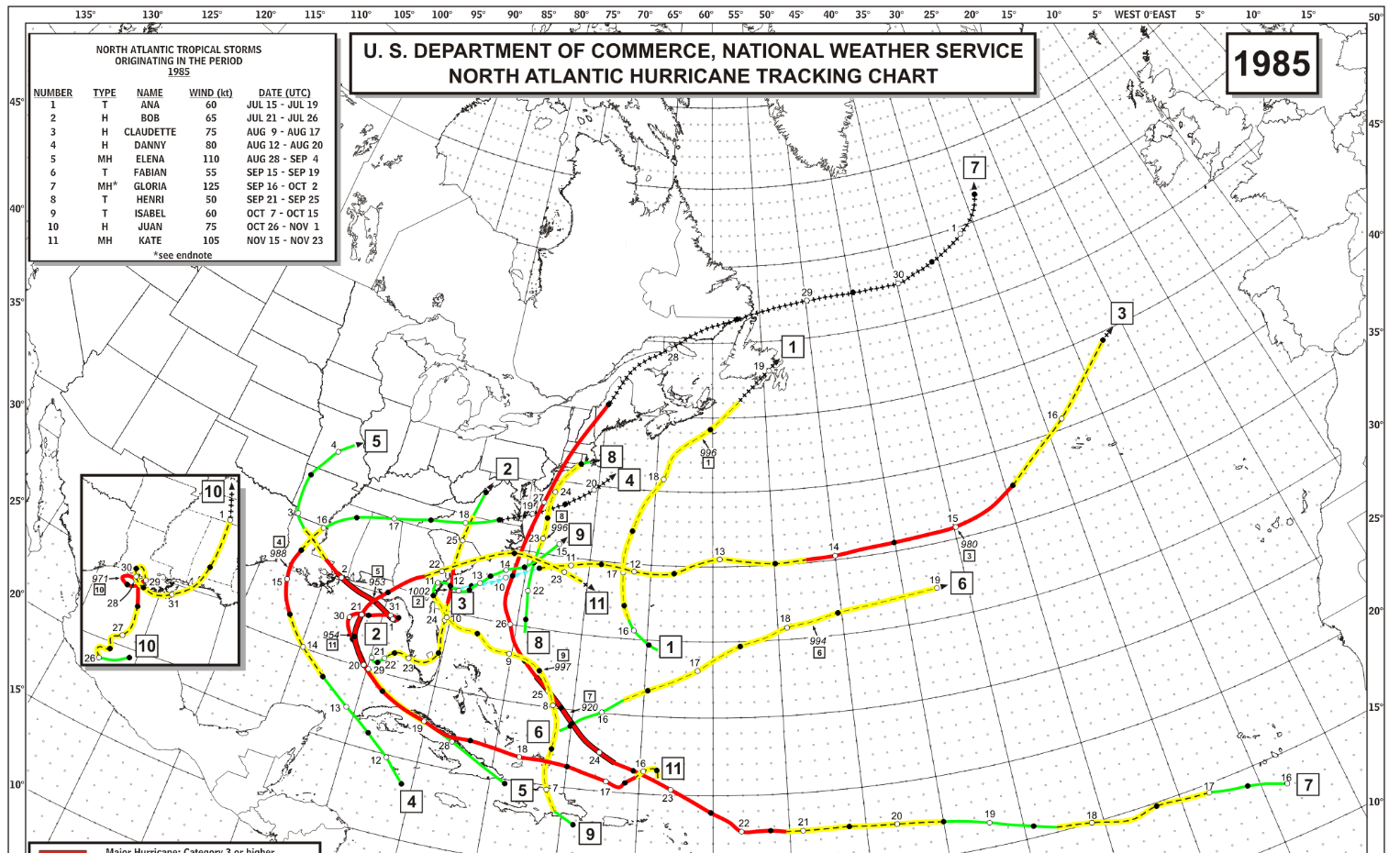
Klotzback notes that the coldest tropical sea surface temperatures seen in June were recorded in 1985, and looking at the 1985 US hurricane season Wikipedia tells us that season was in fact a rather nasty one for the entire east coast of the USA:

The 1985 Atlantic hurricane season featured eight landfalling tropical cyclones in the United States, including a record-tying six hurricanes, the most in a single year since 1916.


1985 season record “destructive and disruptive”

Wikipedia writes that “the year featured average activity overall” but was “particularly destructive and disruptive for the United States, with damage amounting to a then-record US$4 billion.”

Further, Wikipedia adds: “The entire coastline from Brownsville, Texas, to Eastport, Maine, was under a gale warning at some point during the year and a portion of every state was under a hurricane warning.

Bastardi warns of the “in-close” threat

Observing the 1985 hurricane chart, we see that the vast majority of the 11 named storms formed “in-close”, relatively near the US mainland.

Meteorologist Joe Bastardi warned in his May 26th WeatherBell Saturday Summary that warm waters near the coast needed real attention and harbored plenty of threat. In no way should people let themselves get casual about it.

So, don’t let all the cold tropical Atlantic surface water fool you into  thinking that the upcoming hurricane season is going to be on the light side for the US coast.

1985 shows us things can get pretty nasty even when the surface of the tropical Atlantic basin is cold.

===============================
Philip Klotzback is a meteorologist at CSU specializing in Atlantic basin seasonal hurricane forecasts. Avid runner, cyclist and hiker.

via NoTricksZone

https://ift.tt/2JDOIAs

June 8, 2018 at 07:53AM

Andrew Montford: Why Weather Apps Can’t Be Trusted

The Times reports this morning that Bournemouth business leaders are hugely annoyed with the BBC, whose weather app predicted thick cloud and thunderstorms for the recent bank holiday. In the event, it was sunny and warm, but the damage had already been done, and takings on the seafront were said to be down by nearly 40 percent as people decided to stay at home rather than risk a soaking.

While weather forecasting is undoubtedly getting better, it seems fairly clear that ultra-local forecasts of the kind you find on weather apps can be very misleading: reducing the whole forecast to a single icon, as most apps do, removes all the nuance. The lesson seems to be that if you are going to make a decision based on a forecast, you should watch the TV weather and get it explained to you.

However, another problem with weather apps is the ultra-local nature of the forecast, which implies a level of accuracy that weather models just can’t give. It’s easy to see that a thunderstorm is going to hit the Dorset coast, but much harder to say precisely where it’s going to cross. As we have seen, there can be a considerable price to be paid for getting it wrong.

It’s the same story over the longer term. The Met Office produces the UK’s official climate predictions, known as UKCP09, which purport to tell us what is going to happen to the UK’s climate a century hence. The standard results are given for a 25-km map grid, but you can also get results on an ultra-local scale: a 5-km grid. This is, not to put too fine a point on it, grossly misleading. It is far from clear that a computer simulation can tell us anything about the global climate in century’s time — as the eminent climatologist Roger Pielke Sr is fond of pointing out, no computer climate simulation has ever been shown to have any skill in reproducing any aspect of the climate at sub-global levels. Predictions for 5-km squares a century out into the future are therefore outright astrology.

In passing, it’s worth noting that the situation with the UKCP09 is actually even worse than that. Back in 2012, a major bug was discovered in the process that generated the predictions, entirely invalidating the output. Despite this, the Met Office has refused to withdraw them, and still cites them today as if they were entirely trustworthy.

Full post

via The Global Warming Policy Forum (GWPF)

https://ift.tt/2Ht60et

June 8, 2018 at 06:55AM