Month: June 2018

Climate Change and Fear of Change are Natural Conditions Easily Exploited Because People Don’t Understand Amount and Extent of Change

Guest opinion: Dr. Tim Ball

Richard Hooker explained,

“Change is not made without inconvenience, even when from worse to better.”

People know change occurs. They also know it always has and always will. They know that when it occurs everyone is inconvenienced as Hooker observed and some gain and some lose. They fear change because they might be in the loser group but don’t know.

The general condition and view of change in the natural world were reinforced and promoted in western science by a philosophy developed by Hutton and Playfair. The latter was a Church of Scotland minister, mathematician, and naturalist who promoted James Hutton’s work on the theory of the earth called uniformitarianism. It entered mainstream thinking because it provided a basis for Sir Charles Lyell’s thinking in his famous book, Principles of Geology. It became even more pervasive because Darwin took a Lyell’s book with him on his famous Beagle voyage. Darwin acknowledged in his journals that it along with Thomas Malthus’ essay on population together with the fossil evidence were most influential in his theory “On the Origin of Species.” The basic tenet of uniformitarianism is that change is very gradual over long periods of time. It replaced the biblical view of Neptunism that events were either pre- or post-Noah’s flood.

Darwin’s theory was never tested, as normally occurs in the scientific method. His theory of evolution was used by the scientific establishment of the time to defeat religion. Unfortunately, this painted science into a corner. It meant that if anybody challenged Darwin, they were automatically branded as creationists. An example of the level of scientific elitism in existence at the time was the shunning of probably one of the greatest scientists of all time. However, don’t take my word for it he was one of three, along with Newton and Maxwell, scientific heroes of Einstein. He had pictures of all three on his office wall. Faraday’s sins were that he did not have a university education and he belonged to a very strict fundamental religious group called the Sandemanians.

The general theme of the challenges to Darwin, who was aware as anyone of the limitations of his ideas, is that natural selection is a well-observed phenomenon. The problem comes in the evolution portion where there is no evidence to support the increasing evolutionary tree of speciation (Figure1).

clip_image002clip_image002

Figure 1

Two good books on the subject are Michael Denton’s, “Evolution: A Theory in Crisis,” and a second volume, “Evolution: Still a theory in Crisis.”

The failure to test Darwin’s theory is important, but of little consequence to most people. This is like some 40% of the European and American public still think the Sun goes around the Earth even though Copernicus showed it was the opposite 475 years ago. It doesn’t matter to most people. As long as the Sun rises and sets, everything is fine. It changed and became personal with implications for everybody when Darwin said we were animals and just another species of apes.

Another hypothesis with profound implications for everyone evolved in the 1960s and is generally known as anthropogenic global warming (AGW). Like Darwin’s work, it evaded the scientific method. It was never tested and became prey, ironically because he avidly supported Darwin, in Thomas Huxley’s observation 120 years ago

that,

The great tragedy of Science – the slaying of a beautiful hypothesis by an ugly fact.”


An ugly fact appeared after 1998 that dealt a mortal blow to the beautiful AGW hypothesis. It was a beautiful hypothesis because it appeared to confirm the central thesis of the new paradigm of environmentalism that humans were a cancer on the planet. This ludicrous notion, which ignores humans as the most successful animal on the planet from a Darwinian perspective, even received credibility from supposedly thoughtful people. The AGW hypothesis assumed that an increase in CO2 would cause an increase in temperature. After 1998, the CO2 continued to increase, but temperature levelled. Promoters tried to ignore what was going on, but that caught the eye of those humorous cynics, the cartoonists (Figure 2).

clip_image004clip_image004

Figure 2

The people controlling the AGW deception were aware of what was happening. Emails from 2004 leaked from the University of East Anglia revealed the concern. Nick at the Minns/Tyndall Centre that handled publicity for the climate story said,

“In my experience, global warming freezing is already a bit of a public relations problem with the media.”

Swedish climate expert on the IPCC Bo Kjellen replied,

“I agree with Nick that climate change might be a better labelling than global warming.”

Many people noticed the change but didn’t understand the implications. It was still about global warming because CO2 had to remain the demon, but now change became the operative and important word. Promoters of the AGW scoured the world and filled the media with stories of change. The problem is they are all natural and well within natural variability. It resonated because the people listened with uniformitarian ears and minds. Supposedly educated people made innocuous statements sound menacing. Consider this comment from biologist Daniel Inouye and labelled an “accidental climate scientist” shows he doesn’t understand. The problems are most climate scientists are accidental, dealing with one small piece of a complex puzzle.

“These days, plants and animals are arriving at Rocky Mountain Biological Lab a week or two earlier than they were 30 years ago. The robins that used to arrive in early April now show up in mid-March. Marmots end their winter slumber ever earlier.”

Consider this 1772 quote from biologist, fur trader, and arctic explorer Samuel Hearne. His research and description of Arctic Fox and their behavior is still considered by many as the best. How does Inouye explain such significant change, cooling in this case, before AGW could have occurred?

“I have observed, during my several journeys in those parts that all the way to the North of Seal River the edge of the wood is faced with old withered stumps, and trees which have been flown (sic) down by the wind. They are mostly of the sort which is called here Juniper, but were seldom of any considerable size. Those blasted trees are found in some parts to extend to the distance of twenty miles from the living woods, and detached patches of them are further off; which is proof that the cold has been increasing in those parts for some ages. Indeed, some of the older Northern Indians have assured me that they have heard their fathers and grandfathers say, they remembered the greatest part of those places where the trees are now blasted and dead, in a flourishing state.

Hearne knew the context of this. The tree line advanced during the warmth of the Medieval Warm Period (MWP) then retreated in the cooling to the nadir of the Little Ice Age (LIA). This is what Hearne describes with his comment that this is “proof that the cold has been increasing in those parts for some ages.”

It is just 180 years since Louis Agassiz suggested the Earth experiences Ice Ages. It is so recent that most, even scientists, don’t realize that there were four phases in the recent Ice Age and that there have been possibly nine previous ice ages approximately every 250 million years. Most can’t imagine that just 20,000 years ago over half of North America was covered with an ice sheet larger in area than the current Antarctic ice sheet. Even more remarkable sea level was at least 130 meters lower than today (Figure 3). Amazingly, most of the ice melted in approximately 8000 years and sea level recovered in that same period.

clip_image006clip_image006

Figure 3

As climate change became the new target of the deception, many of us pushed back. When it was called global warming, those who challenged, were designated, skeptics. With the shift to climate change, they became deniers. The problem was that most, like me, spent their careers explaining to people how much climate changed all the time naturally. There was pushback because people noticed the change of name and knew climate changes, but they didn’t know how much and assumed it was small because of uniformitarianism.

The response of AGW supporters was to claim the change was more rapid than ever before. They argued that it was outside the natural rate, but it wasn’t. Most of the public didn’t know that because they are not even aware of how rapidly society changes.

It is just 85 years since Hitler came to power. How much has happened since then? World War II, the Korean Conflict, the Vietnam War, the Internet, people on the moon, Satellites, Cell phones, collapse of communism, Jet airplanes, nuclear power, and you can add your own choice to the list. Who predicted any of it? Maybe somebody mentioned the possibility of one or two, but they are usually a result of randomness. The response to such an argument by AGW alarmists is that this is proof of it being a recent phenomenon.

A broad response is in English historian Arnold Toynbee’s observation that history is just one damn thing after another. I also urge you to read the diaries of Samuel Pepys (1633-1703). He began a diary in 1660 and kept it for almost ten years. It is a remarkable read and illustrates how much society changes all the time. For example, he watched Charles I executed and the monarchy replaced by a Republican government under Oliver Cromwell. Pepys’ served in that government and is primarily responsible for the development of the Royal Navy that became the vehicle of global power for the British Empire. Because of his position, he was on the Navy ship that brought Charles II back to England to restore the monarchy. Imagine in your working lifetime going from a monarchy to a republic and back to a monarchy. Fortunately, he only spent a short time in the Tower of London, but that was more because of suspicions he had Catholic leanings.

It is a cliché to say change is the norm, but what people don’t understand is how quickly and dramatically it occurs. That natural pattern is what made people innately afraid of change. People supporting AGW exploit that fear, but they also exploit it by using natural events and claiming they are unnatural and occurring faster than ever before.

via Watts Up With That?

https://ift.tt/2KiK8o5

June 25, 2018 at 05:07PM

“Welcome back, Winter,” Sicily

Snow on Mt Etna – Temperatures typical of January in Catania

“Welcome back, Winter!” says Italian website.

Cold and bad weather. In Sicily winter seems to be back: snow on Etna and temperatures typical of January in Catania where it rains without a break.

This morning (June 25) in most of Italy and especially in the extreme South it seems even back Winter! But it is cold all over the country, in the internal areas of the Apennines we recorded low temperatures worthy of the month of March, just + 8 ° C in Potenza, + 9 ° C in L’Aquila.

And in the city of Etna it is very cold: + 16 ° C at dawn and the mercury  does not exceed + 17 ° C in mid day, as if we were in the middle of winter.

See many photos:
http://www.meteoweb.eu/foto/maltempo-freddo-neve-sicilia-catania-etna/id/1114092/#1

Thanks to Dr Mirco Poletto for this link

The post “Welcome back, Winter,” Sicily appeared first on Ice Age Now.

via Ice Age Now

https://ift.tt/2MZGSjh

June 25, 2018 at 04:05PM

Worse than they thought: Antarctica actually colder than scientists once believed

From the AGU and the “but, but, the continent is melting!” department.

COLDEST PLACE ON EARTH IS COLDER THAN SCIENTISTS THOUGHT

WASHINGTON — Tiny valleys near the top of Antarctica’s ice sheet reach temperatures of nearly minus 100 degrees Celsius (minus 148 degrees Fahrenheit) in the winter, a new study finds. The results could change scientists’ understanding of just how low temperatures can get at Earth’s surface, according to the researchers.

Scientists announced in 2013 they had found the lowest temperatures on Earth’s surface: Sensors on several Earth-observing satellites measured temperatures of minus 93 degrees Celsius (minus 135 degrees Fahrenheit) in several spots on the East Antarctic Plateau, a high snowy plateau in central Antarctica that encompasses the South Pole. But the researchers revised that initial study with new data and found the temperatures actually reach minus 98 degrees Celsius (minus 144 degrees Fahrenheit) during the southern polar night, mostly during July and August.

When the researchers first announced they had found the coldest temperatures on Earth five years ago, they determined that persistent clear skies and light winds are required for temperatures to dip this low. But the new study adds a twist to the story: Not only are clear skies necessary, but the air must also be extremely dry, because water vapor traps some heat in the air.

The researchers observed the ultra-low temperatures in small dips or hollows in the Antarctic Ice Sheet.  The super cold, super dry air is denser than the slightly warmer air around it, so it falls into the hollows and becomes trapped. This allows the snow surface and the air above it to cool further, until the clear, calm, dry conditions change and the cold air mixes with warmer air higher in the atmosphere.

“In this area, we see periods of incredibly dry air, and this allows the heat from the surface of the snow to radiate into space more easily,” said Ted Scambos, a senior research scientist at the National Snow and Ice Data Center at the University of Colorado-Boulder and lead author of the new study in Geophysical Research Letters, a journal of the American Geophysical Union.

The record of minus 98 degrees Celsius is about as cold as it is possible to get at Earth’s surface, according to the researchers. For the temperature to drop that low, clear skies and dry air need to persist for several days. Temperatures could drop a little lower if the conditions lasted for several weeks, but that’s extremely unlikely to happen, Scambos said.

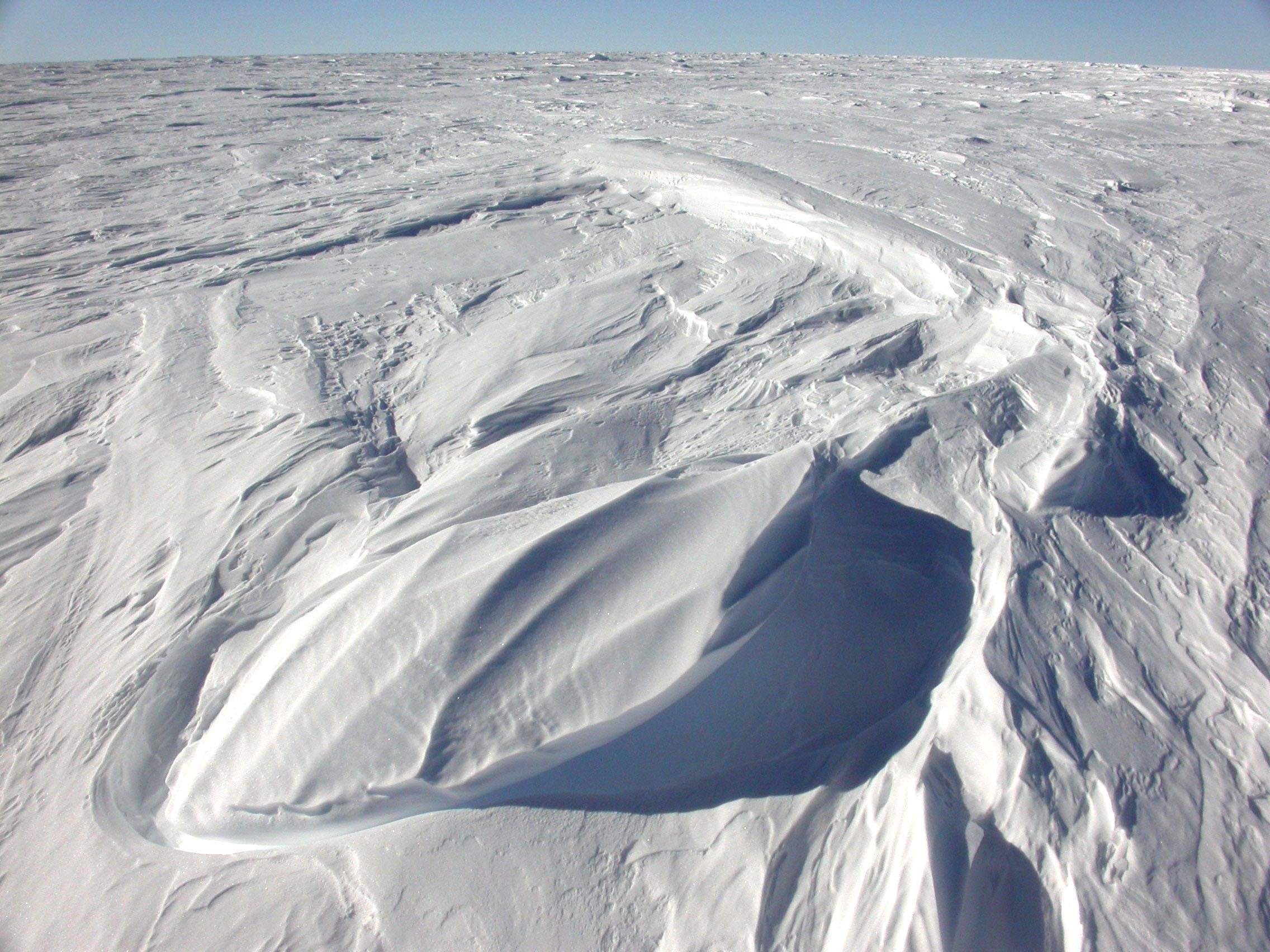
Blowing snow conditions at a camp site near Vostok Station in Antarctic summer.
Credit: Ted Scambos, NSIDC/University of Colorado-Boulder.

Finding the coldest place

The high elevation of the East Antarctic Plateau and its proximity to the South Pole give it the coldest climate of any region on Earth. The lowest air temperature ever measured by a weather station, minus 89 degrees Celsius (minus 128 degrees Fahrenheit), was recorded there at Russia’s Vostok Station in July 1983.

But weather stations can’t measure temperatures everywhere. So in 2013, Scambos and his colleagues decided to analyze data from several Earth-observing satellites to see if they could find temperatures on the plateau even lower than those recorded at Vostok.

In the new study, they analyzed satellite data collected during the Southern Hemisphere’s winter between 2004 and 2016. They used data from the MODIS instrument aboard NASA’s Terra and Aqua satellites as well as data from instruments on NOAA’s Polar Operational Environmental Satellites.

The researchers initially saw a broad region of the plateau more than 3,500 meters (11,000 feet) above sea level where temperatures regularly dropped below minus 90 degrees Celsius (minus 130 degrees Fahrenheit) at the snow surface. The lowest temperature they observed was minus 93 degrees Celsius (minus 135 degrees Fahrenheit).

Data from the MODIS instruments is calibrated using temperature measurements from weather stations on the ground. In 2016, NASA recalibrated the MODIS data with more up-to-date weather station measurements, and the researchers reanalyzed the temperature data. The weather conditions on the plateau did not change, but the adjusted satellite data gave the researchers a more accurate picture of what the actual lowest temperature was.

They found the record low was about 5 degrees Celsius (9 degrees Fahrenheit) colder than they originally reported, about minus 98 degrees Celsius (minus 144 degrees Fahrenheit).

Persistent winds shape the surface of East Antarctica’s snow into small dune forms called ‘sastrugi’.
Credit: Ted Scambos, NSIDC/University of Colorado-Boulder.

How cold can it get?

Scambos and his colleagues analyzed the terrain where they saw these ultra-low temperatures and found they occurred in small hollows 2 to 3 meters (6 to 9 feet) deep in the surface of the ice, on the southern side of high ridges on the plateau.

Interestingly, the researchers noticed a whole cluster of places where temperatures plunged almost exactly to that record low over the 14-year period, even though they were located hundreds of kilometers apart. That got them wondering: Is there a limit to how cold it can get on the plateau?

For the temperature to drop to that record low, skies must be clear and the air must be bone-dry for several days. After the temperature drops below a certain point, the air cools so slowly that it can’t get perceptibly colder before the weather conditions change, according to the researchers. Minus 98 degrees Celsius, then, appears to be the limit to how cold it can get at Earth’s surface, Scambos said.

“There’s a limit to how long the conditions persist to allow it to cool to these ultra-low temperatures, and a limit to how much heat you can actually get through the atmosphere, because water vapor has to be almost nonexistent in order to emit heat from the surface at these temperatures,” he said.

The research team has developed a set of instruments designed to survive and operate at the very coldest places throughout the winter to measure both snow and air temperatures. They are planning to deploy the instruments within the next two years.

###


via Watts Up With That?

https://ift.tt/2tu5etv

June 25, 2018 at 02:38PM

Stacking Up Volcanoes


Guest Post by Willis Eschenbach

As readers of my posts know, I’ve held for many years that there are a variety of emergent phenomena that regulate the earth’s temperature. See my posts The Thermostat Hypothesis and Emergent Climate Phenomena for an overview of my hypothesis.

One of the predictions derivable from my hypothesis is that the earth should be relatively insensitive to small changes in forcing. According to my hypothesis, if the total energy entering the system changes in such a manner that the global temperatures start to drop, inter alia the system responds through changes in the time and strength of the daily emergence of the tropical cumulus field and the associated thunderstorms. This allows more sunlight to enter the system and decreases the thunderstorm-caused surface heat losses, balancing out the energy lost elsewhere and maintaining the temperature.

In this regard, I got to thinking about the Berkeley Earth Land Temperature dataset. It is the longest observational global temperature dataset, stretching back to 1750. This gives me the opportunity to test my hypothesis against the volcanic eruptions that have occurred since 1750.

Now, the general belief is that volcanic eruptions cool the globe … but me, I don’t believe much of anything until I run the numbers myself. And I’ve run the numbers on the eruptions a number of times. I list my previous posts on the subject in the endnotes. But I’ve never looked at the Berkeley Earth record, so let me do that. Remember, if my hypothesis is correct, the volcanic eruptions should not cause a noticeable drop in the temperature.

Let me start with the Berkeley Earth land temperatures. Here is that dataset, along with a Gaussian average to show the underlying variations.

berkeley earth global land temps plus eruptions.png

berkeley earth global land temps plus eruptions.png

Figure 1. Berkeley Earth global average land temperature (gray lines) and 10-month full width at half maximum (FWHM) Gaussian average (black line). Vertical lines show the 24 largest eruptions, those with a Volcanic Eruptive Index (VEI) of 5 or above. Heavy dark lines show the six largest eruptions, those with a VEI of 6 or 7.

Now, to get the average response to an eruption, what we need to do is to “stack” the eruptions. This means that for each eruption, we look at say the three years before and the three years after the eruption. We stack up this data and average it to find out the average change from before the eruptions to after the eruptions. Figure 2 shows that result for the 24 largest eruptions since 1750. I’ve used the Gaussian average shown in Figure 1 to reduce the amount of noise in the data.

berkeley earth 24 largest eruptions stack.png

berkeley earth 24 largest eruptions stack.png

Figure 2. Stacked 24 largest eruptions since 1750. The black and yellow line shows the average of all 24 eruptions. All values are 10-month FWHM Gaussian averages.

As you can see, the prediction from my hypothesis is completely verified. On average there is no global temperature response to the 24 largest eruptions.

But wait, I hear you thinking, maybe it’s only the biggest ones that cause such a response. So I looked at the six largest eruptions shown in Figure 1 above, those with a volcanic explosivity index (VEI) of 6 or larger. Figure 3 shows that result.

berkeley earth 6 largest eruptions stack.png

berkeley earth 6 largest eruptions stack.png

Figure 3. Stacked 6 largest eruptions since 1750. The black and yellow line shows the average of all 24 eruptions. The blue line shows the only VEI 7 eruption in the group, Tambora in 1811.

Once again, the prediction from my hypothesis is confirmed. Even the largest six eruptions since 1750 do not result in any measurable global cooling.

The largest eruption, the VEI 7 eruption of Tambora in 1811 (blue line) is widely believed to be responsible for something called a “year without a summer” … but there is no sign of that in the Berkeley Earth dataset. I discussed this in a post called Missing the Missing Summer.

Conclusions?

Well, I’d say that this is very strong evidence that the global temperature is not at the mercy of changes in forcing as is generally believed. Volcanic eruptions clearly and measurably reduce the incoming sunlight due to volcanic aerosols both reflecting and absorbing solar energy.

However, this does not cause a corresponding reduction in global average temperature. Instead, the climate system responds to reductions in forcing from eruptions by increasing the amount of energy entering the system, as well as by reducing the heat loss from the surface, in order to stabilize and maintain the surface temperature within a fairly narrow range (e.g. ± 0.3°C over the 20th century).


It’s a foggy morning here on the California coast. Two days ago it was blazing hot both here and in the California Central Valley, 108°F (42°C) in Sacramento. When that happens, the hot air rises, drawing the “marine layer” of cool air in off of the Pacific and causing today’s cool foggy weather at our house … the system responds to moderate the changes.

Best of sunshine, fog, weather, and climate to everyone,

w.

NOTE 1: When you comment quote the exact words you are referring to, so we can all understand your precise subject.

NOTE 2: Data Sources. The Berkeley Earth data is here. The volcanic eruption data is from the Smithsonian. Enjoy.

NOTE 3: Some of my previous posts on volcanoes:

Volcanoes: Active, Inactive, and Retroactive 2013-05-22

Anthony put up a post titled “Why the new Otto et al climate sensitivity paper is important – it’s a sea change for some IPCC authors” The paper in question is “Energy budget constraints on climate response” (free registration required), supplementary online information (SOI) here, by Otto et alia, sixteen…

The Eruption Over the IPCC AR5 2013-09-22

In the leaked version of the upcoming United Nations Intergovernmental Panel on Climate Change (UN IPCC) Fifth Assessment Report (AR5) Chapter 1, we find the following claims regarding volcanoes. The forcing from stratospheric volcanic aerosols can have a large impact on the climate for some years after volcanic eruptions. Several…

Overshoot and Undershoot 2010-11-29

Today I thought I’d discuss my research into what is put forward as one of the key pieces of evidence that GCMs (global climate models) are able to accurately reproduce the climate. This is the claim that the GCMs are able to reproduce the effects of volcanoes on the climate.…

Eruptions and Ocean Heat Content 2014-04-06

I was out trolling for science the other day at the AGW Observer site. It’s a great place, they list lots and lots of science including the good, the bad, and the ugly, like for example all the references from the UN IPCC AR5. The beauty part is that the…

Prediction is hard, especially of the future. 2010-12-29

[UPDATE]: I have added a discussion of the size of the model error at the end of this post. Over at Judith Curry’s climate blog, the NASA climate scientist Dr. Andrew Lacis has been providing some comments. He was asked: Please provide 5- 10 recent ‘proof points’ which you would…

Volcanoes Erupt Again 2014-02-24

I see that Susan Solomon and her climate police have rounded up the usual suspects, which in this case are volcanic eruptions, in their desperation to explain the so-called “pause” in global warming that’s stretching towards two decades now. Their problem is that for a long while the climate alarmists…

Volcanic Disruptions 2012-03-16

The claim is often made that volcanoes support the theory that forcing rules temperature. The aerosols from the eruptions are injected into the stratosphere. This reflects additional sunlight, and cuts the amount of sunshine that strikes the surface. As a result of this reduction in forcing, the biggest volcanic eruptions…

Dronning Maud Meets the Little Ice Age 2012-04-13

I have to learn to keep my blood pressure down … this new paper, “Abrupt onset of the Little Ice Age triggered by volcanism and sustained by sea-ice/ocean feedbacks“, hereinafter M2012, has me shaking my head. It has gotten favorable reports in the scientific blogs … I don’t see it at…

New Data, Old Claims About Volcanoes 2012-07-30

Richard Muller and the good folks over at the Berkeley Earth Surface Temperature (BEST) project have released their temperature analysis back to 1750, and are making their usual unsupportable claims. I don’t mean his risible statements that the temperature changes are due to CO2 because the curves look alike—that joke has…

Volcanic Corroboration 2012-09-10

Back in 2010, I wrote a post called “Prediction is hard, especially of the future“. It turned out to be the first of a series of posts that I ended up writing on the inability of climate models to successfully replicate the effects of volcanoes. It was an investigation occasioned…

Volcanoes and Drought In Asia 2014-08-09

There’s a recent study in AGU Atmospheres entitled “Proxy evidence for China’s monsoon precipitation response to volcanic aerosols over the past seven centuries”, by Zhou et al, paywalled here. The study was highlighted by Anthony here. It makes the claim that volcanic eruptions cause droughts in China. Is this possible?…

via Watts Up With That?

https://ift.tt/2MkP4ts

June 25, 2018 at 02:16PM