This message from the Eagles goes out to all those social justice warriors on campus.
Jordan Peterson: “So the first thing that you might want to know about Postmodernism is that it doesn’t have a shred of gratitude — and there’s something pathologically wrong with a person that doesn’t have any gratitude, especially when they live in what so far is the best of all possible worlds. So if you’re not grateful, you’re driven by resentment, and resentment is the worst emotion that you can possibly experience, apart from arrogance. Arrogance, resentment, and deceit. There is an evil triad for you.”
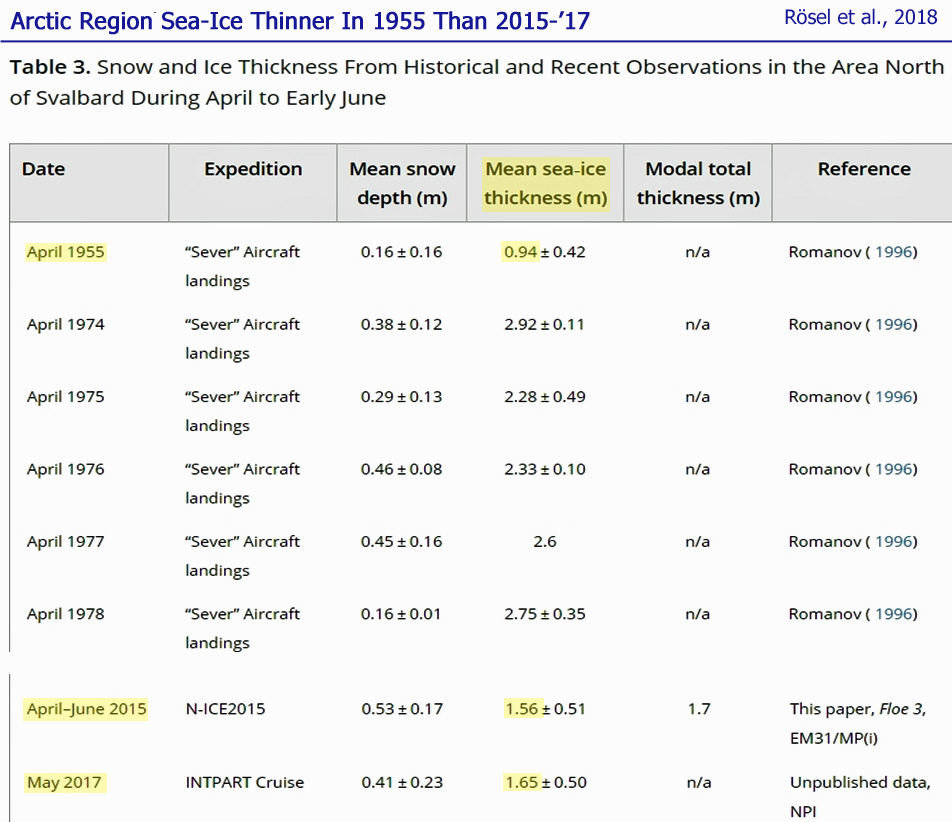
According to a new paper published in the Journal of Geophysical Research, the observed mean thickness of the sea ice in the region north of (Arctic) Svalbard was substantially thinner (0.94 m) in 1955 than it has been in recent years (~1.6 m, 2015/2017).
In 1955, the atmospheric CO2 concentration hovered around 315 ppm, about 90 ppm lower than today’s CO2 values.
It is widely assumed that the steep and substantial rise in CO2 concentration since the 1950s is largely responsible for warming the Arctic, and consequently the decline in the Arctic’s sea ice volume and extent (IPCC, 2013). This assumption is significantly predicated on the observation that sea ice has undergone precipitous losses since the 1970s, which is when the satellite era began.
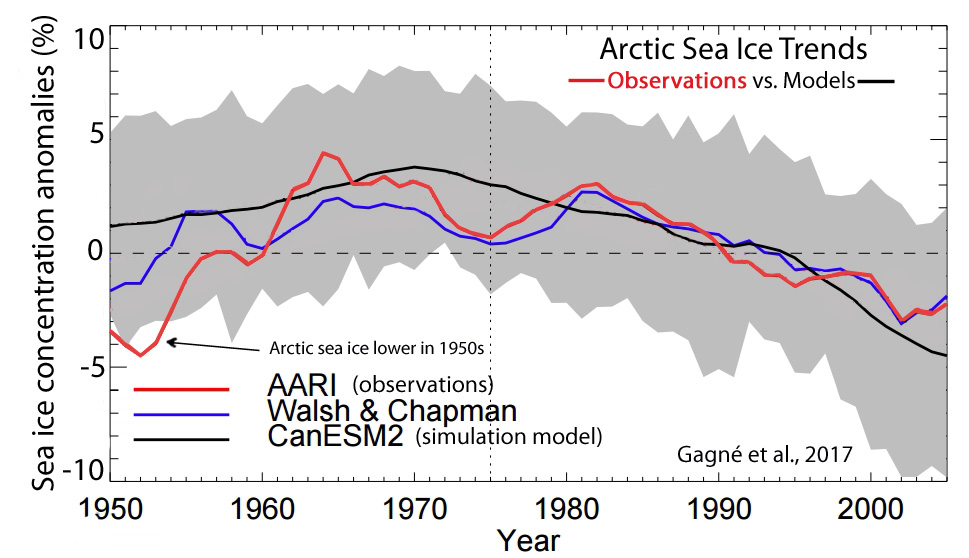
However, longer-term observational data do not appear to support the conclusion that Arctic region sea ice is driven by linear trends in atmospheric CO2 concentration. Indeed, there is evidence that Arctic sea ice extent was comparable or lower than now in the 1940s and 1950s (for example, see this annotated graph from Gagné et al., 2017). Several other recently published papers also fail to support a CO2 – Arctic climate connection, as detailed in several articles found here at NoTricksZone during 2018.
Regional Arctic sea ice was thicker than now in the 1950s?
In another newly published paper, observations from an Arctic region north of Svalbard affirm that sea ice thicknesses were indeed much higher than today during the 1970s, or when the linearly-decreasing sea ice trend documented by satellites (conveniently) commenced.
However, looking closely at Table 3 (shown in the introductory graph above) from the same paper, we see that sea ice thickness values may have been lower in the mid-1950s (0.94 m) than they are today (~1.6 m thicknesses on average).
If sea ice was was thinner than it is now during the same period of time that CO2 concentrations were substantially lower than they are now, this documented observational evidence appears to again undermine the conclusion that CO2 concentration rises are significantly connected to sea ice losses – or to the Arctic climate in general.
Freeboard Observed During N‐ICE 2015 North of Svalbard
“We present a continuous time series of in situ measurements from the N‐ICE2015 expedition from January to June 2015 in the Arctic Basin north of Svalbard, comprising snow buoy and ice mass balance buoy data and local and regional data gained from electromagnetic induction (EM) surveys and snow probe measurements from four distinct drifts.
“The observed mean snow depth of 0.53 m for April to early June [2015] is 73% above the average value of 0.30 m from historical [1955, 1970s] and recent observations in this region, covering the years 1955–2017.”
“The modal total ice and snow thicknesses, of1.6 and 1.7 m [2015] measured with ground‐based EM and airborne EM measurements in April, May, and June 2015, respectively, lie below the [1970s] values ranging from 1.8 to 2.7 m, reported in historical observations from the same region and time of year [but well above the sea-ice thickness values of0.94 m for 1955].”
Guest salivating by David Middleton, petroleum geologist
From Forbes…
JUN 17, 2018
What If India And China Used Natural Gas And Oil Like The U.S.?
Jude Clemente , CONTRIBUTOR
BP’s just releasedStatistical Review of World Energy 2018 has got my wheels turning. The first thing you should know is that global energy consumption has essentially just begun: around 85% of the global population – 6 in every 7 humans – still lives in developing nations. They don’t live in rich cities, like San Francisco, Toronto, New York City, Los Angeles, London, or Tokyo; they live in poorer ones, like Mumbai, Lagos, Jakarta, Guangzhou, Calcutta, and Karachi. This is where the future energy action is man: at least 90% of future demand will be in nations that are currently not developed. We rich, “all the energy that we want at our fingertips” Westerners still aren’t grasping a sad and cold reality: most of the world is poor and energy deprived.
Given that economic growth, especially in the still developing nations where energy demand structures are still immature, is directly tied to more energy usage. So, this has got me thinking about the future energy demands of the world, which of course naturally focuses on the most most critical giants, India and China. These two coal-based titans have really just started to consume natural gas and oil. For the first graphic, don’t forget that “wealth is health.”
[…]
Natural gas and oil supply 60- 65% of the energy used in the world’s richest nations. India and China have 37% of the world’s population but consume just 9% of the world’s natural gas and 17% of the oil. So it becomes very apparent: latent gas and oil demand in India and China is immense.
So now the punch line. How much natural gas and oil will the future world need? Surely a lot more, but what if Indians and Chinese were to consume natural gas and oil like we rich Americans do? International energy markets would quake. Even using half of what we use would cause the gas and oil markets to explode.
The final graphic demonstrates why U.S. oil and gas exporters, as well as the others in the world, are salivating at the opportunity that lies ahead.
[…]
[…]
When considering how even in rich, developed Europe, where incremental demand was tiny, the Kyoto protocol to drastically curtail fossil fuel use and greenhouse gas emissions was a complete failure, and then considering the huge incremental energy needs of the poor countries that signed the latest climate agreement back in December 2015, is it any wonder: “The global Paris climate failure.”
After how rich, healthy, and long living, India and China have watched us oil and gas devouring Westerners become, can you really blame them for wanting to use more? But, somebody else summed up my “hey you can’t use the energy that I use” frustration much better. The headline of the decade: “Should climate scientists fly?”
If Red China and India used oil & natural gas like Americans, we’d know pretty quickly how close the world is to Peak Oil and Peak Natural Gas.
The solid green line raises Red China and India crude oil consumption to current US levels while holding all other nations at 2017 levels. The dashed green line drops UK, France and Germany oil consumption to zero-point-zero in 2040. The solid red line raises Red China and India natural gas consumption in BOE to current US levels while holding all other nations at 2017 levels. Historical data from BP 2018 Statistical Review of World Energy.
It’s nice to dream big! Note what a huge difference it would make if the UK, France and Germany kicked to oil habit (of course that was a sarcastic remark, that’s why I made it.)
What’s more likely by 2040? A 150% increase in crude oil and 177% increase in natural gas production or a 2,898% increase in lithium, 1,928% increase in cobalt, 655% increase in rare earths and a 524% increase in graphite production?
Last week I had the privilege of being invited to present a talk at a small conference of world experts in a variety of disciplines.
The venue was spectacular, on the French Riviera, and we had an entire late-1800’s hotel to ourselves, right on the Mediterranean. For me, it was a once-in-a-lifetime experience. I had the feeling that the organizers wanted the event to have a low profile, and so I won’t mention names.
I had about 12 minutes to lay out the case for climate skepticism. My talk was generally well-received and led to many follow-up discussions over the following days.
One of the attendees was an elderly particle physicist who was also a Nobel Prize winner. During Q&A, he mentioned how he had been teaching a climate class at his university for several years, and that he thought my skepticism was unwarranted.
He was convinced that the Antarctic ice sheet was headed for collapse and we would have to deal with a 30 m rise in sea level as a result.
What was more than a little disturbing was that he openly declared that climate policy would not be able to move forward like it needs to until old skeptics like me die out.
Part of my talk was about the fact that credentialed and published skeptical climate researchers are indeed slowly dying out, with an average age of around 70 now, and that governmental bias in climate funding will basically kill off skeptical research if things don’t change.
I approached him afterward and politely said I didn’t think either one of us was going to change our minds and hoped we could just enjoy the nice dinner that was planned for us. He politely smiled and agreed to that.
I guess what was interesting to me is that the “belief” (his word) in catastrophic climate change, like religion, exists at all education levels. One also can’t help but notice how Nobel Prize winners tend to also be experts in all disciplines after they win their prize. Stephen Hawking comes to mind.


 Iowa Climate Science Education