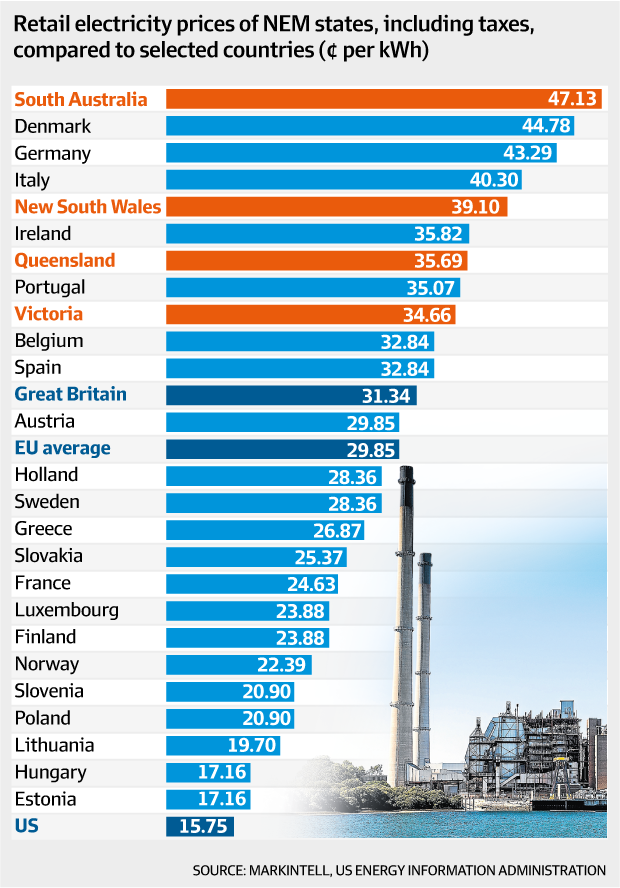
Here it is a good reference point. It clearly demonstrates the futility of the Paris agreement. While governments pay lip service to the climate change agenda it is merely a (very expensive) gesture.
via climate science
June 18, 2018 at 01:30AM
via climate science
June 18, 2018 at 01:30AM
The Alliance for Wise Energy Decisions (AWED) is an informal coalition of individuals and organizations interested in improving national, state, and local energy and environmental policies. Our premise is that technical matters like these should be addressed by using Real Science (please consult WiseEnergy.org for more information).
A key element of AWED’s efforts is public education. Towards that end, every three weeks we put together a newsletter to balance what is found in the mainstream media about energy and the environment. We appreciate MasterResource for their assistance in publishing this information.
Some of the more important articles in this issue are:
Retail Electricity Prices for sample countries
Wind Turbines Threaten Property Values in Upstate NY
Billions in U.S. solar projects shelved after Trump panel tariff
Texas Wind Power Story — Part One
Sound (and Light) Reasons to Tilt at Windmills
Judge’s ruling against Minnesota wind farm causes alarm for advocates
The Observed Impacts of Wind Turbines on Local Vegetation Growth
Essay: Wind Energy Illusions
Archive: Wind and Solar have a Secret Friend — Gas
Wind Developer ordered to buy out Minnesota homeowners
Being “Green” is Easy — Ignore the Facts
Taking aim at the real polluters: some US Environmental Groups
Newly Elected Ontario Premier’s encouraging Statement on Wind Energy
New Texas Wind Project Could Interfere with Radars
Environmentalists don’t support nuclear — as there is no money in it
How North Korea Has Weaponized Electricity
EPA Celebrates 500 Days of American Greatness
Fellows of the Royal Geological Society pushback over climate position
The Rise of Political Correctness
Identity Politics Undermining Science
Americans Served Badly by a Religion that has Run Its Course
Ten Religious Reasons Against Climate Change
Steve Milloy doesn’t like ‘climate bed wetters’
Three Climate Change Questions Answered
Greed Energy Economics:
Retail Electricity Prices for sample countries
Wind Turbines Threaten Property Values in Upstate NY
Billions in U.S. solar projects shelved after Trump panel tariff
Texas Wind Power Story — Part One
Australia’s Self-Inflicted Renewable Energy Crisis: 200,000 Families Can’t Afford Electricity
Cost-Benefit Reform at the EPA
Environmentalists don’t support nuclear — as there is no money in it
Wind developer offers Ocean City free electricity, but town is still fighting offshore turbines
Turbine Health Matters:
Sound (and Light) Reasons to Tilt at Windmills
Judge’s ruling against Minnesota wind farm causes alarm for advocates
Audiologists — A Lingering “Conflict of Interest”
Update of Wind Turbine Accident Data (4/1/18)
Renewable Energy Destroying Ecosystems:
The Observed Impacts of Wind Turbines on Local Vegetation Growth
Archive: Overview of Turbine Fire Problem
A Free Pass to Kill Migratory Birds
Adopting wind and solar energy not so ‘green’
Taking aim at the real polluters: some US Environmental Groups
Miscellaneous Energy News:
Archive: Wind and Solar have a Secret Friend — Gas
Wind Developer ordered to buy out Minnesota homeowners
Being “Green” is Easy — Ignore the Facts
Newly Elected Ontario Premier’s encouraging Statement on Wind Energy
The Social Benefits of Fossil Fuels Far Outweigh the Costs
New Texas Wind Project Could Interfere with Radars
How North Korea Has Weaponized Electricity
Natural gas – the miracle fuel
White House challenges FERC on grid security
Britain Has Gone Nine Days Without Wind Power
New England Operational Fuel-Security Analysis
NY Town Supervisor: I listened to the majority, and can’t be bought by wind developer
NY town tightens wind energy regulations
Wind Turbines and the Montague NY Doppler Radar — An Overview
Town Looks to Remove Failed Wind Turbine
Epic Renewables Fail, as Solar Crashes and Wind Refuses to Blow
Legislator sounds off again against offshore wind off Ocean City, MD
Regulators apply brakes to UMaine offshore wind project
PJM region and California dominate US storage via different paths
Special Judge to Hear Indiana Wind Project Lawsuit
Ontario Election Muddies Red-Hot Green Energy Issue
Canada Explores for more Atlantic Fossil Fuel Reserves
Pope Francis’ Crusade Against Fossil Fuels Hurts The Poor Most Of All
Short video: Yanny, Laurel & Energy
The Future of the U.S. Nuclear Decommissioning Market
Manmade Global Warming Articles:
EPA Celebrates 500 Days of American Greatness
Fellows of the Royal Geological Society pushback over climate position
The Rise of Political Correctness
Identity Politics Undermining Science
Americans Served Badly by a Religion that has Run Its Course
Ten Religious Reasons Against Climate Change
Steve Milloy doesn’t like ‘climate bed wetters’
Three Climate Change Questions Answered
Speculative climate chaos v. indisputable fossil fuel benefits
Climate Change Has Run Its Course
Environmentalists Love Methane When It’s Rebranded ‘Renewable Biogas’
Inclusive of anything other than ourselves at universities
The Climate-Change Tort Racket
Citizens have a right to defend themselves against bad scientists
Tide gauges showing negative absolute sea level rise removed from data base
There’s no need to panic about the rising sea level
Archive: Caring for Creation: A Book of Good Intentions but Poor Science
US Environmental Group Targeted Based on its China Connections
Disequilibrium and relaxation times for species responses to climate change
Why Climate Doomsday Won’t Happen This Summer
Scientists debate human involvement in climate change during panel
The IPCC; Never Has So Much Been Made Out of So Little by So Many at So Great A Cost
Help EPA rethink regulatory cost-benefit analysis
Attachments area
Preview YouTube video Yanny, Laurel & Energy
The post Energy & Environmental Newsletter: June 18, 2018 appeared first on Master Resource.
via Master Resource
June 18, 2018 at 01:24AM

Guest essay by Peter D. Tillman
Got your attention, didn’t it? But they are actually the good guys — two working scientists who, behind the scenes, have had striking success in bringing on retractions by publicly calling out questionable data. Their work was written up in Science Magazine in a freely-available article, here.
Once a problematic paper has been identified, it’s seldom straightforward getting it fixed. Nick Brown and James Heathers have had unusual numbers of successes, perhaps because they start out low-key, but don’t hesitate to go public if they get no response. Other would-be whistle-blowers have had less success, as the Science article describes in some detail. One whistle-blower’s efforts attracted legal threats — another scenario WUWT readers will recall, with a few progressing to actual lawsuits. The litigious Dr. Michael Mann comes to mind.
Heathers & Brown hope their efforts will lead to better peer review.
“In short, peer review misses all the hard stuff, and a worrying amount of the easy stuff.” —James Heathers, Northeastern University, one of the self-described “data thugs”.
Longtime readers here, and participants in the Climate Wars, will recall the remarkable LACK of success in getting questionable data and papers retracted or corrected in Climate Science. Instead, they remains in the scientific record, and are regularly used to buttress such arguments as that 97% of climate scientists support the CAGW consensus.
Readers who are scientists have been taken aback at this lack of success — Steve McIntryre tried for years to get the statistical follies in (for example) the Hockey Stick interpretation by Michael Mann, corrected. He largely failed, despite impeccable statistical work on his part. He did have some (partial) successes, especially in getting data properly archived.
So I recommend you carefully read the Science article, which is free online, and think about how this might be applied to Climate Science, where there is a great mass of poorly-done research awaiting proper review. It won’t be an easy process. As Upton Sinclair once observed, “It is difficult to get a man to understand something when his job depends on not understanding it.”
Science does self-correct, and eventually the failed predictions of climate catastrophe will be recognized as signs that the underlying science is badly flawed. But climate change moves slowly, and the bad advice these folks are giving to policy-makers is already doing a lot of damage, and wasting billions or trillions of dollars. It would be great to speed up the self-correction!
Heathers believes their auditing efforts can be formalized and taught to anyone. Eventually, he would like to produce an online course to spread the methods. “Then things get really interesting,” he predicts.
Peter D. Tillman is a retired geologist who has been interested in paleoclimates since student days, and got interested in the misuses of the tree ring climate proxies from Steve McIntyre’s work at Climate Audit. He earned a bachelor’s degree in geology and chemistry from Rice University in Houston, and a Master’s in Geochemistry from UNC in Chapel Hill. He’s also a longtime WUWT reader.
via Watts Up With That?
June 17, 2018 at 08:05PM

Guest essay by Eric Worrall
Many of us have said all along that the radical left are using climate change as an excuse to rally the troops, but its nice to see it all laid out in clear, without any of the dissimulation or trickery Comrade Lenin recommended for global Communist revolutionaries.
Climate change and the next left
Sunday 17 June 2018, by David Camfield
Climate change is already happening. But the really bad news is that there’s very strong evidence that capitalism will deliver a future of catastrophic climate change that will have far-reaching effects around the world, especially in the imperialized countries of the Global South. There is a vast gap between the continuing growth of greenhouse gas emissions and the massive reductions of emissions needed to prevent widespread catastrophes.
In a thoughtful article, “Revolution in a Warming World: Lessons from the Russian to the Syrian Revolutions,” Andreas Malm writes,
Lenin spoke of the catastrophe of his time as a ‘mighty accelerator’ bringing all contradictions to a head, ‘engendering world-wide crises of unparalleled intensity,’ driving nations ‘to the brink of doom’… Climate change is likely to be the accelerator of the twenty-first century, speeding up the contradictions of late capitalism – above all the growing chasm between the evergreen lawns of the rich and the precariousness of propertyless existence – and expedit[ing] one local catastrophe after another. [2]
In advanced capitalist countries, we could see even more aggressive attacks on public health care, education and social services as states cut there while they spend more in response to floods, droughts and other effects of climate change. It’s easy to imagine mass international migration out of regions of the South hit hard by climate change leading to an intensification of racism and repression and the growth of fascist and other far right movements.
…
The situation we’re in – a stable capitalist society where the ruling class rules unchallenged, with the working class highly fragmented, divided and depoliticized and a feeble radical left – calls for us to unite on the basis of politics that can guide our activity in the current period. That’s different from organizing around a specific political tradition like Trotskyism or anarcho-communism (or as part of a narrower current within a tradition). It’s also different from adopting a basis of unity that claims to have answers to questions that we just don’t face in this moment of history, such as precisely what kind of society beyond capitalism we’re aiming for or exactly how a transition beyond capitalism could be started.
…
There’s been an almost complete break between cohorts in Canada, so that almost none of the lessons learned between the 1960s and the mid-1990s about how to build the radical left have been passed down to today’s activists. It’s not that everything we need to know merely awaits rediscovery. Far from it! But some methods have been tested and shown to be effective, while others have been shown to be ineffective. Let’s learn and use what works. And let’s learn from our experiences, like the failure of the Greater Toronto Workers’ Assembly and, for a positive example, the process leading to the launch of Solidarity Halifax.
There are no short cuts to a new left. The best next step will be different in Toronto, where the radical left is larger than in other cities but also more divided, than in other places. Quebec Solidaire, a sizeable left-reformist party, makes the landscape of the left different in Quebec. But we can and must try to take a step towards a new left.
…
Read more: http://internationalviewpoint.org/spip.php?article5572
The Radical Left won’t get their global warming crisis, nature is failing to oblige with the much anticipated climate change acceleration. But the radical left might be able to spin a potential future global cooling crisis into their radical cause célèbre. Scientists like former NASA GISS Director James Hansen have opened the way for claims that any abrupt drop in global temperature is our fault.
… Global temperature becomes an unreliable diagnostic of planetary condition as the ice melt rate increases. Global energy imbalance (Fig. 15b) is a more meaningful measure of planetary status as well as an estimate of the climate forcing change required to stabilize climate. Our calculated present energy imbalance of ∼ 0.8 W m−2 (Fig. 15b) is larger than the observed 0.58 ± 0.15 W m−2 during 2005–2010 (Hansen et al., 2011). The discrepancy is likely accounted for by excessive ocean heat uptake at low latitudes in our model, a problem related to the model’s slow surface response time (Fig. 4) that may be caused by excessive small-scale ocean mixing.
Large scale regional cooling occurs in the North Atlantic and Southern oceans by mid-century (Fig. 16) for 10-year doubling of freshwater injection. A 20-year doubling places similar cooling near the end of this century, 40 years ear- lier than in our prior simulations (Fig. 7), as the factor of 4 increase in current freshwater from Antarctica is a 40-year advance.
Cumulative North Atlantic freshwater forcing in sverdrup years (Sv years) is 0.2 Sv years in 2014, 2.4 Sv years in 2050, and 3.4Sv years (its maximum) prior to 2060 (Fig. S14). The critical issue is whether human-spurred ice sheet mass loss can be approximated as an exponential process during the next few decades. Such nonlinear behavior depends upon amplifying feedbacks, which, indeed, our climate simulations reveal in the Southern Ocean. …
Read more: http://www.atmos-chem-phys.net/16/3761/2016/acp-16-3761-2016.pdf
While many of our leaders fritter away our wealth on addressing the imaginary global warming crisis, the real potential crisis, the possibility a drop in solar activity will trigger crop failures across much of the North, is being ignored.
Frightened people don’t think, they react – the jump at any promised solution to their problem. Even the voices of the insane left might find an audience in a global cooling crisis.
A strong, vibrant capitalist economy could address even crisis of this magnitude – rapid large scale imports of food from less affected regions could compensate for any local failures. A 2017 crop failure in Spain barely caused a blip in Europe – a few weeks of lettuce shortages. Within weeks large scale imports from the USA and elsewhere made up the loss.
A weak, over regulated society burdened with pointless green taxes might not prove so resilient to a major crisis.
via Watts Up With That?
June 17, 2018 at 05:22PM
 Iowa Climate Science Education