
Guest commentary by David Middleton
Big Oil’s carbon capture tax credit betrayal
BY JOHN NOEL, OPINION CONTRIBUTOR — 07/30/18 09:30 AM EDT
THE VIEWS EXPRESSED BY CONTRIBUTORS ARE THEIR OWN AND NOT THE VIEW OF THE HILL
Instead of finding ways to responsibly reduce production, the fossil fuel industry has decided carbon capture is the preferred way to tackle their climate pollution.
Tax credits recently finalized in Congress under Section 45Q will purportedly lead to an uptick in carbon capture projects that will help us bury more CO2 underground. But according to the International Energy Agency, upwards of 90 percent of these projects will simply sell the captured carbon back to oil companies to be injected underground to coax more oil to the surface.
Over time this process, buoyed by a consistent supply of subsidized CO2, could unlock 81 billion barrels of oil. No wonder the fossil fuel industry is so enthusiastic and its allies in Congress are finally willing to acknowledge carbon emissions are a thing we have to deal with.
[…]
Congress should conduct an investigation into the integrity of the Section 45Q tax credit, including which companies claimed what, when and why the regulations were ignored. This is basic corporate accountability and oversight necessary to ensure the credit doesn’t continue to favor enhanced oil recovery companies and that the public maintains trust in the process of storing captured carbon safely underground at scale.
John Noel is the National Oil & Gas Program director for advocacy organization Clean Water Action.
“Instead of finding ways to responsibly reduce production, the fossil fuel industry has decided carbon capture is the preferred way to tackle their climate pollution.”…
Note #1 to Mr. Noël:
The fossil fuel industry is composed of “businesses.” Businesses exist for one reason: to generate profits for their owners. Many fossil fuel industry businesses are “oil companies.” Oil companies produce crude oil, natural gas, natural gas liquids, etc. This is called “production.” Generally speaking, oil companies have to spend a lot of money to establish production. Oil companies then exchange their “production” for “money.” If oil companies receive more money than what they spent on finding and producing their “production,” they can generate something called “a net profit.” Are you still with me? Profitable oil companies can then reinvest their profits to increase their “production” and grow their businesses in order to hopefully make more “profits.” So… Only a total fracking moron could write this phrase: “Instead of finding ways to responsibly reduce production.”
There is no way for an oil company to “responsibly reduce production.” Even in times of falling oil & gas prices, there is no responsible way to reduce production. Oil companies, particularly publicly traded oil companies, have a fiduciary responsibility to maximize production, to the extent they have the resources to do so. During price collapses, oil companies have less money to spend on new drilling and this ultimately leads to declining production. However, during periods of low prices, oil companies attempt to maximize existing production, while spending as little money as possible. This is to ensure that they maintain a positive operating cash flow. While unprofitable companies can remain in business for long periods of time; companies with negative operating cash flows tend to have very short lifespans.
Note #2 to Mr. Noël:
There’s no such thing as “climate pollution.”
Note #3 to Mr. Noël: “SACROC”
SACROC
Discovered in 1948, the SACROC unit is one of the largest and oldest oil fields in the United States using carbon dioxide flooding technology. The field is comprised of approximately 50,000 acres located in the Permian Basin in Scurry County, Texas. Kinder Morgan owns an approximate 97 percent working interest in SACROC and has expanded the development of the carbon dioxide project initiated by previous owners and increased production over the last several years.In 2016, SACROC produced approximately 29,300 barrels of oil per day, and NGL production averaged approximately 20,900 barrels per day. Kinder Morgan continues to effectively develop this mature field through innovative use of seismic data, lateral drilling and advanced conformance techniques.
Currently, about 300,000 bbl/d of US oil production is due to CO2 enhanced oil recovery (EOR)…


The US Department of Rick Perry, I mean Energy, estimates that CO2 EOR could recover about 85 billion barrels of oil from existing U.S. oil fields:


Since 1972, over 175 million metric tons of CO2 have been injected into the SACROC reservoir; there has never been any evidence of leakage.
When the injection began, total recovery was less than 20% of the original oil in place (SACROC was discovered in 1948). The CO2 EOR has led to nearly a 50% recovery.
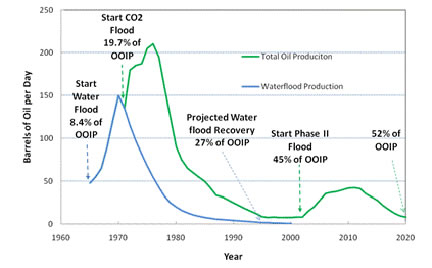
The field is currently producing almost 30,000 bbl of oil and 21,000 bbl of NGL per day.
Produced CO2 is re-injected into the reservoir to produce more oil…

SACROC Safety Record
Is CO2-EOR safe? CO2 is non-flammable and nonexplosive. It is not defined as a hazardous substance, but a Class L, highly volatile, nonflammable/nontoxic material (CFRg, CFRe, Appendix B, Table 4). (WRI, 2008)
Operating for 40 years, CO2 pipelines have an excellent safety record with no serious injuries or fatalities ever reported. Today there are over 3,900 miles of pipeline transporting CO2 for EOR use at wells producing 281,000 (MIT 2011) barrels of oil per day. The industry has operated for decades under existing policy and regulatory oversight at the local, state and federal level.
Geologic storage of CO2 is also regulated under existing policies and regulations. CO2 is contained by a series of physical and chemical trapping mechanisms over time. Most formations that hold oil for thousands of years also have the ability to contain CO2. As an example, research by the University of Texas Bureau of Economic Geology’s Gulf Coast Carbon Center on the SACROC oil field, where CO2 has been injected for EOR since 1972, has found no evidence of CO2 leakage (TBEG). Experience from this decades-old CO2-EOR project and current commercial-scale CO2-EOR projects today shows that CO2-EOR can be performed in a manner that is safe for both human health and the environment.
From the University of Texas Bureau of Economic Geology’s Gulf Coast Carbon Center
Conclusions
Our field-based study of shallow (<500 ft) groundwater overlying and within an ~1,000 mi2 area of SACROC shows no impacts to drinking water quality as a result of over 35 years of deep subsurface (6,000-7,000 ft) CO2 injection. Modeling of stable carbon isotopes (d13C) of injectate CO2 gas, DIC in shallow and deep groundwater, carbonate mineral matrix, and soil zone CO2 suggests that no significant injectate CO2 has been introduced to the shallow groundwater.
Interpretation of groundwater flow regime, and concentrations of major ions and trace metals, indicate mixing of water types and water-rock interaction (i.e. dedolomitization) as major controls on groundwater geochemistry at SACROC. We think the popular assumption that carbonate parameters alone can be used as indicators of groundwater quality over a GS site is too simple, especially in complex hydrogeologic settings. We emphasize the importance of defining the regional groundwater system to (1) understand how it might react to introduction of CO2 and (2) identify the parameters best suited for monitoring over GS sites. Research is ongoing to define and group major geochemical aquifer systems and to assess the protocol that would be appropriate for each group.
Aquifer sampling and analysis of site-specific conditions may be needed to understand how an aquifer system will react to CO2 and the parameters best-suited for monitoring at sequestration sites. Research is ongoing to define and group major geochemical aquifer systems and to assess the protocol that would be appropriate for each group.
For a pdf of the complete report, please click here.
Since John Noël is the National Oil & Gas Program director for advocacy organization Clean Water Action, he should appreciate the fact that “no significant injectate CO2 has been introduced to the shallow groundwater” over SACROC.
While CO2 injection is not a hazard-free operation (no drilling operation is hazard-free)…
Operating for 40 years, CO2 pipelines have an excellent safety record with no serious injuries or fatalities ever reported. Today there are over 3,900 miles of pipeline transporting CO2 for EOR use at wells producing 281,000 (MIT 2011) barrels of oil per day. The industry has operated for decades under existing policy and regulatory oversight at the local, state and federal level.
Section 45Q tax credit
If the tax credit is Mr. Noël’s concern, tuff schist. CO2 EOR operations are expensive. If *the government* wants oil companies to spend more of their money on CO2 EOR operations than would be supported by current economics, they need to provide an incentive. So… since *the government* thinks that carbon sequestration and enhanced oil recovery are good ideas, they devised a tax credit to encourage oil companies to spend more of their money on CO2 EOR operations. Maybe Mr. Noël would be happier if *the government* ended all subsidies.
The Section 45Q tax credit was established in 2008, it was enhanced in 2018 in an unusually bipartisan fashion.
A bipartisan group of Senators, spearheaded by Heidi Heitkamp (D-ND), John Barrasso (R-WY), Sheldon Whitehouse (D-RI) and Shelley Moore Capito (R-WV), led the effort to enhance the 45Q credit. Their bill, S. 1535, the Furthering carbon capture, Utilization, Technology, Underground storage, and Reduced Emissions Act (FUTURE Act), was included in Senate Finance Committee Chairperson Orrin Hatch’s (R-UT) larger tax extenders bill, S. 2256, before finally gaining inclusion in the Bipartisan Budget Act of 2018.
Mr. Noël seems to take issue with the fact that the “EPA has no record that any of the captured carbon is actually contained in “secure geologic storage,” a condition necessary to qualify for the tax credit in the first place”… If it’s been pumped into an oil reservoir, it is, by definition, contained in “secure geologic storage”… Because the oil was contained in “secure geologic storage,” before oil companies drilled holes into the “secure geologic storage.”
However, the Treasury Department should get together with the EPA, DOI and DOE and issue regulations which clearly define “secure geologic storage.”
Section 45Q continues to require that carbon oxides be placed in “secure geological storage” to qualify for the credit. The enacted language did not include a provision, championed by Sen. John Hoeven (R-ND), to require the Secretary of Treasury to issue regulations by the end of the year to define “secure geological storage” and to define it in the case of carbon oxide used for EOR to encompass reporting under Subpart UU of the US Environmental Protection Agency’s (EPA) Greenhouse Gas Reporting Rule. Since its original enactment in 2008, Section 45Q has included a requirement that the Treasury issue regulations defining the term, in consultation with EPA, the Department of Energy and the Department of Interior. Treasury issued guidance in 2009, but has never issued regulations. This has led to some confusion that needs to be eliminated.
Mr. Noël seems to want to blame everyone not responsible for this oversight. He blames the oil companies, he blames Sen. John Hoeven (R-ND). I’m surprised he didn’t blame the Trump Administration. If anyone deserves blame, it’s the Obama Maladministration… Section 45Q in 2009. The requirement that the Treasury issue regulations defining the term, in consultation with EPA, the Department of Energy and the Department of Interior was ignored through the entire 8 years of the Obama Maladministration… But somehow that’s the oil industry’s fault or John Hoeven’s fault?
The latest update from IRS reported that 59,767,924 metric tons of CO2 were claimed under 45Q as of May 14, 2018.20 The claimed credits are valued between $597 million and $1.3 billion.21 EPA’s Greenhouse Gas Reporting Database, however, reports only 3 million metric tons of sequestered carbon.22
Note #4 to Mr. Noël:
59,767,924 metric tons of CO2 equals 16,285,538 metric tons of C. So, the EPA is only missing 13,285,538 metric tons of sequestered carbon, as opposed to the 56,767,924 metric tons you seem to be implying. Unless, of course, you were using CO2 and C interchangeably.
The odds are that if the Section 45Qtax credit claims were bogus, the Obama Maladministration IRS would have nailed some oil companies’ hides to the wall… Unless they were too busy harassing conservative political groups.
via Watts Up With That?
August 2, 2018 at 01:29PM
 Iowa Climate Science Education