

Artist rendering of a fusion reaction.
By Larry Kummer. From the Fabius Maximus website.
Summary: News from the frontiers of science, where the future is being built and the predictions of doomsters will be defeated. Also, see the last section: why has fusion always been 30 years away? And naming the people responsible for this failure.
“We think we have the science, speed and scale to put carbon-free fusion power on the grid in 15 years.”
— Robert Mumgaard, CEO of Commonwealth Fusion Systems (PhD in Nuclear Physics, MIT). Source: The Guardian, March 2018.
One of the great oddities of our time is the widespread belief that our CO2 emissions will destroy the Earth in the 21st century. The thin foundation for these stories is the IPCC’s worst-case scenario, RCP8.5 (often misrepresented as a “business as usual scenario”). In this we burn off most of the Earth’s available oil – then turn to an alternative. In RCP8.5 the fuel of the future is the fuel of the 19th century – coal. The result would be catastrophic. It’s also unlikely, and widespread belief it is probability is stunning achievement of modern propaganda.
In the real world, the technology of energy generation and use advances rapidly. Although nuclear power is dying as an industry (destroyed by incompetence), solar tech is taking a growing share of the electric generation market. Steady improvements suggest that it has a big future (although less than dreamers believe).
To see how quickly tech can advance, a decade ago electric cars were considered a technology for the distant future. A 2009 report by the National Academies of Science said that even plug-in hybrids “are unlikely to have much impact before 2030.” We have already leaped over that stage, with many of the world’s major car companies now offering all-electric cars (~1% of the market) – and the others rolling them out in the next five years. The report did not even mention them.
The private sector sees profits in fusion power
The US government fusion program was funded since 1976 at levels far below that required to deliver results at at some indefinite date (“far out in time”; see the last section below). But decades of work have brought fusion to an important milestone. The growing interest of private investors – especially professional venture capitalists – marks the start of a new phase in the development of fusion power. These are smart business people expecting results soon, and putting money on the table. This is an update of a list that I have shown before.
- LPPFusion – Created in 1994 with funding from NASA, incorporated in 2002, based in NJ. Their website. Funding: first round in 2008 raised $1.2 Million from The Abell Foundation and Individual Investors, with five more offerings completed since then (including some crowdfunding).
- TAE Technologies – Founded 1998, based in California. Their website. Rumored to have raised $150 million; Crunchbase shows 6 rounds since 2002 from 3 VC firms. See Wikipedia. Partnered in 2017 with Google.
- General Fusion – Founded 2002, based in Canada, 50 scientists. Their website. Funding: $90 million, in 8 rounds from venture capitalist, government, and energy companies. See Wikipedia.
- Proton Scientific – Founded 2005, based in Illinois. Their website. Funding: unknown.
- Woodruff Scientific, Inc. – Founded 2005, based in Seattle. Their website. Contract research in fusion, working for both public and private firms.
- Global Energy Corporation – Founded 2006, based in Virginia. Their website. Research on hybrid fission-fusion tech. NASA has funded some of their work. See this list of relevant patents, papers, and other work.
- Tokamak Energy – Founded 2009, based in Britain. Their website. Funding: $13 million in one round from venture funds. They hit a major milestone in June.
- First Light Fusion – Spun out from Oxford in 2011, based in Britain. Their website. Funding: $32 million, in 3 rounds from 2 VC firms.
- Helion Energy – Founded 2013, based in Washington. Their website. Funding: $5 million seed capital from DoE, plus $12 million in 2 rounds from 2 VC firms. See Wikipedia.
- Applied Fusion Systems – Founded 2014, based in Britain. Their website. Funding: unknown, tapping individual investors.
- CTFusion – Spun off from U Washington in 2015, based in Seattle. Their website. Funding: unknown, most or all from the US government.
- Commonwealth Fusion Systems – Spun Off from MIT in 2017, based in Massachusetts. Their website. Funding: $50 million investment from ENI (a global energy corp).
- Hyperjet Fusion – Founded in 2017, merged with HyperV Technologies Corp in 2017, based in Virginia. Their website. Funding: $28 million from the US government plus an unknown sum from Strong Atomics (a VC).
One mega-corp is investing in fusion: Lockheed Martin’s Skunk Works began building a compact fusion system in 2010. See their website and the Wikipedia entry. From their October 2014 press release …
“{Lockheed} is working on a new compact fusion reactor (CFR) that can be developed and deployed in as little as ten years. …The smaller size will allow us to design, build and test the CFR in less than a year. After completing several of these design-build-test cycles, the team anticipates being able to produce a prototype in five years.”
Most of these companies issue exciting press releases and videos about breakthroughs and timetables. Most are falling behind on their initial promises. The sums spent are small, as such things go. But most new evolves slowly at first. We can only guess at what they might accomplish in the next decade.
This is one facet of a large story, one of the biggest of our era: a new industrial revolution has begun!
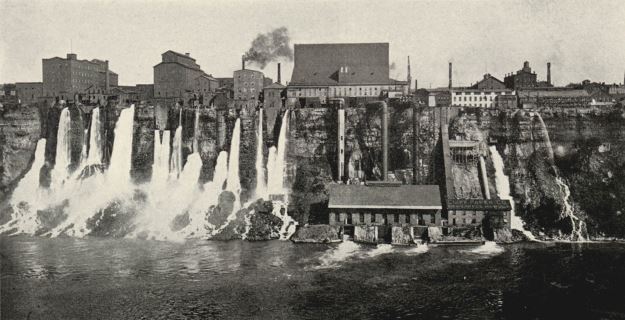
Great things come from small beginnings. See Niagara Falls in 1904, with little factories tapping some of its power.
Here is the “Z Machine” of Sandia National Laboratory. It could provide fusion energy for the future. See Science, Nov 2016.

By Randy Montoya.
For More Information
Another often-told story about natural resources is about the replacement of whale oil by petroleum. The reality was much more complex, with no obvious lessons for us. See an analysis by Bill Kovarik, Professor of Communication at Radford University; also see the discussion in the comments.
Why has fusion always been 30 years away?
There have been countless articles like this by Nathaniel Scharping in Discover March 2016, asking “Why Nuclear Fusion Is Always 30 Years Away.” Sometimes other numbers are given, such as “Forever 20 years away: will we ever have a working nuclear fusion reactor?” in the November 2014 New Statesman. Oddly, these seldom quote people in 20 or 30 years ago making such predictions.
But there is a deeper reason why fusion scientists disappointed us: we did not give them the money they said they needed to deliver in 20 or 30 years. See this graph (click to enlarge) from the peak enthusiasm days of fusion. It is from page 12 of “Fusion Power by Magnetic Confinement: Program Plan“, a report by the U.S. Energy Research and Development Administration (1976), updated to show 2012 dollars. We did not even provide the funding required to deliver future at some indefinite date (“far out in time”). We got what we paid for.

via Watts Up With That?
September 17, 2018 at 06:04PM
 Iowa Climate Science Education