
The year’s most acrimonious scientific fight is a mega-drama over a mega-drought.
This summer, the decree went out: We are living in a new geological chapter in the planet’s 4.5-billion-year history.
For a certain corner of the world, this was big news. You have probably heard of the Jurassic period (when dinosaurs ruled the Earth) or the Cambrian explosion (when complex animal life arose). Now we had a new name for our own neighborhood in time: We modern humans—you, me, and Jesus of Nazareth—were all born in the Meghalayan age. According to the global governing body of geologists, this new era began 4,200 years ago, when a global mega-drought sent ancient societies around the world into starvation and collapse.
How interesting!, you may think. I love science! And perhaps in an earlier era, that’s all you would have had to think. The dawn of the Meghalayan would have earned some wide-eyed headlines, made life slightly easier for a few researchers, and promptly been relegated to a second-round Jeopardy!question.
Instead, the Meghalayan kicked off one of the cattiest, most intransigent fights among earth scientists that I can remember—a battle that now concerns some of the most profound questions up for scholarly debate today, including the importance of climate change, the likelihood of societal collapse, and the ultimate place of humanity in the universe.
“There was no sudden, universal civilizational collapse,” writes Guy Middleton, a visiting archeologist at Newcastle University, in the piece. “Overall, the archaeological and historical evidence suggests that 2200 b.c.was not a threshold date.”
Middleton’s point is larger than just the Meghalayan: He is siding with a group of scholars, mostly at European universities, that argues that climate change has almost never led to war or total ruin in the past. He writes as much in his piece: “Climate change never inevitably results in societal collapse, though it can pose serious challenges, as it does today.”
The Meghalayan’s architects did not mince words in their response.
“This is a totally misleading piece of writing, which displays a lamentable grasp of the facts,” said Mike Walker, a professor at the University of Wales and the leader of the team that proposed the Meghalayan.
“I do not see a single accurate claim,” agreed Harvey Weiss, a professor of archeology at Yale who also helped write the Meghalayan proposal.
In a series of emails, Weiss lambasted his critic’s credentials. “Middleton, a pop-archeology writer, failed archaeology Ph.D., and English-as-a-second-language instructor in Japan, now claims archeo-expertise in matters about which he knows nothing, and gets great audience in Science—of all journals!” he wrote.
“For me, the most intriguing question is, ‘Why does Science publish this rubbish?’” he said in another message, sent several hours later under the subject line “and Weiss added … ”
“I see you’ve been talking to Harvey Weiss!” Middleton replied when I told him about some of these charges without identifying their source. Middleton is the author of a book about societal collapse, and he holds a doctorate in Aegean prehistory. He has also “proudly” taught English for Academic Purposes classes at Tokyo University and Northumbria University, he said, writing: “It has put bread on the table since 2002 and paid me through my Ph.D.”
It wasn’t always clear that the Meghalayan would arouse this level of controversy. The new age was meant to be an aid for geologists and climate scientists who study the past 11,700 years of Earth’s history. This period of time—called the Holocene epoch—contains nearly all of modern human history and is crucial to the study of contemporary climate change.
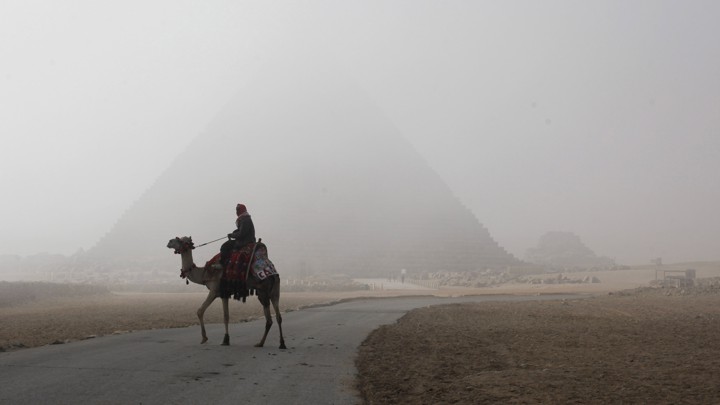
The July paper proposing the new age described the mega-drought of 2200 b.c.as “one of the most pronounced climatic events” to afflict human communities since the end of the Ice Age. It offers a tour of a world in catastrophe circa 2200 b.c.: In Egypt, the Old Kingdom “seems to have collapsed” after the Nile’s floods faltered. In Mesopotamia, the Akkadian empire crumbled, a disaster “linked to sudden acidification.” Throughout the Levant, people abandoned towns and cities. In modern-day Pakistan, the urban Harappan civilization—which once flourished in the Indus Valley—transitioned to a “rural, post-urban society.” In China, multiple Neolithic cultures failed. Settlement around the Yangtze and Yellow Rivers seems to have reached a nadir.
Middleton disputes almost all of these conclusions.
Full post
see also Benny Peiser: Civilisation Collapse and Climate Change
The post Climate Wars: Scientific Mega-Drama Over An Alleged Mega-Drought appeared first on The Global Warming Policy Forum (GWPF).
via The Global Warming Policy Forum (GWPF)
September 21, 2018 at 03:10AM
 Iowa Climate Science Education