
Guest batting practice by David Middleton
Liberal arts types spouting nonsense about energy and climate science are like batting practice pitchers.
From the High Country News, and the author is clearly high on something.
Trump’s methane rule rollback burns the natural gas bridge
Without emissions regulations, the ‘clean’ fossil fuel is as dirty as coal.
Jonathan Thompson PERSPECTIVE Sept. 19, 2018
This summer’s statistics on electricity use and generation included a significant gem: Over the last 12 months, power generation from coal has dropped to a three-decade low. That was party-worthy news for the climate, for air quality, for folks who live near power plants and for the natural gas industry, which is partly responsible for coal’s decline. Just days later, however, the Trump administration crashed the shindig, causing a major buzzkill.
No, the president’s attempts to revive coal have not succeeded. But on Sept. 18, the Interior Department snuffed out new rules aimed at lowering the oil and gas industry’s methane emissions, just days after the Environmental Protection Agency started the process of euthanizing its own methane regulations. This is a bummer not only for the planet, but also for the natural gas industry’s efforts to portray its product as the clean fossil fuel.
[…]
Jonathan Thompson is a freelance journalist with a B.A. in modern history. He clearly is clueless about natural gas production, the energy industry, running a business or anything else that is functionally useful.
Natural gas has an Achilles’ heel: When it is sucked from the earth and processed and moved around, leaks occur. The main ingredient in natural gas is methane, a greenhouse gas with 86 times the short-term warming potential of carbon dioxide.
[…]
When the Obama administration proposed rules that would make the oil and gas industry clamp down on methane emissions, it was a gift, not a punishment. Not only would people and the climate benefit; the natural gas industry would be able to sell itself as a clean fuel and a bridge to the future.
The Obama-era rules are similar to those passed in Colorado in 2014, with the industry’s support. Far from being onerous, they simply require companies to regularly look for and repair leaks and to replace faulty equipment. Some companies already do this on their own…
“Leaks” are fixed if it makes economic sense. A rule requiring the repair of “leaks” which doesn’t make economic sense, would lead to gas wells and pipelines being shut in. The methane rule was not only a punishment, it was a moronic punishment that could only be conjured up by people with no functional utility to society. Only an idiot would think that businesses need the government to tell them fix things when the repairs make economic sense.
After whining about Trump burning the bridge, the modern historian suggests that “maybe the time has come to let that bridge burn”…
Meanwhile, the death of Interior’s methane rule on Tuesday will add another half-million tons of pollutants to the air. In the process, it will erode the pillars of the once-vaunted natural gas bridge.
Then again, maybe the time has come to let that bridge burn. We get 70 times more electricity from solar sources now than we did in 2008, and renewables hold 11 percent of the total share of power generation. Perhaps just as significant is a less-noticed fact: Electricity consumption in the U.S. has held steady for the last decade, even dropping during some years, despite a growing population, a burgeoning economy…
setting aside the fact that fossil fuels account for 62.7% of our electricity generation, while solar, with its 70-fold increase since 2008, only accounts for 1.3%…
What “burgeoning economy”???
Obama was the first president in US history to complete two terms in office, during which real GDP growth never reached 3%. Since 1985, US electricity consumption has increased in every year in which the economy grew by 3% or better. During the 8 years of the Obama maladministration, real annual GDP growth averaged 1.9% and electricity consumption declined by an annual average of 0.1%.
| Terawatt-hours | ΔGDP | ΔTWh | |
| 1998 | 3,856 | 4.9% | 3.8% |
| 1999 | 3,936 | 4.8% | 2.1% |
| 1987 | 2,772 | 4.5% | 3.6% |
| 1997 | 3,716 | 4.5% | 1.4% |
| 1996 | 3,663 | 4.4% | 2.7% |
| 2003 | 4,138 | 4.4% | 0.6% |
| 1992 | 3,284 | 4.4% | 0.4% |
| 1994 | 3,459 | 4.1% | 1.6% |
| 1988 | 2,914 | 3.8% | 5.1% |
| 2004 | 4,232 | 3.3% | 2.3% |
| 2005 | 4,323 | 3.2% | 2.2% |
| 2000 | 4,052 | 3.0% | 3.0% |
| 1986 | 2,676 | 2.9% | 0.7% |
| 1989 | 3,155 | 2.8% | 8.3% |
| 2014 | 4,363 | 2.7% | 0.8% |
| 2010 | 4,394 | 2.6% | 4.5% |
| 1993 | 3,405 | 2.6% | 3.7% |
| 2013 | 4,330 | 2.6% | 0.5% |
| 2006 | 4,331 | 2.6% | 0.2% |
| 2017 | 4,282 | 2.5% | -1.5% |
| 1995 | 3,567 | 2.2% | 3.1% |
| 2002 | 4,112 | 2.1% | 3.2% |
| 2007 | 4,432 | 2.0% | 2.3% |
| 2015 | 4,349 | 2.0% | -0.3% |
| 2016 | 4,348 | 1.9% | 0.0% |
| 2011 | 4,363 | 1.6% | -0.7% |
| 2012 | 4,311 | 1.5% | -1.2% |
| 1991 | 3,271 | 1.2% | 1.2% |
| 1990 | 3,233 | 0.7% | 2.5% |
| 2009 | 4,206 | 0.3% | -4.2% |
| 2001 | 3,984 | 0.2% | -1.7% |
| 2008 | 4,390 | -2.7% | -0.9% |
Sources: BP 2018 Statistical Review of World Energy, Federal Reserve Bank of St. Louis.
A real burgeoning economy and rising electricity consumption
The US economy is on track to better than 3% growth this year…
The US EIA forecasts that electricity demand will rise from 2018-2050.

U.S. primary energy consumption 2017-2050. “Other renewable energy” includes wind, offshore wind, solar PV, solar thermal, geothermal and several other bit players. US EIA.
With natural gas leading the way…

Projected mix of generation technologies (2017-2050). Naturally, my bet is on “high oil and gas resource and technology.” “Renewables” includes hydroelectric. US EIA.
Eroding the pillars of the once-vaunted natural gas bridge
There is no evidence that leakage from natural gas drilling, production and transportation operations is significantly contributing to the rise in atmospheric methane over the past few years.
Ruling things out
The post-2007 uptick in global methane levels roughly coincides with the rapid deployment of natural gas “fracking” in the United States, making fugitive emissions a logical suspect. But attempts to verify the connection have produced counter-intuitive results, according to Stefan Schwietzke, a methane expert from the Cooperative Institute for Research in Environmental Sciences (a NOAA-University of Colorado Boulder partnership).
Schwietzke’s research suggests that methane emissions from fossil fuels are higher than countries’ self-reported inventories suggest, and they may even be increasing. And yet, he explained via email, methane derived from fossil fuels is enriched with carbon-13—a rare, heavy isotope of carbon—and air samples show that the amount of carbon-13-flavored methane is dropping worldwide.
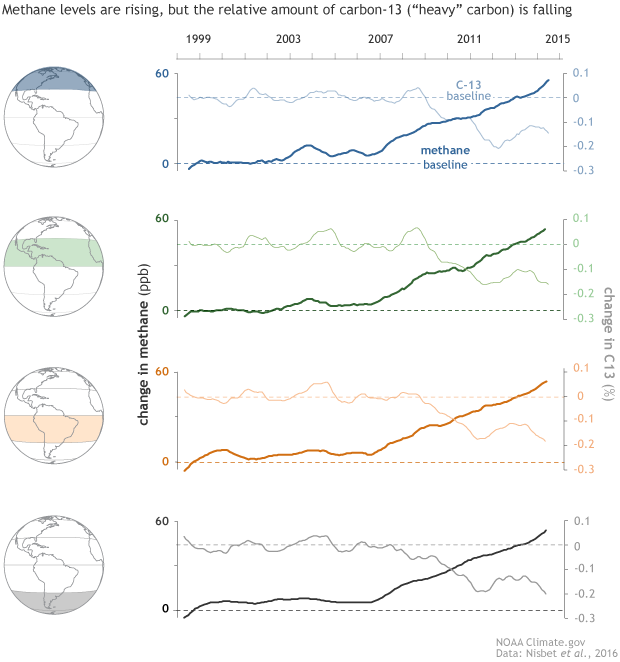
Methane concentrations (dark lines) and the amount of carbon-13 in the methane (light lines) from 1998-2014 for four latitude zones: Northern and Southern Hemisphere tropics (green and orange) and Northern and Southern high latitudes (blue and gray). Starting in 2007, methane concentrations in all latitude zones began to rise, but the amount of methane carrying “heavy” carbon-13 started to fall. NOAA Climate.gov graphic, based on data from Nisbet et al., 2016, provided by Martin Manning.
The drop seems to rule out fossil fuel emissions, wildfires, or biomass cook stoves as the reason for the post-2007 methane surge. All those sources of methane, to a greater or lesser extent, are enriched in carbon-13, not depleted.
It’s a counterintuitive finding: methane from fossil fuels is higher than we thought, but it seems to be making up a smaller share of total global emissions. In his email, Schwietzke wrote, “The decline in the 13-C isotope of methane in the atmosphere indicates that microbial sources must have an increasing share of total methane emissions globally.”
As if that’s not enough, the 63% of the reduction in US CO2 was due to switching from coal to natural gas.
| CO2 Emission Reduction (million metric tons) | |||
| Natural Gas | Non-Carbon | ||
| 2006 | 36 | 27 | |
| 2007 | 65 | -9 | |
| 2008 | 65 | 23 | |
| 2009 | 112 | 90 | |
| 2010 | 123 | 64 | |
| 2011 | 147 | 130 | |
| 2012 | 268 | 112 | |
| 2013 | 226 | 150 | |
| 2014 | 232 | 164 | |
| 2015 | 350 | 177 | |
| 2016 | 383 | 240 | Total |
| Sum | 2,007 | 1,168 | 3,175 |
| % of Total | 63% | 37% | |
Source: US EIA
To the extent that natural gas is a bridge fuel, the pillars are stronger than ever.
A bridge to nowhere
Natural gas as a “bridge fuel” to nuclear power, particularly fusion power, is a concept worth exploring. Natural gas as a bridge to unicorns is “a bridge to nowhere.

I think this is my new favorite graph… And I have a lot of graphs.
If there actually was a need to fight climate change and modern historians were serious about fighting it, they would be pursuing an N2N strategy (natural gas to nuclear).
The fastest, most cost effective, way to reduce carbon emissions would be to transition from coal to natural gas and nuclear power.
Unless modern historians are incapable of basic arithmetic, I have to assume that their true motive isn’t saving the world from climate change.
“This is the first time in the history of mankind that we are setting ourselves the task of intentionally, within a defined period of time, to change the economic development model that has been reigning for at least 150 years, since the Industrial Revolution.”
–Christiana Figueres, executive secretary of U.N.’s Framework Convention on Climate Change
Film at 11
I couldn’t find any film of President Trump burning bridges… But I do have a favorite burning bridges film…
MAGA
via Watts Up With That?
September 21, 2018 at 01:17PM
 Iowa Climate Science Education