
Descending air in the atmosphere rises in temperature as it is adiabatically compressed in the pressure gradient created by gravity acting on atmospheric mass. This has been known for centuries. However, the MET Office has decided to do away with this fundamental fact of physics in a short video it has produced.
Here is some more information on what we mean by the Foehn Effect pic.twitter.com/h8Zr9XJ2Y2
— Met Office (@metoffice) October 23, 2018
Even their own website page on the Foehn effect (now safely screenshotted and web-cited) tells us:
“ foehn air… becomes warmer and drier on the leeside after it is compressed with descent due to the increase in pressure towards the surface.”
So why would the MET Office miss out one of the principle causes of the Foehn Effect in its info-video they tweeted out? Is it that the MET Office is staffed by people who don’t understand the basic thermodynamics of meteorology these days?
Or could it be they don’t like Ned Nikolov and Karl Zeller’s discovery that adiabatic heating in the pressure gradient is the cause of the ‘greenhouse effect’ rather than trace gases like water vapour and carbon dioxide.
It also contradicts what the MET-O say on their own website!
“ foehn air becomes warmer and drier on the leeside after it is compressed with descent due to the increase in pressure towards the surface.”https://t.co/9MfE7vHSmX— Rog Tallbloke (@RogTallbloke) October 24, 2018
I made an info-graphic by modifying the NASA energy budget to show how adiabatic compression heating is an important factor missed off by climate scientists in their models. They don’t account for the way descended air heated by adiabatic compression will impede the surface-air conduction rate by lowering the temperature differential.
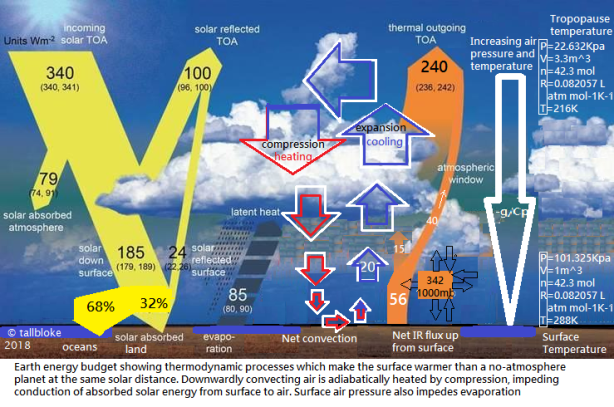
It looks like the propaganda war to deny this critical omission has started.
via Tallbloke’s Talkshop
October 24, 2018 at 06:06AM
 Iowa Climate Science Education