
Guest ridiculing by David Middleton
Energy & Environment
Washington could be the first state to charge for carbon emissions that cause climate change
By Steven Mufson October 28
The bride had asthma. The scenic Seattle skyline — the ideal backdrop for photographs — was shrouded in smoke from wildfires. And Perfectly Posh Events, the wedding planner, had to scramble for an indoor venue in the middle of summer, usually the best time of the year for an outdoor exchanging of vows.
“I’ve lived in Seattle my whole life. This is not something I remember growing up with,” said Holly Olsen, owner of the business. “Clearly there has been some kind of change that happened.”
What’s happened is climate change. It has contributed to the dry conditions that fueled forest fires, blanketing Seattle with smoke this year. It has altered the acidity of the oceans, damaging oyster farms in Seattle’s Puget Sound. And now, climate change has made its way onto the Nov. 6 ballot, in the form of a statewide initiative that would impose a $15-a-ton fee on carbon emissions that cause global warming.
[…]
How in the Hell could someone write something this FRACKING stupid?
It has altered the acidity of the oceans…
This is how:
Steven Mufson
Washington, D.C.
Reporter covering energy and other financial matters
Education: Yale University, BA in economics and political science
Steven Mufson covers energy and other financial matters. Since joining The Washington Post, he has covered the White House, China, economic policy and diplomacy. He has worked at The Post since 1989 and has been its chief economic policy writer, Beijing correspondent, diplomatic correspondent and deputy editor of the weekly Outlook section. Earlier, he spent six years working for the Wall Street Journal in New York, London and Johannesburg, and wrote a book about the 1980s uprisings in South Africa’s black townships.Honors & Awards:
- Shared the following: 2011 Sigma Delta Chi award for “Breakaway Wealth”;
- 2012 American Geophysical Union’s David Perlman award for explanatory earthquake coverage;
- 2009 Association of Food Journalists for project;
- 1988 Alicia Pattterson Foundation fellowship
Foreign languages spoken: Some French, a little Chinese
Books by Steven Mufson:
- “Fighting Years; Black Resistance and the Struggle for a New South Africa”
- Keystone XL: Down the Line
He’s apparently a professional science “explainer”… A science explainer dumb enough to write this:
It has altered the acidity of the oceans…
The oceans aren’t acidic, haven’t been acidic at any time during the Phanerozoic Eon, and couldn’t become acidic even if we burned every short ton of coal, barrel of oil and cubic foot of natural gas in the Earth’s crust by next Monday.
But wait! It gets even stupider!
Taylor Shellfish, a family business that has been plying the waters of Puget Sound since 1890 and now employs 700 people, has already been getting clear signals of climate change.
A decade ago, it lost 75 percent of the oyster larvae critical to producing baby oysters. The family consulted a leading expert at the National Oceanic and Atmospheric Administration, but the diagnosis wasn’t good: Carbon dioxide that had been stored in the ocean was disrupting the coastal ecology, causing a shortage of carbonate ions. That made it impossible for the tiny larvae to build shells without using up the energy they need to build feeding organs in the same crucial 48-hour period.
“Probably the most difficult part of the message is that the water upwelling along the Washington coast is actually 30 to 50 years old and it’s been circulating at depths,” Bill Dewey, the company’s senior director of public affairs, said. “So even if the world stops burning fossil fuels today, our fate is already sealed for the next 30 to 50 years. The ocean is going to continue to get more acidic because of what is already absorbed and in the pipeline.”
Upwelling ≠ Climate Change
While long-period oceanic oscillations can be correlated to coastal upwelling patterns, upwelling is not “climate change.” Furthermore… The upwelling episode that damaged the oyster larvae occurred “a decade ago” and the water was “actually 30 to 50 years old” at the time.
First, a bit of elementary school arithmetic:
- 10 + 30 = 40
- 10 + 50 =60
- 2018 – 40 = 1978 (the frigid depths of That 1970’s Climate Science Show)
- 2018 – 60 = 1958 (second half of the International Geophysical Year)
Atmospheric CO2
- 1958 315 ppmv
- 1978 336 ppmv
If oysters can’t hack 315-336 ppmv CO2, they didn’t evolved on Earth… But they did. The oldest fossil oysters date back to the Triassic Period.

Coastal upwelling is what makes certain areas of the Pacific Ocean extremely productive:
An important process affecting primary productivity during the spring and summer off the Pacific Northwest is coastal upwelling. Upwelling is caused by northerly winds that blow along the Oregon coast from April to September. These winds transport offshore surface water southward (orange arrow in Figure CU-01), with a component transported away from the coastline (to the right of the wind, light green arrow). This offshore, southward transport of surface waters is balanced by onshore, northward transport of cool, high–salinity, nutrient–rich water (dark blue arrow).
Figure CU-01. Forces affecting coastal upwelling.
The strength of an upwelling process can be calculated based on estimates of wind speed. Using such data, Dr. Andy Bakun (1973) developed the coastal
Upwelling Index.
The Upwelling Index is, as its name implies, a measure of the volume of water that upwells along the coast; it identifies the amount of offshore transport of surface waters due to geostrophic windfields. Geostrophic wind fields are calculated from surface atmospheric pressure fields measured and reported by the U.S. Navy
The Upwelling Index is calculated in 3–degree intervals from 21°N to 60°N latitude, and data are available from 1947 to present. For the northern California Current, relevant values are from 42, 45, and 48°N. Year–to–year variations in upwelling off Newport (45°N) are shown as anomalies of the upwelling index Figure CU-02. The years of strongest upwelling were 1965–1967.
Figure CU-02. Anomalies of the coastal Upwelling Index during May to September each year, 1946 – present
Many studies have shown correlations between the amount of coastal upwelling and production of various fisheries. The first to show a predictable relationship between coho survival and upwelling were Gunsolus (1978) and Nickelson (1986).
[…]
Chicken Little of the Sea vs. Washington’s Oysters
The bad oyster crop occurred in 2007 and was deemed to be “An Upwelling Crisis: Ocean Acidification” by NOAA.
Dr. Richard Feely explains…
Feely can’t say for sure whether acidic waters are to blame. He and other scientists have started to work with an oyster hatchery in the region to install an observing system that regularly records pH levels of the seawater pumped into the hatchery. “What we do know is that oyster farmers are finding more severe impacts when they see corrosive waters in their hatcheries,” Feely says.
While a number of environmental problems, including a low-oxygen dead zone of the coast of Oregon, could be contributing to the mass kill-offs of oyster larvae, Feely believes that corrosive waters are mainly responsible for exacerbating the bacterial infestation and killing off oyster larvae. Hatcheries in the region report that their die-offs tend to occur after periods of persistent northwesterly winds, when deep waters well up and enter the bay, and the pipes that feed the hatcheries. The oyster larvae are swimming in these acidified waters, which can be corrosive enough to dissolve their fragile shells. To make matters worse, the hatchery managers observe that Vibrio tubiashii seems to thrive in a more corrosive environment.
The NOAA article included some “helpful” graphics:

The oceans have never been acidic enough to be pure water during the Phanerozoic Eon, not even during the nefarious Paleocene-Eocene Thermal Maximum.
If the total myth of ocean acidification didn’t feature the oceans turning into battery acid, or even becoming acidic… Why feature a graphic with a lead-acid battery label? The oceans can’t even reach coffee or hand soap… not even under the rosiest Climatariat RCP8.5 fantasies.
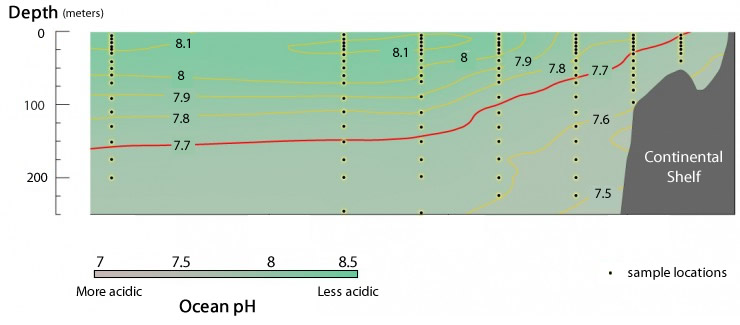
In Climatariatese, “more acidic” means “neutral” and “less acidic” means “alkaline.”
For the sake of science, I will now replace the fake phrase “ocean acidification” with the more appropriate moniker: “Chicken Little of the Sea”.
Here’s how Chicken Little of the Sea has devastated Washington’s oyster harvest:
Historical trends: Figure 2 summarizes 28 years of shellfish production data for Washington State. From 1986 until 1998,total shellfish aquaculture production stayed relatively stable, between 11.7 and 15.1 million pounds. Between 1998 and 2005, total production increased considerably, reaching a peak in 2005 at 24.9 million pounds. After 2005, production leveled off again, decreasing to a low in 2011 of 22.5 million pounds. Pacific oyster, Manila clam, and mussels have continued to be the three primary staples of shellfish aquaculture production, with the Pacific oyster maintaining the highest production by species in Washington State. Manila clam production was almost equal to Pacific oyster production in 2012, but a drop in Manila clam production in 2013 increased the gap slightly.
What’s that? You missed the devastated bit? So did I.
About those fires
Click on the link for a larger PDF. Oregon is pretty close to Washington. Clearly, neither the bride with asthma nor the frustrated wedding planner were around in the early 20th century.
Washington’s Expensive and Futile Carbon Tax
From The Washington Post article:
Some climate experts criticize the fee for being too small. After kicking in at $15 a ton, the fee would increase $2 a ton a year until 2035. It would raise more than $1 billion annually by 2025.
[…]
Quoting a study by NERA Consulting, which often works for the oil and gas industry, Bieber said that the measure would cost the average Washington state household $440 a year at the gas pump and on utility bills. She said it would raise $30 billion over 15 years and create “an unelected board of political appointees who can spend money any way they choose.”
This is how a carbon tax would affect the prices of some common “climate wrecking”fuels:
| Carbon Tax per Metric Ton of CO2 | |
| 2019 | $15 |
| 2025 | $27 |
| 2030 | $37 |
| 2035 | $47 |
| per Gallon of Gasoline (8.89 kg/gal) | |
| 2019 | $0.13 |
| 2025 | $0.24 |
| 2030 | $0.33 |
| 2035 | $0.42 |
| per Thousand Standard Cubic Feet of Natural Gas (53.12 kg/1,000 scf) | |
| 2019 | $0.80 |
| 2025 | $1.43 |
| 2030 | $1.97 |
| 2035 | $2.50 |
| per Short Ton Sub-Bituminous Coal (1,686 kg/short ton) | |
| 2019 | $25.29 |
| 2025 | $45.52 |
| 2030 | $62.38 |
| 2035 | $79.24 |
Carbon tax as a percentage of recent prices:
| per Gallon of Gasoline % of $2.70/gal | |
| 2019 | 5% |
| 2025 | 9% |
| 2030 | 12% |
| 2035 | 15% |
| per 1,000 scf of Natural Gas % of $10.91/1,000 scf | |
| 2019 | 7% |
| 2025 | 13% |
| 2030 | 18% |
| 2035 | 23% |
| per Short Ton of Sub-Bituminous Coal % of $12.10/short ton | |
| 2019 | 209% |
| 2025 | 376% |
| 2030 | 516% |
| 2035 | 655% |
And this is how much it would affect the average surface temperature of the Earth:
via Watts Up With That?
October 30, 2018 at 09:21AM
 Iowa Climate Science Education