
By Jonathan Griffin
A strong solar storm in 1972 caused widespread disturbances to satellites and spacecraft, and may have led to the detonation of mines during the Vietnam War, according to new research showing the event may have been a more devastating solar storm than previously thought.
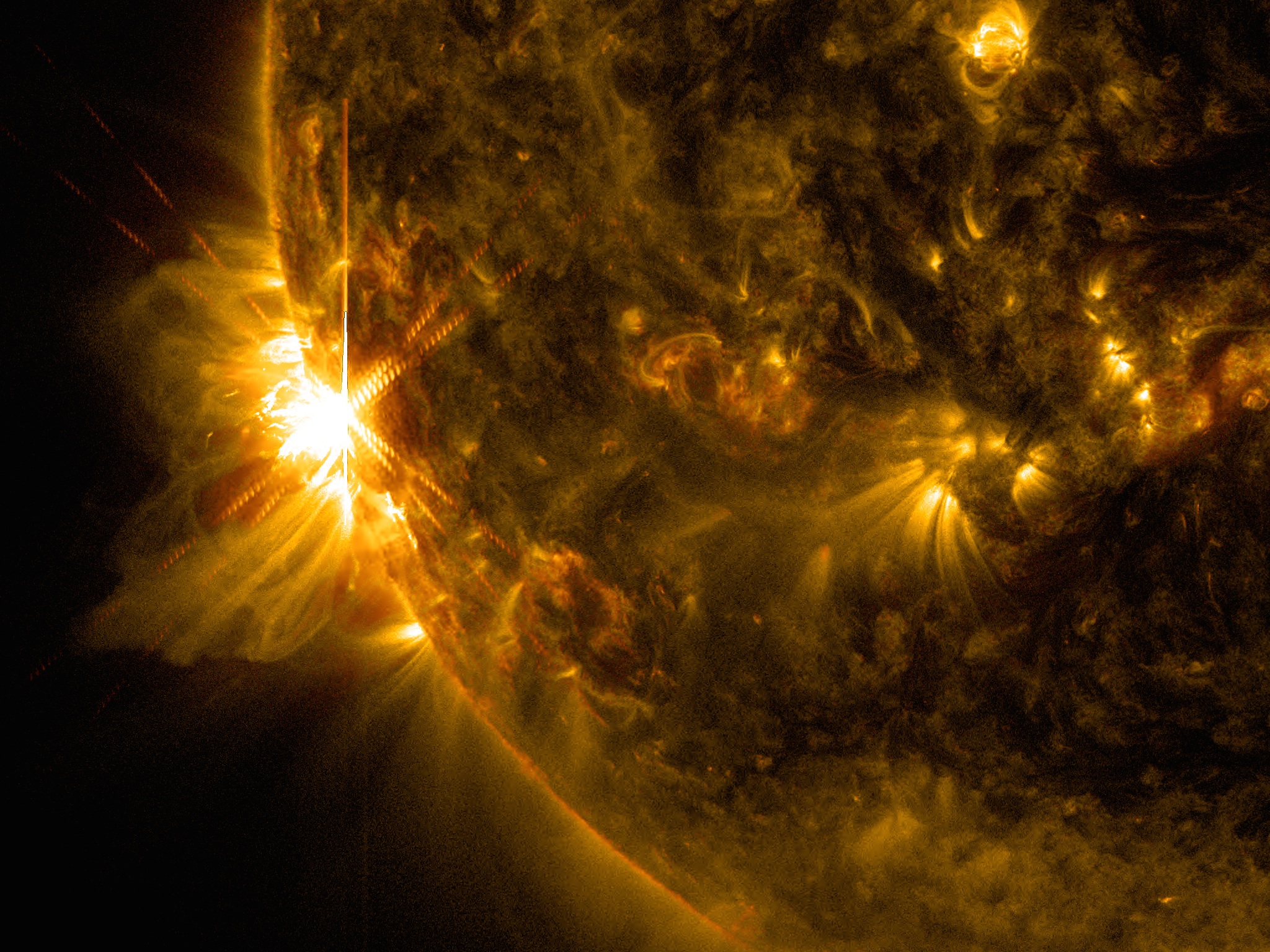
A solar flare bursts off the left limb of the sun in this image captured by NASA’s Solar Dynamics Observatory Credit: NASA/SDO/Goddard/Wiessinger
In a new study in Space Weather, a journal of the American Geophysical Union, researchers pieced together data and historical records related to the solar activity of 1972 to better understand the nature of the solar storm. In the process, they uncovered an incident where sea mines off the coast of Vietnam were detonated by the solar event.
The study’s authors suggest the solar storm was a Carrington-class storm, meaning it may have been similar to the strongest storm on record, the Carrington Event of 1859. They hope the new findings will motivate further investigation of the storm and help scientists prepare for solar events in the future.
“This is a Carrington-class storm that has gone under the radar,” said Delores Knipp, a research professor at the University of Colorado Boulder and senior research associate at the High Altitude Observatory of the National Center for Atmospheric Research in Boulder, Colorado. “What I am asking scientists to do is go back and reinvestigate with new eyes.”
Intense solar activity in early August 1972 hurled hazardous radiation, solar plasma and charged particles in Earth’s direction. After reaching Earth on Aug. 4, the highly energetic particles and magnetized plasma disturbed both human technology and natural phenomena, Knipp said.
The solar activity damaged spacecraft and satellites, and led to power issues across North America. Auroras, resulting from charged particles from the Sun interacting with air in Earth’s upper atmosphere, were visible in the northern United States and southern United Kingdom.
“Had we had astronauts on the way to the Moon, it appeared that they would have become very, very ill from the radiation sickness,” Knipp said.
On the same day, while observing the coastal waters of North Vietnam from aircraft, US Navy personnel witnessed dozens of destructor sea mines exploding with no obvious cause. These mines were airdropped by the US Navy into Vietnamese waters as part of Operation Pocket Money, a mission aimed at blocking supplies from reaching North Vietnamese ports.
The Navy promptly investigated the peculiar explosions, working with the National Academy of Sciences and the National Oceanic and Atmospheric Administration, to conclude that more than 4,000 mine detonations were most likely triggered by the solar storm, Knipp said.
A now declassified report about the mining of North Vietnam from the Chief of Naval Operations at the Mine Warfare Project Office noted, “this was the first example of what happens to a major mining campaign in the face of the vagaries of nature.”

Destructor mines (DST) were developed during the Vietnam War. These were Mark 80-series GP bombs converted to mines by the addition of mine-type arming, detection and filling systems. They differ from conventional sea mines in that they can be used against land targets as well as sea targets. The Mark 36, 40 and 41 Destructors were respectively the Mark 82 [500 lbs. (227 kg)], Mark 83 [1,000 lbs. (454 kg)] and Mark 84 [2,000 lbs. (907 kg)] bombs. Arming, detection and firing were common to all three types. The following description is from “Naval Weapon Systems 1991/1992:”
Many of the destructor mines were designed to trigger if they sensed changes in magnetic fields associated with moving ships. Solar activity is known to
perturb Earth’s magnetic field
, and in early August 1972, the perturbations were likely strong enough to meet the magnetic requirements for detonation, Knipp said.
“I was able to connect all these things and say well, not only did the sea mines blow up and do we have pretty good evidence of that … but the likely way this would have happened was if this was really a storm of much greater proportion than anyone was understanding,” Knipp said.
As humanity becomes more intertwined with and dependent on technology, the effects of solar activity will become increasingly important, Knipp said. Dependence on satellite systems, like GPS, could make today’s world more vulnerable to another event like the 1972 storm.
“If the same storm were to occur today, how well could we withstand it?” Knipp said. “It is worth asking and answering that question.”
On the Little‐Known Consequences of the 4 August 1972 Ultra‐Fast Coronal Mass Ejecta: Facts, Commentary, and Call to Action
Abstract
Today the extreme space weather events of early August 1972 are discussed as benchmarks for Sun‐Earth transit times of solar ejecta (14.6 hr) and for solar energetic particle fluxes (10 MeV ion flux >70,000 cm−2·s−1·sr−1). Although the magnetic storm index, Dst, dipped to only −125 nT, the magnetopause was observed within 5.2 RE and the plasmapause within 2 RE. Widespread electric‐ and communication‐grid disturbances plagued North America late on 4 August. There was an additional effect, long buried in the Vietnam War archives that add credence to the severity of the storm impact: a nearly instantaneous, unintended detonation of dozens of sea mines south of Hai Phong, North Vietnam on 4 August 1972. The U.S. Navy attributed the dramatic event to magnetic perturbations of solar storms. Herein we discuss how such a finding is broadly consistent with terrestrial effects and technological impacts of the 4 August 1972 event and the propagation of major eruptive activity from the Sun to the Earth. We also provide insight into the solar, geophysical, and military circumstances of this extraordinary situation. In our view this storm deserves a scientific revisit as a grand challenge for the space weather community, as it provides space‐age terrestrial observations of what was likely a Carrington‐class storm.
Plain Language Summary
The extreme space weather events of early August 1972 had significant impact on the U.S. Navy, which have not been widely reported. These effects, long buried in the Vietnam War archives, add credence to the severity of the storm: a nearly instantaneous, unintended detonation of dozens of sea mines south of Hai Phong, North Vietnam on 4 August 1972. This event occurred near the end of the Vietnam War. The U.S. Navy attributed the dramatic event to magnetic perturbations of solar storms. In researching these events we determined that the widespread electric‐ and communication‐grid disturbances that plagued North America and the disturbances in southeast Asia late on 4 August likely resulted from propagation of major eruptive activity from the Sun to the Earth. The activity fits the description of a Carrington‐class storm minus the low‐latitude aurora reported in 1859. We provide insight into the solar, geophysical, and military circumstances of this extraordinary situation. In our view this storm deserves a scientific revisit as a grand challenge for the space weather community, as it provides space‐age terrestrial observations of what was likely a Carrington‐class storm.

Fig1. (a) Calcium spectroheliogram of McMath Region 11976 on 3 August 1972. (b) Hydrogen‐α solar spectroheliogram of flaring region at 0648 UT on 4 August 1972. Copyright BASS2000, Paris Observatory, PSL (used with permission). The east limb is at the left of both images. (c) Hourly‐average solar wind plasma data 4–11 August 1972 (Zastenker et al., 1978). (d) Magnetosheath magnetic measurements for 2120 – 2230 UT from ATS 5 geosynchronous spacecraft at 15 LT (Cahill & Skillman, 1977); (e) Manila Observatory magnetic X component variations 4 August 17 UT to 5 August 7 UT (Salcedo, 1973). The vertical jump at 2240 UT represents a 168‐nT/min increase. After the second sudden commencement giant geomagnetic pulsations were present in the magnetosphere.
via Watts Up With That?
November 15, 2018 at 05:39AM
 Iowa Climate Science Education