
Guest Opinion by Kip Hansen
 As if the latest IPCC 1.5 °-limit report wasn’t alarmist enough, a mob of 23 authors, including a couple of the usual suspects, double down on it with a Review Article in Nature Climate Change titled “Broad threat to humanity from cumulative climate hazards intensified by greenhouse gas emissions.”
The Eureka press release was covered here at WUWT in “Greenhouse gasses triggering more changes than we can handle”.
From the title, one would think that is a review of the literature that found threats to human society being intensified by climate change.
Not so. This effort searched for papers that found negative effects on humanity from weather events and then compared these as they would or could possibly be intensified in all of the possible imaginary future scenarios of climate change in IPCC literature.
Really — they searched the literature “to find case examples of climate hazards impacting human systems.” (When they say climate, they mean the usual, average weather of a location.)
Here’s the method:
“A systematic review of observed impacts was conducted by creating a table in which ten climate hazards (warming, precipitation, floods, drought, heatwaves, fires, sea level, storms, changes in natural land cover and ocean chemistry) were listed in columns and six aspects of human systems (health, food, water, infrastructure, economy and security) were listed in rows.”
“This table was used as a guide for all possible combinations of keywords to search for publications reporting the impacts of climate hazards on key aspects of human life.”
It comes as no surprise to anyone even vaguely familiar with climate change literature that they were able to find “over 12,000 references …, we identified 3,280 relevant papers that were read in full to find case examples of climate hazards impacting human systems.”
It is important to note that they did not make any judgement as to whether “climate hazards” were caused by change of any sort — climate or otherwise. They just identified climate hazards — well, really weather hazards: warming, precipitation, floods, drought, heatwaves, fires, sea level, storms, changes in natural land cover and ocean chemistry. The only ones I see that they left out of the list are “cooling” or “severe winter weather”. Nearly every adverse impact on human systems possible has been blamed on some aspect of weather and/or climate change in the literature over the last 30 years.
They supply this chart, obviously meant to instill fear and panic:
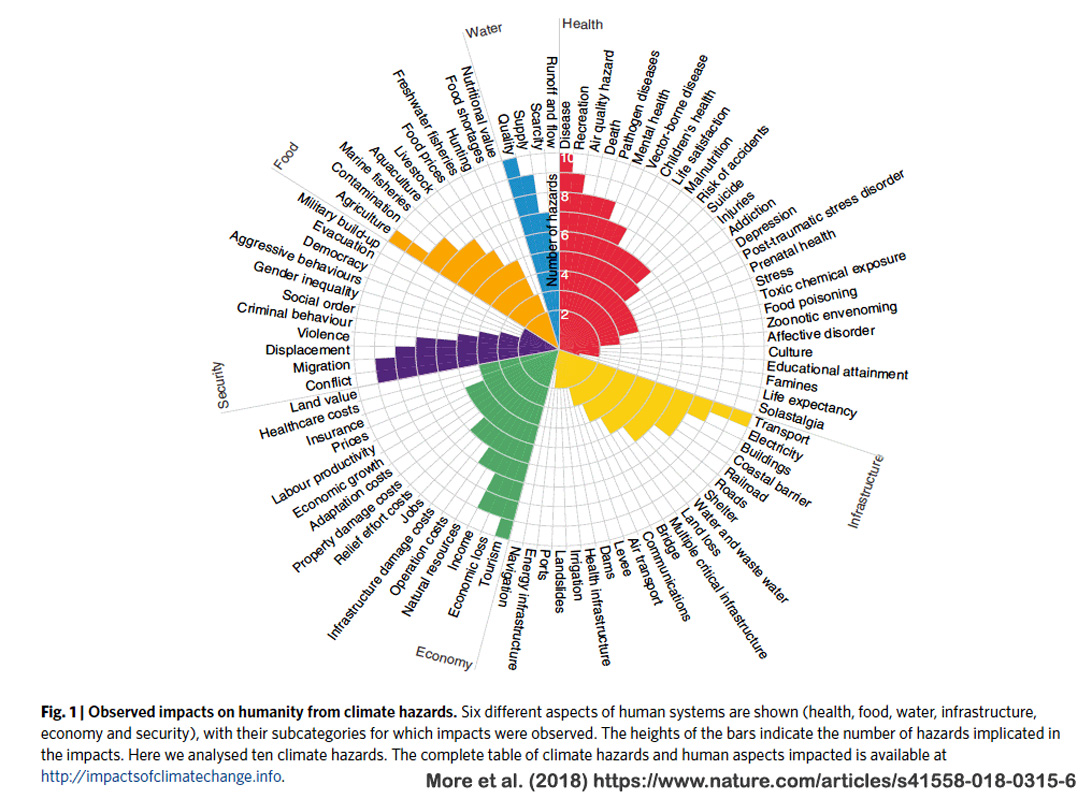
Click HERE for full-sized image.
Among the “intensified hazards” humanity will face (according to their version of IPCC projections) are:
- Solastalgia; 2. Affective Disorder; 3. Zoonotic Envenoming (which usually refers to snakebite); 4. Toxic chemical exposure; 5. Addiction; 6. Depressions; 7. Injuries (in general); 8. Risk of Accidents; 9. PTSD; 10. Prenatal Health (I guess they mean threat to…); 11. Vector-borne disease; 12 . Mental Health (magicaly different from #s 2, 5, 6 and 9); 13. Food Poisoning; 14. Suicide; 15. Death (again, in general, death is a bad thing…must be caused by and will surely be intensified by climate change).
This ridiculous list has worn me out — I’m still in the red section of the chart. This mob of serious scientists have put together a terrific list and a totally incomprehensible colorful chart — altogether, they “found case examples for 467 interactions or pathways by which humanity has been impacted by climate hazards.” Who would have known that the weather has that many adverse effects on human systems?
The list is a lot longer than the DailyCaller’s “Global Warming Ate My Homework: 100 Things Blamed on Global Warming “ but very short of John Brignell’s “A complete list of things caused by global warming’.
Of course, there is virtually no evidence whatever in the paper that any of the adverse effects have been caused by climate change — just that someone once said in some paper that such-and-such adverse effect on a human system was associated with a weather-related hazard.
They do have some real eye openers (or maybe, better said, eye rollers): Gender Inequality. Now, that is obviously a climate hazard — to whom, I have no idea. How about Military Build-up? — another sure hazard from the changing climate. And with military build-up, there will be more Conflict or maybe the other way around.
Let’s not forget this one, which is obviously endangered by Climate Change: Democracy. Ask Tim Ball if democracy is endangered by Climate Change — he has a lot to say about it — of course, he means democracy is endangered by the UN-led Climate Change Consensus political movement. Social Order is on the list of things threatened. Tim Ball would again agree, as he points out the political leaders of the Climate Consensus repeatedly call for a total overhaul of the social order to eliminate capitalism, democracy and replace these with their own odd version of equality, social justice and ultimately to redistribute world wealth — all under their own “enlightened” direction, of course.
Favorite quotes from the paper illustrating examples of the dire “already happening” climate hazards:
“There were also impacts on hunting, such as warming and melting sea ice in the Arctic shifting the distribution of walrus, leading to the loss of subsistence hunting grounds.”
“Livestock mortality was associated with warming (for example, the livestock disease bluetongue was positively correlated with increasing temperatures in Europe)”
“Likewise, floods, heatwaves and intense rain have been related to increases in snake bites due to inhospitable conditions forcing animals to move closer to people.”
Here a good one in which drought and floods apparently conspire: “Drought was associated with outbreaks of West Nile virus, leishmaniasis and chikungunya virus, and hantavirus when interacting with floods.”
“…from 1980 to 2014, over 780 events of excess human mortality were reported during heatwaves worldwide, drowning during floods (approximately 3,000 deaths in the 1998 floods in China), starvation during droughts (approximately 800,000 famine deaths attributed to the Ethiopian drought in the 1980s), blunt injury during storms (roughly 140,000 deaths occurred in the 1991 Cyclone Gorky in Bangladesh) and asphyxiation during fires (approximately 173 deaths occurred in the 2009 Australian Black Saturday fire).”
[As we are talking here at WUWT about fires recently, let me note that the official cause of the Black Saturday Fires in Australia was “Around midday, as wind speeds were reaching their peak, an incorrectly-rigged SWER line was ripped down at Kilmore East. This sparked a bushfire that would become the deadliest and most intense firestorm ever experienced in Australia’s post-1788 history.“ The same sort of event apparently caused the Camp Fire that incinerated most of Paradise, California.]
“Direct physical losses occurred due to storms (for example, roughly 35% of bean production was lost to Hurricane Mitch in Honduras in 1998), precipitation (a 10 mm increase in rainfall caused a loss of 0.3 t ha-1 of paddy rice in the Mekong Delta), floods (over 7,600 ha of agricultural land was destroyed by floods in Vietnam in 2009), sea-level rise (agricultural land has been lost to saltwater intrusion in Bangladesh), fires and drought (approximately 33% of grain production was lost to a mixture of fires and drought in Russia in 2010).”
With 30 years for weather history from which to cherry-pick, the authors managed to find a marvelous selection of bad weather-related things that happened to someone somewhere during that period. None of the events are claimed to have been caused by climate change. Many of the quotes above are events that were caused by local political and societal forces and choices that have resulted in human disaster.
The purpose of this paper is perfectly clear — they are not doing science — they are doing politics and their conclusion ends not with a scientific assessment but with a demand for policy acceptance and enforcement:
“Overall, our analysis shows that ongoing climate change will pose a heightened threat to humanity that will be greatly aggravated if substantial and timely reductions of GHG emissions are not achieved.”
…and is timed to coincide with the upcoming 24th annual climate circus which is to be held in Poland in a couple of weeks.
To wrap-up, I quote the late Hans Rosling:
Fear plus Urgency leads to “stupid, drastic decisions with unpredictable side effects.”
And one more, Rosling’s warning to the authors of this paper, who like Al Gore, insist on exaggeration of risk and jumped up false urgency:
“Exaggeration once discovered makes people tune out altogether.”
# # # # #
Author’s Comment Policy:
This is an Opinion piece. It is my opinion and not the opinion of Anthony Watts, Charles the Moderator, or anyone else associated with this web site.
It is my carefully-moderated-for-public-consumption opinion. My raw opinions are a bit stronger.
There will be a lot of nattering in comments from Junior Climate Warriors ™ defending their sacred cows. While my replies to them are normally as patient as I can make them (sometimes, I admit, they do manage to wear me down and I get a little snippy…), I find them tiresome for the most part. Somehow they just never seem to get the main point of a column — but try to nibble the author to death over inconsequential details or contested word definitions (see the recent endless silliness over forest fire vs. wildfire vs. WUI fire.)
[A big THANK YOU to all of you who have donated, or even just wanted to donate, to the WUWT Camp Fire Relief Fund.]
Thanks for reading.
# # # # #
via Watts Up With That?
November 20, 2018 at 09:10PM
 Iowa Climate Science Education