
By Paul Homewood
The Guardian hypes up the latest attempt to claim that climate change is making hurricanes worse:

Climate change worsened the most destructive hurricanes of recent years, including Katrina, Irma and Maria, by intensifying rainfall by as much as 10%, new research has found.
High-resolution climate simulations of 15 tropical cyclones in the Atlantic, Pacific and Indian Oceans found that warming in the ocean and atmosphere increased rainfall by between 5% and 10%, although wind speeds remained largely unchanged.
This situation is set to worsen under future anticipated warming, however. Researchers found that if little is done to constrain greenhouse gas emissions and the world warms by 3C to 4C this century then hurricane rainfall could increase by a third, while wind speeds would be boosted by as much as 25 knots.
“Climate change has exacerbated rainfall and is set to enhance the wind speed,” said Christina Patricola, who undertook the study with her Lawrence Berkeley National Laboratory colleague Michael Wehner. “My hope is that this information can be used to improve our resilience to the kinds of extreme weather events we are going to have in the future.”
The research, published in the journal Nature, used climate models to see how factors such as air and ocean temperatures have influenced hurricanes. Projections into the future were then made, based upon various levels of planetary warming.
The findings suggest that enormously destructive storms have already been bolstered by climate change and similar events in the future are on course to be cataclysmic.
In a world where temperatures were 3C warmer on average, Hurricane Katrina, which resulted in nearly 2,000 deaths when levees breached near New Orleans in 2005, would’ve been even worse, with around 25% more rainfall. Cyclone Yasi, which hit Australia in 2011, would have had around a third more rain, while the deluge during Gafilo, a huge storm that killed more than 300 people in Madagascar in 2004, would have been 40% more intense.
Jennifer Francis, a hurricane expert at Rutgers University, said: “This study adds exclamation points to the already clear message that we must slow global warming by conserving energy and switching from fossil to renewable fuels while preparing for more extreme weather to come.”
Hurricanes, or cyclones as they are known in the Pacific region, draw their strength from warmth in the upper layers of the ocean, while their rainfall is influenced by the amount of moisture in the atmosphere. Climate change, driven by human activity, is creating more favorable conditions for stronger hurricanes, with recent research finding that storms are intensifying more rapidly than they were 30 years ago.
Last year was the costliest hurricane season on record for the US, with $306.2bn in damage caused by a trio of category four storms – Harvey, Irma and Maria – which, respectively, drowned parts of Houston, rattled most of Florida, and decimated Puerto Rico. Two further major storms this year, Michael and Florence, caused widespread damage and dozens of deaths in Florida and North Carolina.
“Five or 10% more rain can make a big difference, the carrying capacity of stormwater systems in a town or city can be breached with that amount of extra rainfall,” said James Elsner, an atmospheric scientist at Florida State university.
Elsner said the study follows previous findings showing the climate change “fingerprint” on hurricanes. “There’s still discussion over the size of the affect but it’s clear,” he said. “We need to connect the dots after storms more than we have in the past. We know climate change is having an affect, the only real question is how much.”
https://www.theguardian.com/environment/2018/nov/14/climate-change-hurricanes-study-global-warming
Every time there is a big hurricane, some “scientist” jumps up to “prove” that it was much worse because of global warming.
And each time, the actual hurricane record proves they are wrong.
The first thing to note in this latest study is the claim that in a warmer world wind speeds would be boosted by as much as 25 knots. We have been told many times, of course, that warming has already made storms stronger.
Yet tucked away in this report is the statement that wind speeds remained largely unchanged. Claims of stronger storms in future are, I would suggest, bunkum.
As for the central claim that rainfall is intensified, this relies solely on those computer models, which rely on the programs they are fed with. In other words, they are purely hypothetical and have no basis in fact.
Hurricane Harvey has naturally drawn much attention, because it was the wettest tropical cyclone on record in the US. Yet we know that this was only because the storm stalled at landfall, because of common meteorological conditions.
Over the six days, during which Harvey was stalled near to Houston, 60 inches of rain fell on Nederland, setting the new record. However, the highest daily amount was 31 inches:
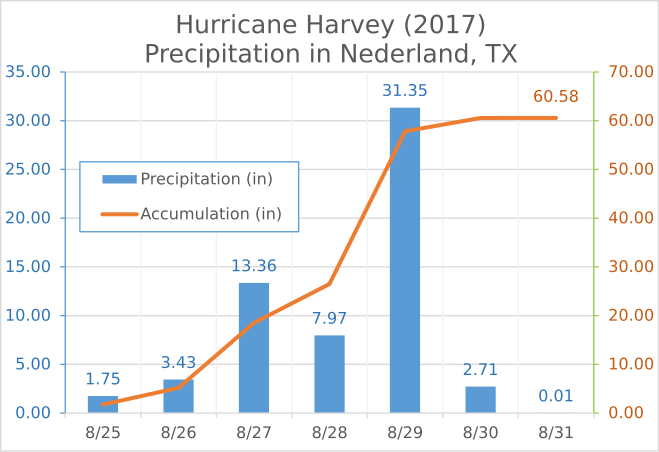
https://en.wikipedia.org/wiki/List_of_wettest_tropical_cyclones_in_the_United_States
The National Hurricane Center confirm that 31 inches was also the highest daily figure during Harvey. The next highest daily totals were 27 inches at Boondocks and Smith Gully.
In terms of rainfall intensity, Amelia and Claudette, which hit Texas in 1978 and 1979 were much more intense. Claudette still holds the 24-hour record of 42 inches, which fell on Alvin.
Amelia, which set the record of 48 inches, only lasted two days in total before.dissipating, making it also much more intense than Harvey. A 12- hour total of 26 inches was measured at Abilene.
One of the biggest problems with comparing current storms with those of the past is the comparability of the data.
60 inches of rain may have fallen on Nederland, but the National Hurricane Center has daily data from literally thousands of recording stations in the area during Harvey. There are, for instance, 2880 recording stations in Texas alone, which appear on the NHC database. Of these, 377 record more than 30 inches.
Were there as many station records in 1978? I strongly suspect not. Particularly given that these weather stations are now fully automated, rather than relying on some guy to go outside and measure his rain gauge while his house is flooding.
What I do know is that the more data you have, the more likely you are to find the most extreme numbers. Of those 2880 Texas stations, only 17 measured more than the 48 inches which fell during Amelia.
The use of climate models in this sort of exercise may have value. However, they should not be confused with reality.
I am prepared to accept the theory that a warmer atmosphere may lead to greater rainfall. But the theory needs to be proven against real world data, and explain how earlier storms, such as Claudette and Amelia, tell a different story.
via NOT A LOT OF PEOPLE KNOW THAT
November 23, 2018 at 08:11AM
 Iowa Climate Science Education