
Remember how oil demand was going to fall because green millennials are different and don’t want to kill the planet? Well, think again.
Starting around 2012 there was a lot of discussion about millennials being different. “Why Don’t Young Americans Buy Cars?” asked Jordan Weissman in the Atlantic. “Why Aren’t Younger Americans Driving Anymore?” wrote Brad Plumer in the Washington Post.
At the time, it made sense to ask these questions. Back in 2012, U.S. gasoline sales had declined for five years in a row and were at their lowest level in more than a decade. New vehicles sales had still not recovered from a sharp decline in 2009, and automakers were anxious. Analysts were looking around for an explanation for what appeared to be a “generational” shift in gasoline consumption and car buying, and the millennial story seemed like a good match.
The story also felt entirely plausible. Born in the 1980s and 1990s, millennials have grown up in the digital age, so it makes sense that they could have unique tastes and preferences. For many of us, the stereotypical millennial lives in an urban area, likes to bike, and uses public transit. Could it be that this generation has a fundamentally different relationship with driving? And, if so, might a generational shift go a long way toward reducing the harms caused by driving, like pollution and traffic congestion?
The Present Looks a lot Like the Past
Could be, but probably isn’t. Fast forward to 2019. U.S. gasoline consumption has increased steadily now for seven years in a row. What looked in 2012 like a generational shift now looks more like a temporary blip.
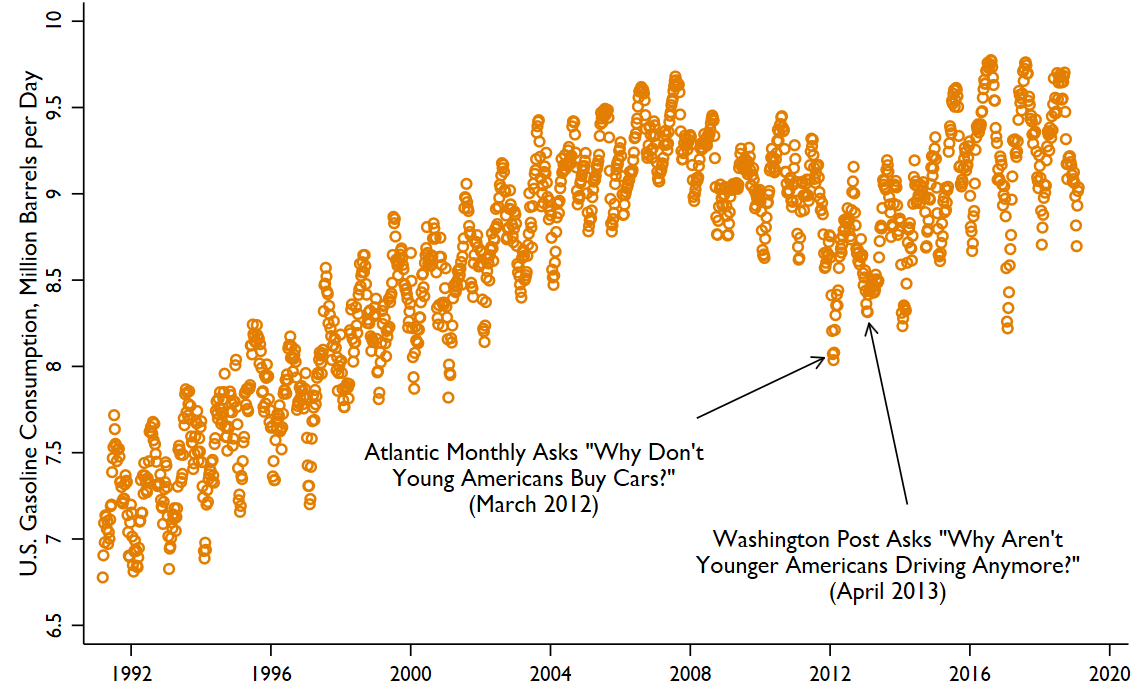
Americans are driving more than ever. Yes, even millennials. As their employment and income prospects have improved, millennials are buying cars and driving just like previous generations. It is becoming increasingly clear that economic factors — not changing tastes – are what explains the recent pattern for gasoline consumption.
To be fair, many of the same media outlets which initially touted the millennial story have been quick to note the reversal. “Millennials: Not So Cheap, After All,” writes Derek Thompson in the Atlantic. “Why Driving in the U.S. is Making a Big Comeback”, writes Brad Plumer in Vox. Cheap gasoline since 2014 and an expanding economy and, what do you know, this new generation is jumping into car ownership and driving just like previous generations.
But, it is not enough to squint at the aggregate data. Two recent studies use detailed household-level microdata to much more carefully test the millennial theory.
Buying Cars
Economists Christopher Kurz, Geng Li, and Daniel Vine have a paper called “Are Millennials Different?” that examines a range of consumption behavior by millennials, including driving.
Many millennials entered their working-age years during the great recession, so they have lower earnings and fewer assets than previous generations at the same age. However, when you control for these economic factors, Kurz and coauthors find no differences in consumption preferences for millennials compared to previous generations.
The authors specifically examine vehicle purchases. New vehicle purchases by young households dropped during the great recession, but the shortfall was not particularly large and the rate has now returned to the same range as previous generations. Overall, when viewed from a life-cycle perspective, average spending by millennials on both new and used vehicles is right in line with previous generations.
So yes, millennials are buying cars.

And Driving, Too
Ok, so millennials are buying new cars, but are they driving them as much as previous generations? Economists Benjamin Leard, Josh Linn, and Clayton Munnings examine this question in a recently published paper “Explaining the Evolution of Passenger Vehicle Miles Traveled in the United States”.
Total U.S. national vehicle miles traveled (VMT) follows a pattern similar to the pattern for total U.S. gasoline consumption. VMT increased steadily during the 1990s and early 2000s – then plateaued in the mid-2000s – then increased again starting in 2012.
Leard and coauthors use household-level microdata from before the slowdown to estimate the relationship between VMT and economic characteristics. They then use the model to predict VMT since the great recession, and to test whether the recent pattern is explained by economic factors or generational tastes. Bottom line. Economic factors – not generational tastes — explain most of the variation in VMT.
So yes, millennials like to drive.
Don’t Wait for the Millennials to Change the World
I take all this as striking validation that economic factors matter. For U.S. millennials, like prior generations, it is becoming increasingly clear that income and other economic factors matter much more than generational tastes.
The post ‘Green’ Millennials Grab the Wheel and Step on the Gas appeared first on The Global Warming Policy Forum (GWPF).
via The Global Warming Policy Forum (GWPF)
February 26, 2019 at 11:08PM
 Iowa Climate Science Education