
We aren’t likely to see it happen, but it’s still sobering.
Scott K. Johnson – 2/25/2019, 6:13 PM
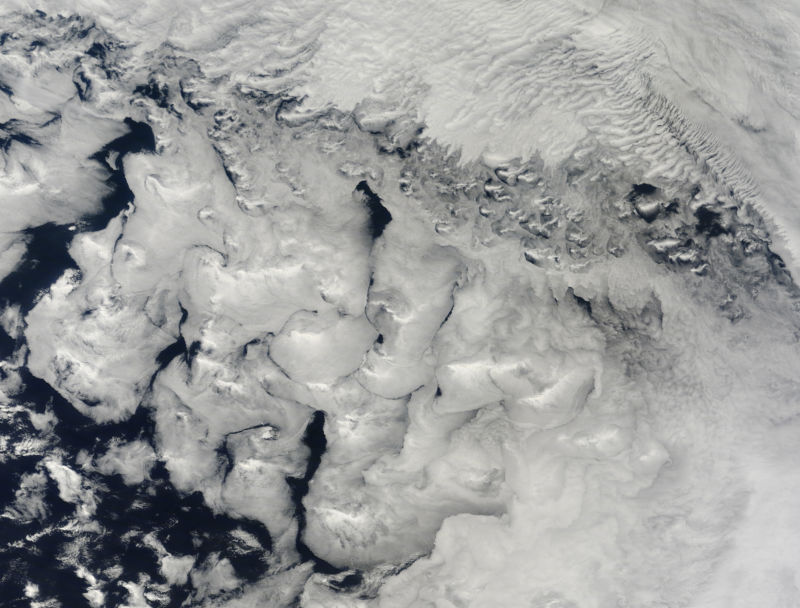
Stratocumulus clouds, like those in the lower two-thirds of this image, are common over the oceans.
The word “hysteresis” doesn’t immediately seem threatening; it hints at a portmanteau of “history” and “thesis”—a dense read, perhaps, but those never killed anyone. But that’s not what the word means. Hysteresis is a profound behavior some systems can display, crossing a sort of point-of-no-return. Dial things up just one notch, and you can push the system through a radical change. To get back to normal, you might have to dial it down five or six notches.
Earth’s climate system can provide examples. Take the conveyor-belt-like circulation of water in the Atlantic Ocean. Looking back at the past, you can see times that the circulation seems to have flipped into an alternate pattern regarding climatic consequences around the North Atlantic. Switching from one pattern to the other takes a significant nudge, but reversing it is hard—like driving up to the top of a ridge and rolling down into the next valley.
A new study led by Caltech’s Tapio Schneider may have identified a disturbing hysteresis in Earth’s climate—a shift in cloud patterns in response to warming that could quickly heat the planet much further. If we were to continue emitting more and more greenhouse gas, we’d eventually end up running this experiment for real. (Let’s not, please.)
Cloud services
The center of this drama is a particular type of cloud. Stratocumulus clouds typically blanket about a fifth of the low-latitude ocean. Most clouds are formed because air warmed by the Earth’s surface (or forced over mountains) cools as it rises, condensing water vapor to cloud droplets.
Stratocumulus clouds are a little different. The convection that lifts their moisture isn’t driven by warming at the bottom but by cooling at the top.
The water in this cloud deck absorbs much of the infrared radiation emitted upward from the warm surface. The cloud deck re-emits some radiation back downward and some into outer space. The air above these clouds is drier and absorbs much less of the outgoing energy passing through it. That means you can think of these clouds like the cooling fins of a radiator. They shed more heat upward than they receive from the atmosphere above them, allowing them to cool off from the top down. The cold air at the top of the clouds sinks, setting up a convection loop that brings water vapor up from the sea surface to the cloud deck.
So, what happens to this unique process in a warmer world?
Nothing but blue skies
To tackle this, Schneider and his colleagues flipped things around. They utilized a model that can simulate these clouds in a small patch of atmosphere—given a simplified version of the world around them. Specifically, they simulated a patch of the subtropical ocean with stratocumulus clouds above and a neighboring patch of tropical ocean responding to global warming. They did this for varying concentrations of greenhouse gas equivalent to 400 parts per million of CO2 (similar to today) on up to 1,600 parts per million.
Up to about 1,000 parts per million, there were no major surprises. Things got around 4°C warmer and numbers changed for things like water vapor and cloud altitude. But the cloud deck generally looked familiar.
At about 1,200 parts per million, however, the simulated clouds suddenly dissipated. And without that shade reflecting sunlight, the world warmed another 8°C.
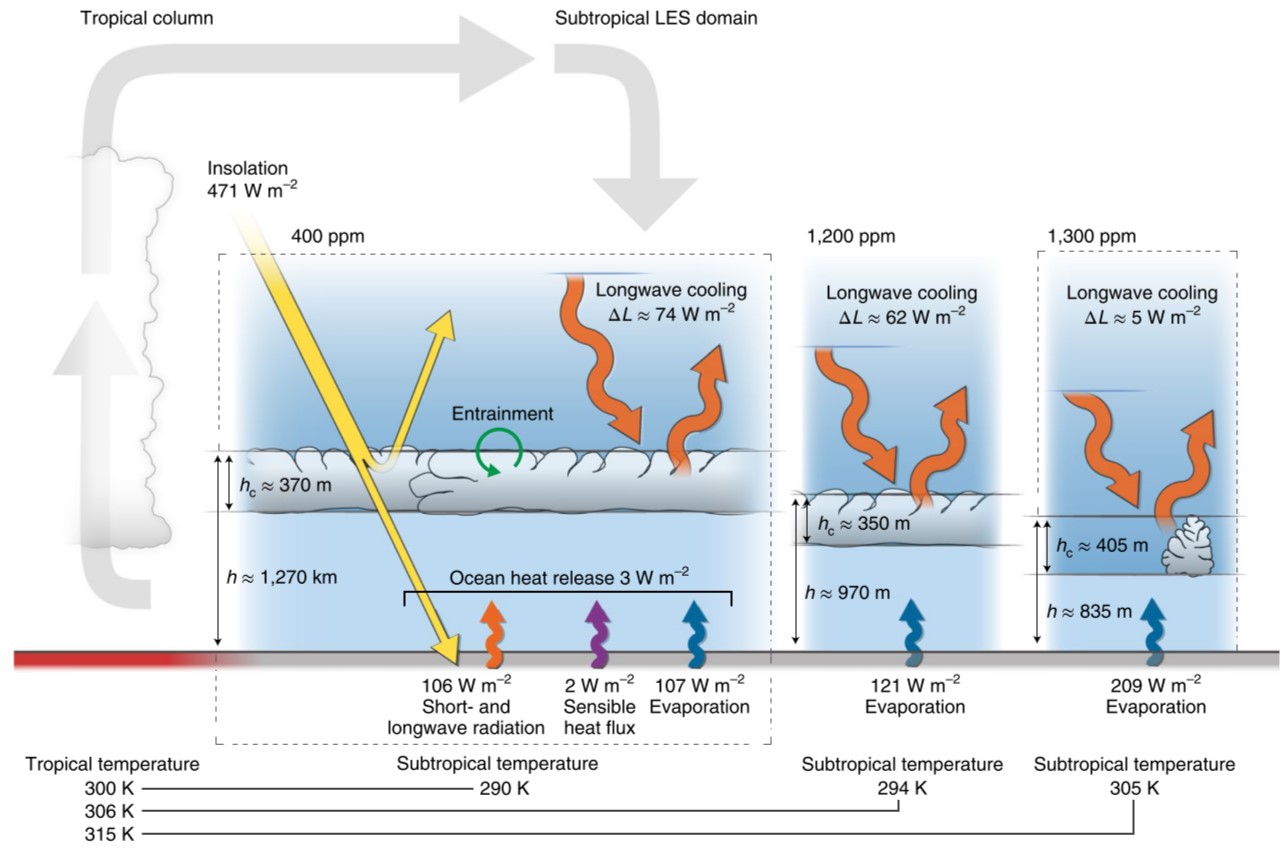
Processes responsible for the cloud deck breaking up around 1,200 ppm CO2 in the model. Temperatures shown in units of kelvins.
Schneider et al./Nature Geoscience
How is CO2 flipping the switch on these clouds? The researchers found a pair of simple processes working together in their simulation. First, warmer air carries more water vapor up from the sea surface, and when that water vapor condenses, it releases a lot of latent heat. That extra latent heat gives the air a little buoyancy boost, increasing the turbulent movement that can mix dry air from above into the cloud layer. This dries out the cloud deck and makes cloud formation less likely.
via Watts Up With That?
February 26, 2019 at 08:16PM
 Iowa Climate Science Education