Month: March 2019

Climate Kids Spurious Lawsuit Claims

Robert W. Endlich provides the back story on the flimsy complaints from kids suing the US government for the right to a stable climate. He writes at Master Resource Sixty Minutes on the Kiddie Climate Lawsuit: Hypocrisy Squared. Some excerpts in italics wth my bolds to encourage you to go read the whole article.

Plaintiff #1: Kelsey Cascadia Rose Juliana, Oregon

Her activist parents stopped government from managing the forests. Now she blames wildfires on “climate change.”
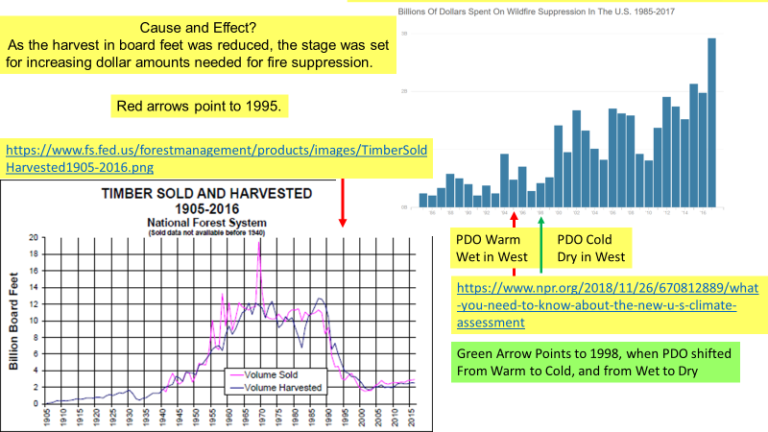
Figure 1. Left line graph: timber sold and harvested 1905-2016. Right bar graph: dollars spent on firefighting. The red arrows represent the year 1995. The green arrow shows when the Pacific Decadal Oscillation shifted from its warm and wet period in the US West, to its cold and dry period.

Now a college student, Kelsey Cascadia Rose Juliana tells us that the often-severe forest fires that plague the Pacific Northwest are a result of “Climate Change,” because, “that’s what the scientists tell us.” That this might have been a result of the fuel buildups when logging was stopped in the Spotted Owl case has not entered her head; nor the thought processes of Sixty Minutes’ producers; nor the thinking of scientists, teachers, professors and politicians who “taught” her and Sixty Minutes about fires and climate change.

Although many other scientists could have explained the clear link between fuel buildups and massive conflagrations in forests where timber thinning and cutting are prohibited, they were not consulted.

Juliana says, “We have everything to lose if we don’t act on climate change.”

Evidently, no one ever told Juliana it is just as impossible to “stop climate change” as it is to “stop continental drift,” stop the progression of tides, or stop sea level changes and land subsidence. All of these are a result of natural environmental processes that are (or once were) taught in basic Earth Science courses – processes that were carelessly or deliberately left out of the reporting by CBS reporter Steve Croft and CBS Producer Dragon Mihaljevic.
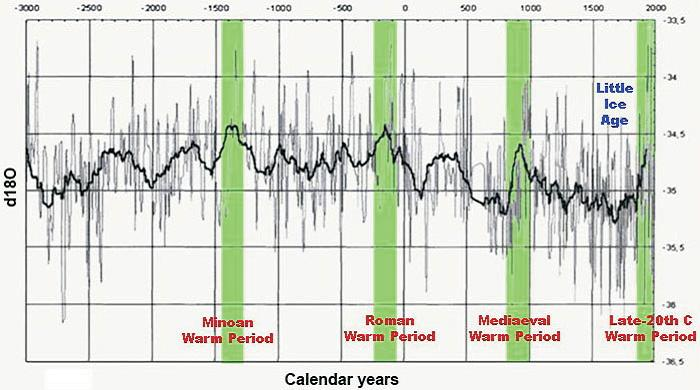
Figure 2. Temperature time series from the GISP2 ice core, showing the past 5,000 years of temperatures with Minoan, Roman, Medieval and Late 20th Century warm periods highlighted [Source]. The likelihood that humans can “stop climate change” that is a natural aspect of Earth’s environment should be obvious.

Plaintiff #2: Levi Draheim, Florida

He lives on a barrier island off the hurricane-prone Atlantic coast. The government is supposed to protect him from storms and rising sea level that have always eroded coastal islands.
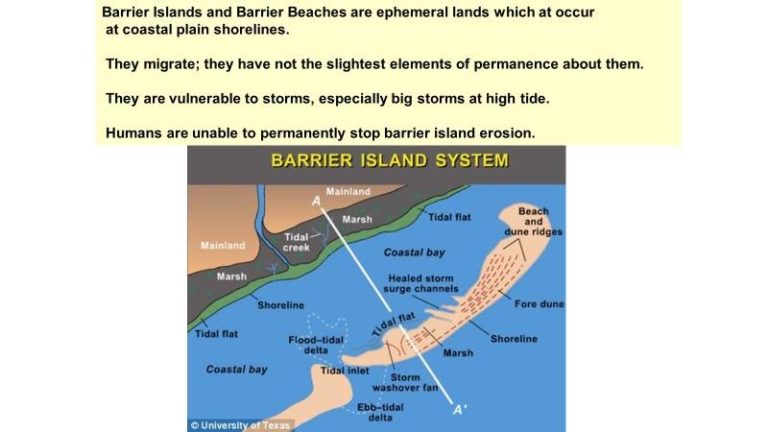
Figure 4. Graphic showing the features of Barrier Island Systems from the University of Texas showing they are characteristic of flat coastal plains. That Sixty Minutes should not recognize the peril of exposing permanent resident children to life on barrier islands seems studied ignorance of obvious environmental hazards.

Plaintiff #3: Jayden Foytlin, Louisiana

Her home was flooded in Rayne, LA, about 20 miles from the Gulf Coast and a mere 20 feet above sea level. She claims a right against rainstorms, even though her home is called the “Frog Capital of the World,” with numerous houses elevated on blocks.

Climate Kid 15-year-old Jayden Foytlin, from southern Louisiana, found her home flooded in August 2016. Mr. Mihaljevic speaks of flooding rains in southern Louisiana as somehow an unexpected new phenomenon that young Jayden suddenly experienced when she woke up and “put her foot into climate change.” Not into a frequent weather event on the Louisiana Coast, but into “climate change.” It’s not very subtle propaganda, but most viewers must be prepared, or they will miss it.

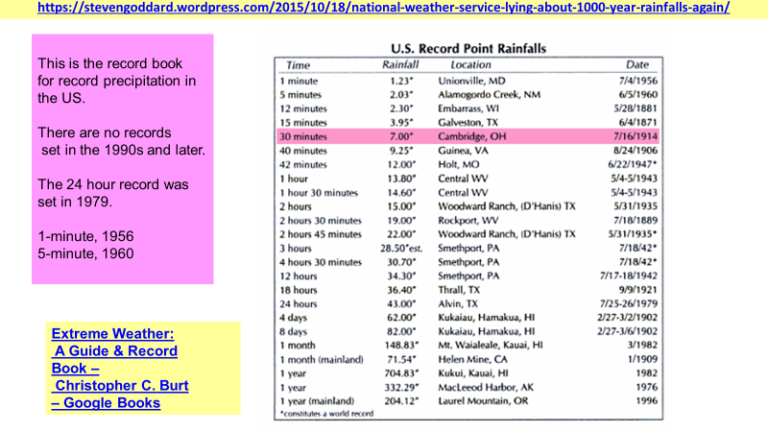
She lives in Rayne, LA, about 20 miles from the Gulf Coast and a mere 20 feet above sea level. This is very flat outer coastal plain with poor drainage. That she has no clue that flat-lying land adjacent to the Gulf Coast would be subject to flooding when a hurricane strikes and some 16 inches of rain can occur within two days – is an artifact of inadequate education, and lack of self-awareness that might be attributable to her tender years.

That a fifteen-year old student would have no knowledge of even the possibility of flooding during a hurricane (or spring melts after heavy snows in the Upper Mississippi Basin) strains credulity. But perhaps her expectations were shaped by the 12-year absence of any Category 3-5 hurricane making US landfall between Wilma (2005) and Harvey (2017) – virtually her entire perceptive lifetime.

That the Sixty Minutes report makes it seem as if sixteen inches of rain within two days is somehow related to climate change, rather than a result of the climate and weather we have today, and have had for decades and centuries, is yet another willful study in ignorance by the talking heads seen on MSM and CBS.

Just a few minutes of internet searching will uncover substantial data on extreme rainfall events in the USA. Some are displayed below in Figure 5.
Ironies of History, Concerns for America’s Future

The irony here is too rich not to discuss. Juliana’s parents and environmentalists, along with politicians and courts teamed up a few decades ago to file lawsuits that blocked timber sales and cutting, thereby causing a gradually enormous buildup of diseased, dying and dead trees, brush and other highly inflammable materials.

Huge, deadly conflagrations inevitably ensued – and now the same parties blame climate change for the infernos, enlist their (indoctrinated) children as sympathetic plaintiffs, focus on the kids’ deep fears, and sue fossil fuel producers for damages. Is there such a thing as criminal hypocrisy?

I have no great hopes that lawyers and courts will come up with the right answer.

We need only look at the results of the Massachusetts vs. EPA lawsuit, which was filed by Massachusetts based on the notion that sea level rise is caused by or accelerated by our use of fossil fuels. For “authority,” the U.S. Supreme Court accepted a political document, the IPCC Working Group I report, which considers only human factors in climate change and now asserts that only humans are causing climate change, with natural factors relegated to the sidelines as essentially irrelevant.

That such ignorance, stupidity and anti-science are now central elements of our legal system is simply breathtaking.

Indeed, had EPA attorneys been competent, and had they presented appropriate sea level data and other real-world evidence during trial and on appeal, the Supreme Court could have examined data like that from National Oceanic and Atmospheric Administration’s (NOAA’s) tide gage in Boston harbor. As Figure 8 illustrates, the rate of sea level rise is essentially unchanged over the past century and longer, even as CO2 levels climbed, then accelerated, in their rate of increase, especially since the 1960s.

Carbon dioxide from burning hydrocarbon fuels and human exhalations is the same colorless, odorless gas that plants use, in combination with energy from sunlight, to create carbohydrates. It is not a pollutant, but the elixir of life. Humans, animals and plant life are all carbon-based life forms.

The Supreme Court was just as wrong in its 2007 Massachusetts vs. EPA decision as it was in its infamous 1857 Dred Scott decision – which held that no “negro whose ancestors were imported into [the United States] and sold as slaves” could be an American citizen, and therefore had no standing to sue in federal court. Dred Scott, it can be argued, eventually led to the Civil War.

I have no great hope that today’s Supreme Court or lower courts can be depended on to arrive at the right answer when it comes to science in this case. I just hope cases like the “climate kids” Juliana vs the USA will not cause such energy, economic, societal and political disruption that our nation becomes embroiled in another civil war over our energy, livelihoods, living standards, and whether courts and bureaucrats will have the right to dictate Americans’ rights and choices in these matters.

Robert W. Endlich served as Weather Officer in the USAF for 21 Years. From 1984 to 1993, he provided toxic corridor and laser propagation support to the High Energy Laser Systems Test Facility at White Sands Missile Range. He has published in the technical literature and worked as software test engineer at New Mexico State University. Endlich was elected to Chi Epsilon Pi, the national Meteorology Honor Society, while an Air Force Basic Meteorology student at Texas A&M University. He has a bachelor’s degree in Geology from Rutgers University and a master’s in Meteorology from the Pennsylvania State University.

via Science Matters

https://ift.tt/2FjpcgY

March 18, 2019 at 09:19AM

The Myth That Oil Demand Is Coming To An End

Demand for oil is not coming to an end for a very long time, if ever.

On March 12, 2019, Maclean’s Magazine published an article by Jen Gerson entitled What Happens When the Demand for Alberta Oil Goes Away? In it, she commented on the forthcoming Alberta provincial election and wrote that carbon taxes and culture wars are not the real long-term concern. It is that “the demand for oil is going to go way”. She went on to explain that this may not happen in the next five to fifteen years, but that “it’s a pretty safe bet that the global demand for oil is going to abate within my lifetime, as climate policies, decarbonization efforts, and new technologies come to the fore”. She speculated that her child, now a toddler, “will probably drive an electric car”.

I have always thought that the job of managing editors
at major newspapers and magazines was to ensure that writers exercise at least
a minimal level of fact-checking before they publish their work, even when it
concerns future developments. One hour of on-line research of the authoritative
sources of information about global oil supply and demand would have
demonstrated to Ms. Gerson that her speculations are completely at odds with
present trends and with the views of the experts that project oil supply and
demand well into the future.

The Past

Oil is now and has been for over 60 years the most
important source of energy for the global economy, and the trends in its use
have long been linked to increasing incomes. Global demand grew from 61 million barrels of oil per day (Mb/d) in
1980 to 77 Mb/d in 2000 and 100 M/d in 2018.
Over the past 33 years, annual
oil demand has only failed to increase three times, during periods of severe
economic recession.

Further, over the past decade the pace of oil demand
growth has accelerated. Annual oil
demand growth has been over one Mb/d since 2012. It was over 1.5 Mb/d in 2017
and 1.4 Mb/d in 2018. The period since 2012 has witnessed the fastest sustained
period of demand growth in history. Demand is at its highest level ever.

This is confirmed by all major authorities, including the International Energy
Agency (IEA) and the U.S. Energy Information Administration (EIA).

Present Trends

Both the IEA and EIA produce regular reports on
current oil market trends. In its most recent report, Oil 2018, the IEA noted
that a strong world economy, with projected global economic growth of 3.9% in
the next few years and all regions expected to perform well, means that oil demand will continue to surge ahead at
an average annual rate of 1.2 Mb/d. By 2023, the IEA projects global oil demand
to reach 104.7 Mb/d.
China and India together will account for nearly 50%
of global demand growth. The IEA goes further, and states that “there is no peak oil demand in sight.”

While the transportation sector will constitute the
largest source of demand as usual, the fastest growing source of demand growth
is petrochemicals, particularly in the United States and China.

Only a few years ago, many voices were claiming that
the world was headed for a period of peak oil supply. Instead, even with OPEC
oil production capacity growing slowly, and socialist Venezuela steadily
reducing production from its enormous resources, the almost doubling of U.S.
oil production since 2010 and supply growth in Brazil, Norway, Canada and
others is assuring adequate supply and moderate prices. The IEA projects U.S.
oil production to increase by 3.7 Mb/d from 2018 to 2023.

The Outlook to 2040 and Beyond

Over the longer term, the demand for oil will be
determined by several factors including notably the rate of economic growth,
technological change, the growth of middle classes in developing countries, and
the effects of government policies, regulations and subsidies designed to
promote increased fuel efficiency, alternative fuel vehicles and
electrification of the economy. In this regard, it is important to note that, for most transportation uses, there simply
are no technologically and commercially viable alternatives to oil fuels,
especially for freight movement and aviation.

Four organizations are recognized as the premier sources of analysis of
long-term energy supply and demand: the IEA the EIA, Exxon, and British
Petroleum. In their most recent projections of supply and demand to 2040, none
of them project a reduction in oil demand.

The Role of Electric Vehicles and Hybrids

Ms. Gerson’s speculations appear to be driven in part
by her belief that electric vehicles will soon (i.e. within a generation) replace
internal combustion engines.

Let us examine this thesis. Today, electric vehicles
enjoy the benefits of billions of dollars in government subsidies in Europe,
North America and China, which has led to their steady growth in sales. They
benefit also from virtually endless hype in the media. According to JATO, a
well-regarded automotive market research firm, in 2017 there were 3.8 million personal
electric vehicles (i.e. cars and SUVs) sold globally. Most of them were hybrids,
that continue to rely on oil as a fuel part of the time. 668,000 were battery
electric vehicles.

For context, one can read the reports of the
International Organization of Motor Vehicle Manufacturers (OICA), which
publishes statistics on annual sales of personal cars, commercial vehicles and
all vehicles globally. Table 1, drawn from OICA data, shows global personal car
sales for selected years:

                          Global Sales of Personal Cars (million)

These figures illustrate a number of points.

  • Total personal car sales
    were almost 71 million in 2017. Battery electric vehicles were 0.9% of global
    sales.
  • Total personal car sales grew by an annual average
    rate of 2.2% over the period 2010 to 2017.
  • Despite all the rhetoric about Europeans giving up
    cars, sales rose over the period.
  • The Americas is the only region in which annual car
    sales fell. The USA and Canada, combined, represent only 9.4% of global sales.
  • The growth in car sales, like the growth in energy
    use, is occurring overwhelmingly in Asia, the Middle East and Oceania.
  • China’s growth in cars sales from 2010 to 2017
    exceeded total USA car sales in 2010.

The figures for commercial vehicles are comparable,
except that the number of battery-powered commercial vehicles sold is
negligible. There are no authoritative estimates of the current global car
fleet; some estimates put it in the range of 1.1 to 1.3 billion. As the average
lifetime of a car in use is about 10 years, it will take many, many decades
before most people drive battery-powered electric cars, if ever.

The economics of car ownership reinforce these points.
For most of history, car ownership per thousand people (i.e. the “motorization
rate”) showed profound differences between the wealthier countries of the OECD
and the poorer ones in Asia and elsewhere. Even today, the motorization rate in
the United States is 821, compared to a world average of 182. That, however, is
changing rapidly, as the middle classes of China, India and Southeast Asia
increase sharply in numbers and incomes. A decade ago, China’s motorization
rate was under 50; today it is 118. India’s rate is 22; when its population of
1.2 billion becomes able to afford motorized transport, the effect on car sales
will be dramatic. Consumers will be looking for the most economical choices and
that is almost certainly not electric.

Conclusion

Ms. Gerson reportedly has an excellent reputation as a
journalist, but she made a serious error in accepting the aspirational goals of
climate alarmists as credible substitutes for evidence-based analysis of energy
markets. Demand for oil from Alberta and many other places is not coming to an
end for a very long time, if ever. Government policies based on the presumption
that they were would do immense harm to the public interest.

The post The Myth That Oil Demand Is Coming To An End appeared first on The Global Warming Policy Forum (GWPF).

via The Global Warming Policy Forum (GWPF)

https://ift.tt/2UHSP0s

March 18, 2019 at 09:10AM

Monday Mirthiness – Greta’s two degrees

Josh comes through with another cartoon. In case you missed it, over the weekend, Willis Eschenbach published “Planet-Sized Experiments – we’ve already done the 2°C test” One of the truths in that article was directed at this past weekend’s “climate strikes”, inspired by 16 year old Greta Thunberg. Willis makes a lot of sense with…

via Watts Up With That?

https://ift.tt/2HteLts

March 18, 2019 at 09:04AM

No new natural gas hookups in New York’s Westchester County, Con Ed says

Con Ed is sticking to its plans for the moratorium.  The pain of green policies begins to be felt in NY.~ctm A logo of New York power utility Consolidated Edison Inc is seen in New York July 1, 2012. REUTERS/Eric Thayer (Reuters) – New York energy company Consolidated Edison Inc said on Friday it still…

via Watts Up With That?

https://ift.tt/2O8DP9s

March 18, 2019 at 07:04AM