Month: March 2019

Solar tsunami can trigger the sunspot cycle

Sunspots [image credit: NASA]

Something else for solar theorists to ponder. The researchers say: ‘We have demonstrated here a physical mechanism, the solar tsunami, which gives birth to the new cycle’s sunspots precisely within a few weeks from the cessation of old cycle’s spots.’

According to the model, the next sunspot cycle can be expected to begin in 2020, says The Hindu.

It is believed that the “solar dynamo” — a naturally occurring generator which produces electric and magnetic fields in the sun — is linked to the production of sunspots.

What kick-starts the 11-year sunspot cycle is not known. Now, a group of solar physicists suggests that a “solar tsunami” is at work that triggers the new sunspot cycle, after the old one ends.

The extreme temperature and pressure conditions that prevail some 20,000 km below the sun’s surface cause its material to form a plasma consisting primarily of hydrogen and helium in a highly ionised state. The plasma is confined with huge magnetic fields inside the sun.

Explains Dr. Dipankar Banerjee from the Indian Institute of Astrophysics, Bengaluru, and one of the authors of the paper published in Scientific Reports, “The [sun’s] toroidal magnetic field, from which sunspots get generated, wraps around the sun in the east-west direction.”

Celestial rubber bands

These magnetic fields behave like rubber bands on a polished sphere. They tend to slip towards the poles. Holding these fields in their place requires that there is extra mass (plasma mass) pushing at the bands from higher latitudes.

Thus, a magnetic dam is formed which is storing a big mass of plasma. At the end of a solar cycle, this magnetic dam can break, releasing huge amounts of plasma cascading like a tsunami towards the poles.

These tsunami waves travel at high speeds of about 1,000 km per hour carrying excess plasma to the mid-latitudes. There they give rise to magnetic flux eruptions. These are seen as the bright patches that signal the start of the next cycle of sunspots.

The tsunami waves can traverse the required distance in a few weeks, unlike in earlier models.

Full article here.

via Tallbloke’s Talkshop

https://ift.tt/2TGwYds

March 17, 2019 at 10:49AM

Arctic Ice Marching 2019

A previous post discussed 15M km2 as the average maximum threshold for March arctic ice extents.The graph shows 2019 exceeded the previous two years, but now it appears to fall just short.  On day 61, March 2, 2016 peaked well above 15M, and did not reach that level again. The graph shows 2017 peaked early and then descended into the Spring melt.  2018 started much lower, gained steadily before peaking on day 74, 250k km2 below average. 2019 has been exceptional, surging early to surpass average on day 54, then declined for a week, before re-surging to virtually tie the average extent on day 70.  Day 71 extent matched the earlier peak, then retreated and is now unlikely to go higher after day 75.

Presently, on day 75 2019 is 1% below the 12 year average (2007 to 2018 inclusive) and slightly higher than the preceding three years.


As reported previously, the action is mostly in the Pacific basins.  The last 10 days show Bering on the right recovering from its minimum to add back 230k km2.  Meanwhile Okhotsk on the left lost 120k km2, so the gain was not enough to reach the average.  On the Atlantic side, ice extents held firm, with Barents higher than in recent years.

Note on the left the ice has pushed well south of Newfoundland.  On the right Barents ice is holding onto Svalbard, and Kara remains at its maximum.

The table below shows the distribution of ice over the various Arctic basins compared to average and to last year.

Region 2019075 Day 075
Average
2019-Ave. 2018075 2019-2018
 (0) Northern_Hemisphere 14823898 14996207 -172310 14704038 119860
 (1) Beaufort_Sea 1070498 1070200 297 1070445 53
 (2) Chukchi_Sea 965766 966002 -236 966006 -240
 (3) East_Siberian_Sea 1087137 1087134 3 1087137 0
 (4) Laptev_Sea 897845 897842 3 897845 0
 (5) Kara_Sea 934746 917400 17346 934970 -224
 (6) Barents_Sea 777137 618675 158462 718542 58595
 (7) Greenland_Sea 549834 616633 -66799 533408 16426
 (8) Baffin_Bay_Gulf_of_St._Lawrence 1561378 1593403 -32025 1480294 81084
 (9) Canadian_Archipelago 853337 852783 555 853109 229
 (10) Hudson_Bay 1260903 1257469 3434 1260838 66
 (11) Central_Arctic 3235099 3218575 16524 3167361 67738
 (12) Bering_Sea 371625 802103 -430478 432417 -60791
 (13) Baltic_Sea 54792 82770 -27978 125618 -70826
 (14) Sea_of_Okhotsk 1194159 995230 198928 1159963 34196

The table shows that except for Bering, Arctic ice extents are firm almost everywhere.  Barents and Kara and Okhotsk are well above average, but not enought to offset the deficit of Bering ice, even with the recent recovery.

Typically, Arctic ice extent loses 67 to 70% of the March maximum by mid September, before recovering the ice in building toward the next March.

Drift ice in Okhotsk Sea at sunrise.


via Science Matters

https://ift.tt/2JgP8xC

March 17, 2019 at 10:41AM

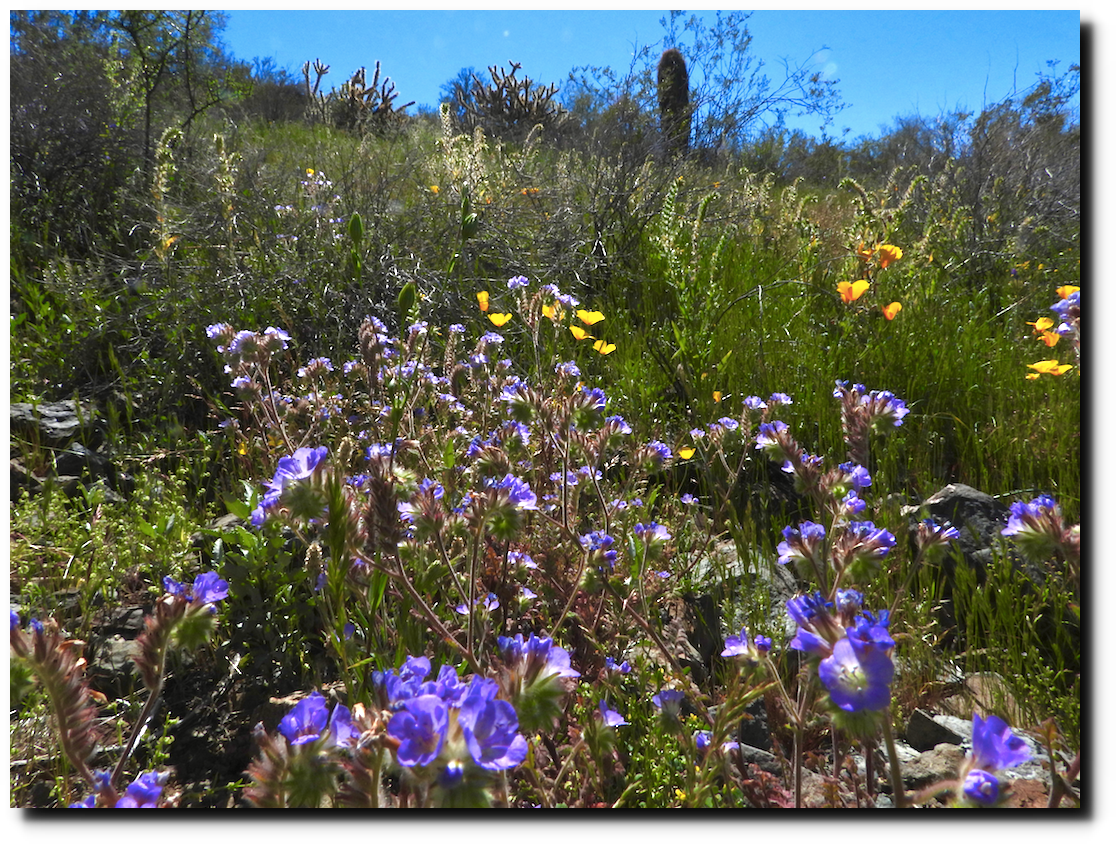
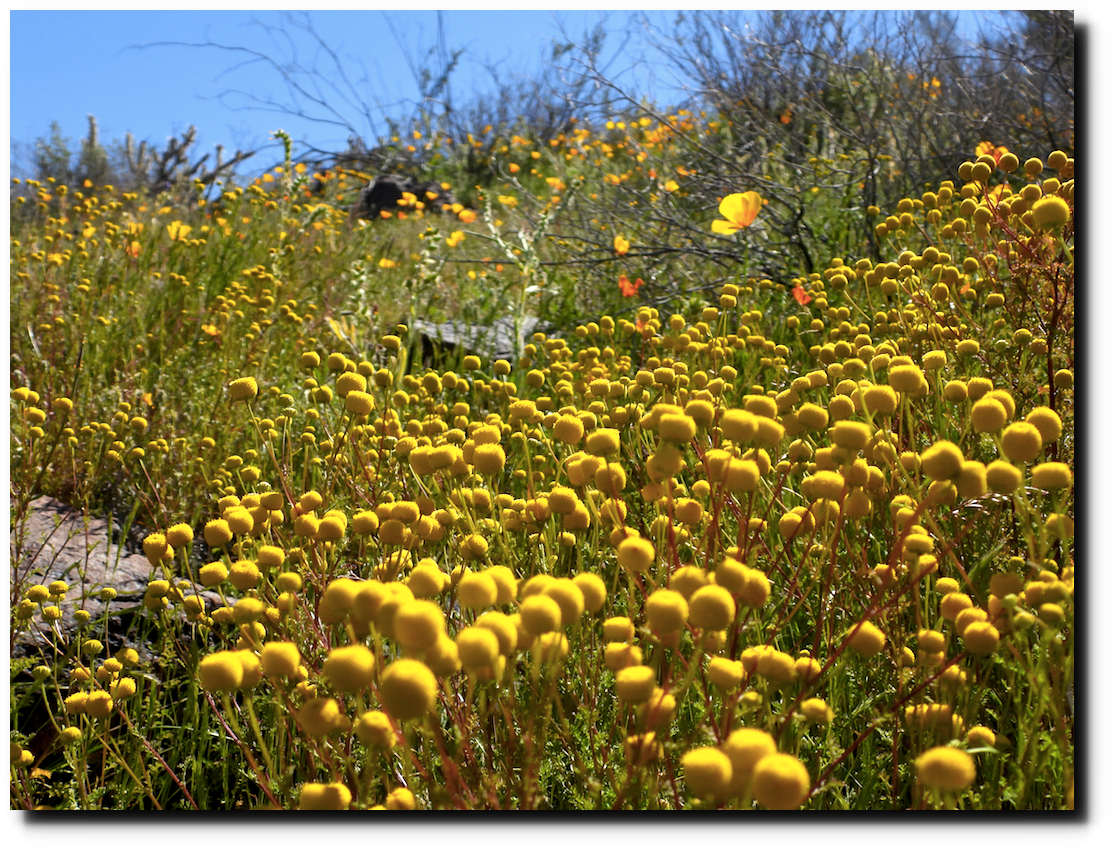
Last Day In The Desert

via The Deplorable Climate Science Blog

https://ift.tt/2FeVmJ0

March 17, 2019 at 10:24AM

“Global Warming” Leaves Ireland In The Cold …Emerald Island Has Been Cooling Over Past 3 Decades!

By Kirye

As today is St. Patricks Day, it’s a good time to look at Ireland’s annual mean temperatures over the recent decades.

As we recall, global cooling was the scare of the 1970s before global warming became the scare in the 1980s. So since the 1980s, a fair amount of warming must have taken place, right?

No.

Ireland has been cooling

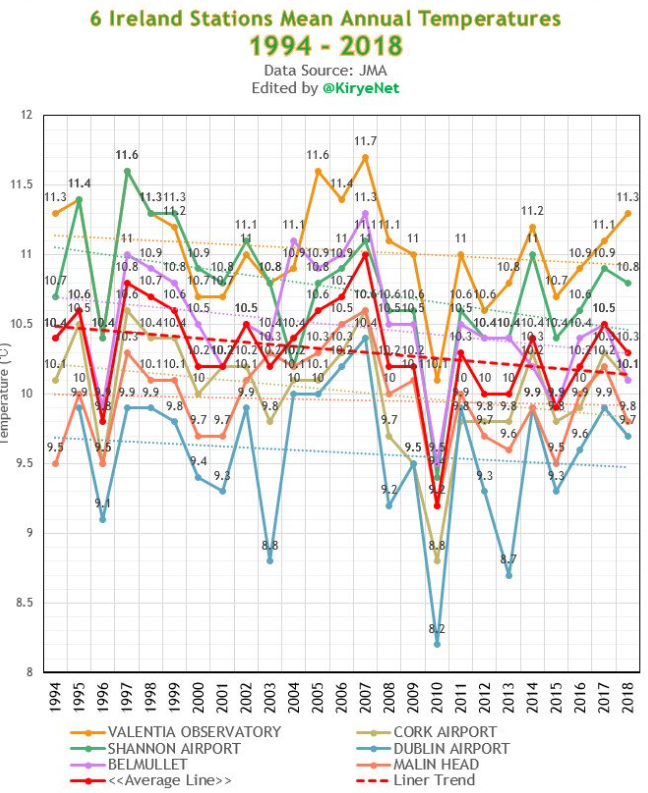
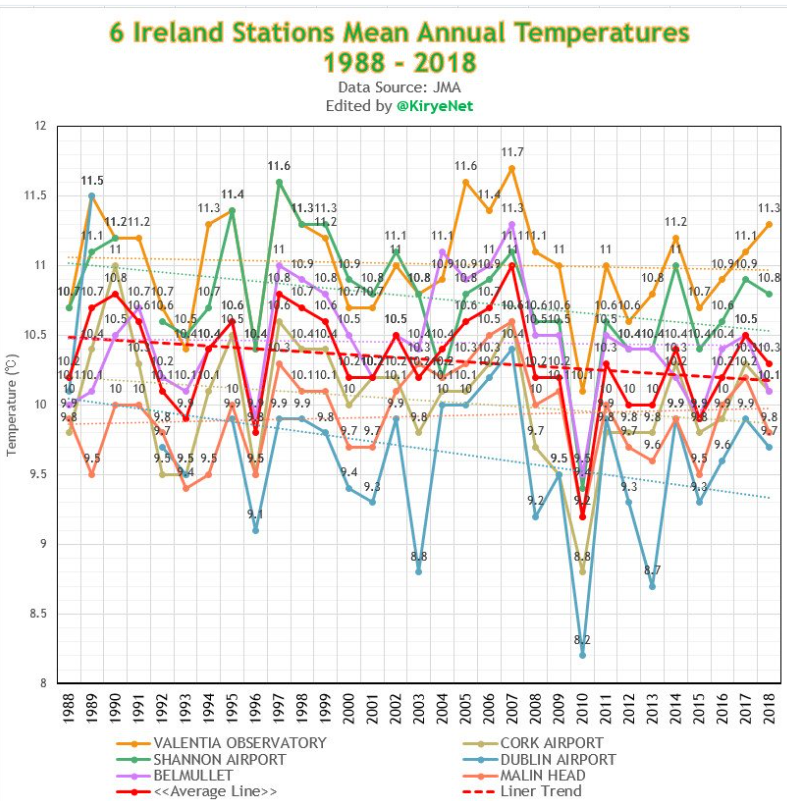
Looking at 6 stations (half at airports!) across the emerald island, we see in fact there’s been a notable cooling over the past 25 years, since 1994:

Data: JMA

Obviously global warming never made it to the island. And yes, it’s mysterious how the Irish media still continue to hysterically warn about warming when temperatures in fact have been falling instead of rising.

The source of the (untampered) plotted data is the Japan Meteorology Agency (JMA). The six datasets were selected because of their data completeness – only a few months of data are missing.

30 years of cooling

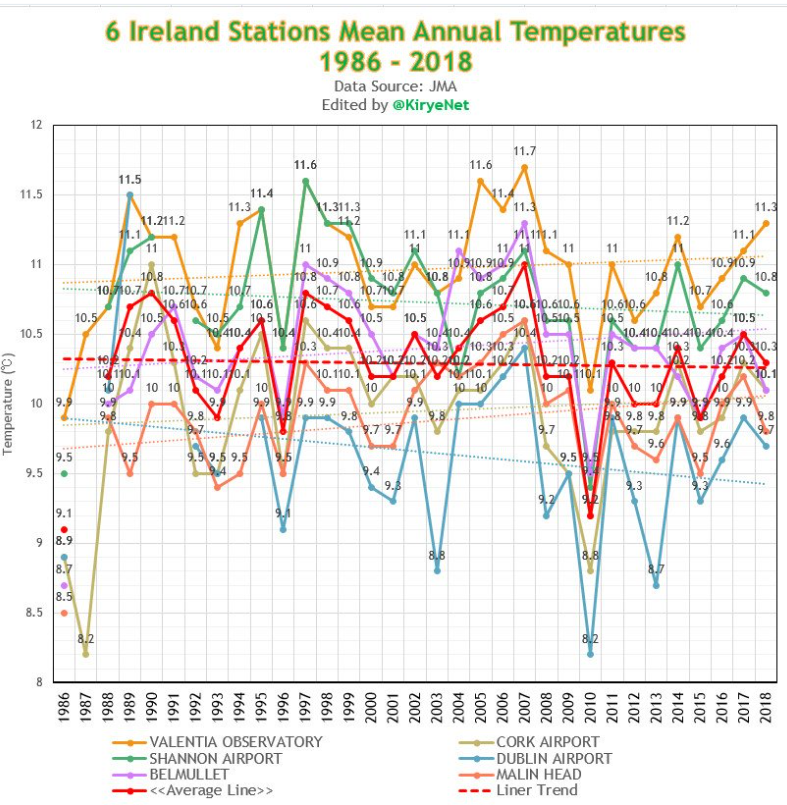
The non-warming trend of the 6 Irish stations goes back to 1986, i.e. more than 30 years:

Data: JMA

There has not been any warming since 1986, thus surpassing the 30-year mean that is defined as “climate”. We see a similar trend in my home country of Japan.

Cooling since Hansen’s 1988 warnings of warming

When did the Irish cooldown start? After the cold years of 1986 and 1987, the temperature spiked more than 3°C in a single year to 11.5°C in 1988, the year that Dr. James Hansen told the world before Congress that the planet was heating and would heat up to unbearable conditions within 30 years.

Plotting the data since Dr. Hansen’s dire warnings in 1988, we see that Ireland in fact has cooled off:

Data: JMA

If the Irish can celebrate anything this St. Patrick’s Day, it is the fact that they won’t need to worry about overheating anytime soon.

Happy St. Patrick’s day everyone.

===============================
Pierre Gosselin contributed to this article.

via NoTricksZone

https://ift.tt/2HDQ7Fz

March 17, 2019 at 09:10AM