
by Judith Curry
“For decades, scientists and policymakers have framed the climate-policy debate in a simple way: scientists analyse long-term goals, and policymakers pretend to honour them. Those days are over. Serious climate policy must focus more on the near-term and on feasibility.” – Y. Xu, V. Ramanathan, D. Victor
On twitter, Joe Duarte drew my attention to an editorial published in Nature: Global warming will happen faster than we think.
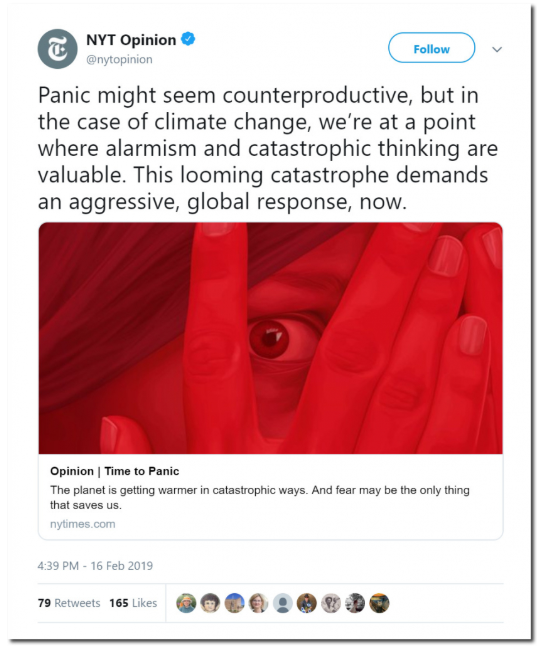
No surprise that the article sounds the ‘alarm’, accelerated warming, speeding freight train, and all that.
Towards the end of the article, the authors make some very astute recommendations regarding climate policy, which is reproduced in its entirety:
Four Fronts
“Scientists and policymakers must rethink their roles, objectives and approaches on four fronts.
Assess science in the near term. Policymakers should ask the IPCC for another special report, this time on the rates of climate change over the next 25 years. The panel should also look beyond the physical science itself and assess the speed at which political systems can respond, taking into account pressures to maintain the status quo from interest groups and bureaucrats. Researchers should improve climate models to describe the next 25 years in more detail, including the latest data on the state of the oceans and atmosphere, as well as natural cycles. They should do more to quantify the odds and impacts of extreme events. The evidence will be hard to muster, but it will be more useful in assessing real climate dangers and responses.
Rethink policy goals. Warming limits, such as the 1.5 °C goal, should be recognized as broad planning tools. Too often they are misconstrued as physical thresholds around which to design policies. The excessive reliance on ‘negative emissions technologies’ (that take up CO2) in the IPCC special report shows that it becomes harder to envision realistic policies the closer the world gets to such limits. It’s easy to bend models on paper, but much harder to implement real policies that work.
Realistic goals should be set based on political and social trade-offs, not just on geophysical parameters. They should come out of analyses of costs, benefits and feasibility. Assessments of these trade-offs must be embedded in the Paris climate process, which needs a stronger compass to guide its evaluations of how realistic policies affect emissions. Better assessment can motivate action but will also be politically controversial: it will highlight gaps between what countries say they will do to control emissions, and what needs to be achieved collectively to limit warming. Information about trade-offs must therefore come from outside the formal intergovernmental process — from national academies of sciences, subnational partnerships and non-governmental organizations.
Design strategies for adaptation. The time for rapid adaptation has arrived. Policymakers need two types of information from scientists to guide their responses. First, they need to know what the potential local impacts will be at the scales of counties to cities. Some of this information could be gleaned by combining fine-resolution climate impact assessments with artificial intelligence for ‘big data’ analyses of weather extremes, health, property damage and other variables. Second, policymakers need to understand uncertainties in the ranges of probable climate impacts and responses. Even regions that are proactive in setting adaptation policies, such as California, lack information about the ever-changing risks of extreme warming, fires and rising seas. Research must be integrated across fields and stakeholders — urban planners, public-health management, agriculture and ecosystem services. Adaptation strategies should be adjustable if impacts unfold differently. More planning and costing is needed around the worst-case outcomes.
Understand options for rapid response. Climate assessments must evaluate quick ways of lessening climate impacts, such as through reducing emissions of methane, soot (or black carbon) and HFCs. Per tonne, these three ‘super pollutants’ have 25 to thousands of times the impact of CO2. Their atmospheric lifetimes are short — in the range of weeks (for soot) to about a decade (for methane and HFCs). Slashing these pollutants would potentially halve the warming trend over the next 25 years.”
JC reflections
Although these recommendations come from a position of ‘alarm’, I agree with each of these recommendations, since each can be justified in terms of ‘no regrets’ actions.
I most particularly agree with the first recommendation on focusing on climate variability/change over the next 25 years. This is the time scale that is of greatest relevance for city/regional planning and for industry/enterprise. While recognizing the key importance of natural climate variability on this time scale, the authors miss what is likely to be the most significant event during this period: a transition to the cold phase of the Atlantic Multidecadal Oscillation.
The second recommendation recognizes the farce of the current international policy on emissions reductions.
Adaptation makes a lot of sense, and the adaptation objectives are mostly the same whether the cause of the extreme events or trend is caused by humans or nature.
And finally, the climate rapid response plan. I don’t know why this hasn’t received more traction, particularly related to soot.
via Climate Etc.
March 25, 2019 at 09:40AM



 Iowa Climate Science Education