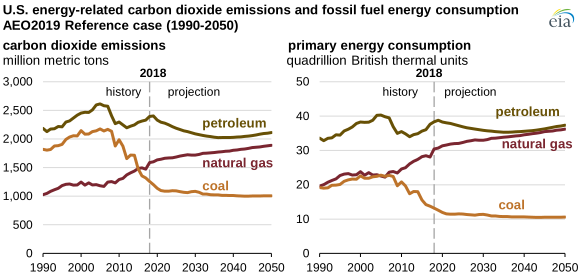
Carbon dioxide emissions from U.S. energy consumption will remain near current levels through 2050, according to projections in EIA’s Annual Energy Outlook 2019.
The AEO2019 Reference case, which reflects no changes to current laws and regulations and extends current trends in technology, projects that U.S. energy-related carbon dioxide (CO2) emissions will be 5,019 million metric tons in 2050, or 4% below their 2018 value, as emissions associated with coal and petroleum consumption fall and emissions from natural gas consumption rise.
Energy-related CO2 emissions generally follow energy consumption trends. In the United States, emissions associated with the consumption of petroleum fuels—motor gasoline, distillate, jet fuel, and more—have consistently made up the largest portion of CO2 emissions. In 2018, the transportation sector’s consumption accounted for 78% of U.S. CO2 emissions from petroleum and more than one-third of all U.S. energy-related CO2 emissions. Petroleum emissions from other sectors have fallen in recent years as equipment and processes that use petroleum fuels have been replaced by those using other fuels, in particular, natural gas.
Environmental Protection Agency Administrator Andrew Wheeler says that unsafe drinking water — not climate change — poses the greatest and most immediate global threat to the environment.
In his first network interview since his confirmation last month, Wheeler told CBS News chief Washington correspondent Major Garrett that while the administration is addressing climate change, thousands are dying everyday from unclean drinking water. Wheeler is announcing the EPA’s global clean water push in a speech at the Wilson Center in Washington, D.C., Wednesday morning.
“We have 1,000 children die everyday worldwide because they don’t have safe drinking water,” Wheeler told Garrett. “That’s a crisis that I think we can solve. We know what goes into solving a crisis like that. It takes resources, it takes infrastructure and and the United States is working on that. But I really would like to see maybe the United Nations, the World Bank focus more on those problems today to try to save those children. Those thousand children each day, they have names, we know who they are.”
The U.S., Wheeler said, has a number of clean water financing programs that provide grants and loans. He wants those to be models for international organizations like the United Nations to provide money to third-world countries.
The World Health Organization estimates that at least 2 billion people globally use a drinking water source contaminated with feces. It’s unclear what, if any, new funding the Trump administration might be providing for the clean water push.
Wheeler also insists his EPA is working to combat climate change, a phenomenon to which he says man “certainly contributes.” He said the Trump administration will roll out two major regulations later this year in an effort to reduce CO2 emissions in the U.S. Those measures would replace rules limiting carbon emissions from power plants and clean car standards.
Climate change, Wheeler said, “is an important change we have to be addressing and we are addressing.” But he added that “most of the threats from climate change are 50 to 75 years out,” while unsafe drinking water is killing people right now.
Wheeler noted that the U.S. has already cut CO2 emissions, which are thought to be the primary driver of climate change, by “14 percent since 2005.” He argued that the U.S. is “doing much better than most westernized countries on reducing their CO2 emissions, but what we need to do is make sure that the whole world is focused on the people who are dying today, the thousand children that die everyday from lack of drinking water. That is something where we have the technology, we know what it will take to save those children. And internationally, we need to step up and do something there.”
Asked if he views the EPA’s mission as protecting both the environment and business, Wheeler didn’t mention business.
“Well, the mission of our agency is to protect public health and the environment and that’s what we do and we do that every day. You know, it’s public health and the environment and that is our mission,” Wheeler told Garrett.
Wheeler says that’s why he thinks the Green New Deal, the proposal championed by progressive Democrats like Rep. Alexandria Ocasio-Cortez, is an “aspirational” but unrealistic idea. He claims the proposal could actually jeopardize clean drinking water.
“In fact, on the drinking water side, the Green New Deal does not value — at least nowhere in the documents does it value — having reliable electric grid,” Wheeler said. “A reliable electric grid is absolutely necessary to provide drinking water. You have to have the electricity. When we go, as a first responder, when we go into a community that’s been hit with a hurricane, or some other natural disaster, the first thing we do is try to make sure the electric grid is back up and running in order to provide the drinking water for those communities.”
As the recent crisis in Flint, Michigan, painfully brought to light, clean drinking water isn’t only a global issue. CBS News has reported that lead in America’s water system is a national problem, with warning signs surfacing in cities including Newark, Chicago, Detroit, Baltimore and Milwaukee.
Wheeler said the EPA is looking at what it can do to require regular testing for water in schools and daycares later this year.
“First of all, I want to make sure the American public understands 92 percent of the water everyday meets all the EPA requirements for safe drinking water,” Wheeler said.
“We have the safest drinking water in the world. We are working to update a number of regulations, one of which is our lead and copper rule, which takes a look at the pipes. The lead pipes that we have around the country. As part of that, we’re looking at what we can do to require regular testing for schools and daycares, so that would be part of that regulation when it comes out later this year.”
Wheeler also said that the water in Flint now meets EPA standards.
“Part of the problem with Flint was there was a breakdown in once they got the data, once the city of Flint, the state of Michigan, the Obama EPA – they sat on it,” Wheeler said. “We’re not doing that. As soon as we get information that there’s a problem, we’re stepping in, we’re helping the local community get that water system cleaned up.”
March 5, 2019 By James Taylor Download the PDF A review of all risk factors reveals that imposing carbon dioxide restrictions on the U.S. economy would diminish, rather than enhance, American military preparedness. Global warming activists claim climate change poses a threat to America’s military and national security. Their primary assertion is that alleged negative…
By Die kalte Sonne
(Text translated by P Gosselin)
New report shows Austrian winters have ignored global warming. Image cropped Zukunft Skisport.
The Austrian Paznaun is a valley in the far west of North Tyrol with an altitude of 900-1800 meters above sea level.
The region thrives on tourism, especially skiing, which generates more than 2 million overnight stays annually. For this reason, hosts and visitors have a special interest in the effects of climate change in Paznaun.
What are the current trends? In November 2018, ski tourism researcher Günther Aigner presented a study in which he closely examined winter trends using the official series of measurements. The pdf of the work can be downloaded free of charge from the web platform “Zukunft Skisport“, where further studies are also available.
Here is the short version of what he found:
The winters in the Paznaun since 1895: An analysis of official winter temperature and snow measurement series
The winters on the Ischgler Idalpe have become colder in the past 30 years. At the ZAMG station (Austrian Central Institute for Meteorology and Geodynamics), winter temperatures fell in a linear trend from minus 4.8 to minus 6.1 degrees Celsius – that is: by 1.3 degrees. Seven of the last ten winters were colder than the 30-year average.
However, no significant winter temperature changes have been observed on the Paznaun mountains for the past 50 years. In discussions about the course of temperatures in relation to winter sports in Tyrol, the choice of time axis is therefore of great importance. The snow measurements at the ZAMG Galtür station over the last 123 years show no statistically significant trends.
Since 1895/96, the annual number of days with natural snow cover has remained statistically unchanged at an average of 173 days. The highest annual snow heights since 1895/96 also show no statistical change and average 114 cm. Their variability is considerable, as the range goes from only 38cm in winter 2016/17 to 210cm in winter 1998/99.
In the ski area “Silvretta Arena” in Ischgl one could ski on 155 days in the average of the last 32 years. The linear trend is rising. Looking at the official measurement data evaluated in this study, the climatological conditions for winter sports in Paznaundie have remained favorable over the last 30 years. No forecasts for the future can be derived from the evaluations published here.”




 Iowa Climate Science Education