
According to the calculations of Dr. James Hansen, the radiative influence derived from the increase in CO2 during the last deglaciation was so negligible that it equated to “a third of energy required to power a honey bee in flight” (Ellis and Palmer, 2016).
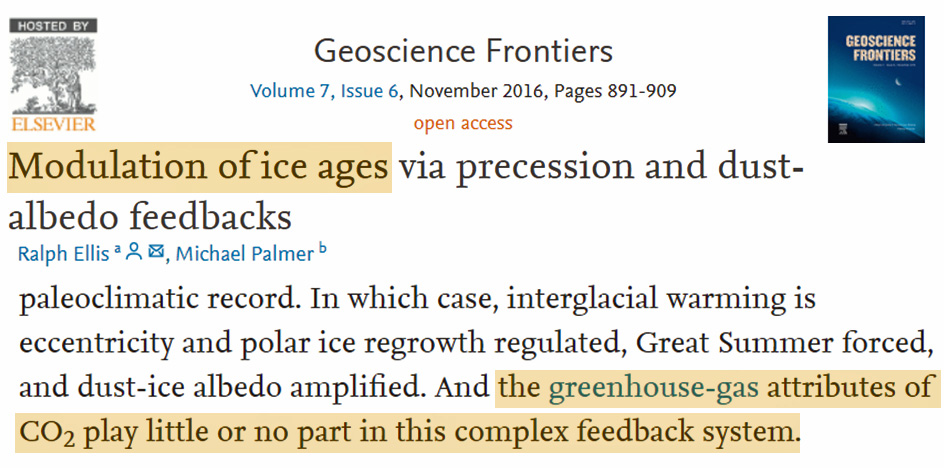
Image Source: Ellis and Palmer, 2016
Between about 22,000 and 17,000 thousand years ago, Earth’s sea levels were about 120 meters lower than they are now because much of the Earth’s seawater was locked up in kilometers-thick continental ice sheets.
Then, about 14,500 years ago, nearly the entire Northern Hemisphere abruptly warmed up by about 4-5°C within a span of about 20-30 years as sea levels rose at rates between 3 and 6 meters per century (Ivanovic et al., 2017). Northern Hemisphere sea surface temperatures warmed by 3°C in less than 90 years during this time.
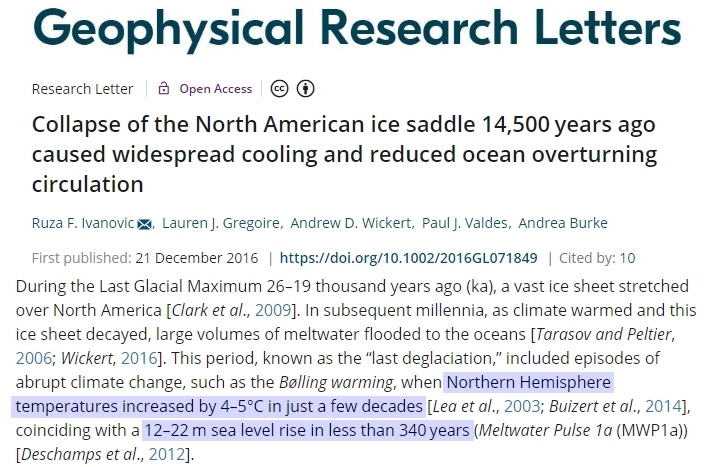
Image Source: Ivanovic et al., 2017
The last ice age ends and the Holocene begins
The Earth cooled and warmed and cooled and warmed for the next 3,000 years, during which time there was a gradual overall increase in global temperature of about 5-6°C superimposed on the abrupt decadal- and centennial-scale climate undulations.
By 11,700 years ago, when Greenland warmed up by 10°C within about 50 years (Steffensen et al., 2008), the last ice age glacial period ended and the Holocene interglacial warmth we now enjoy officially commenced.
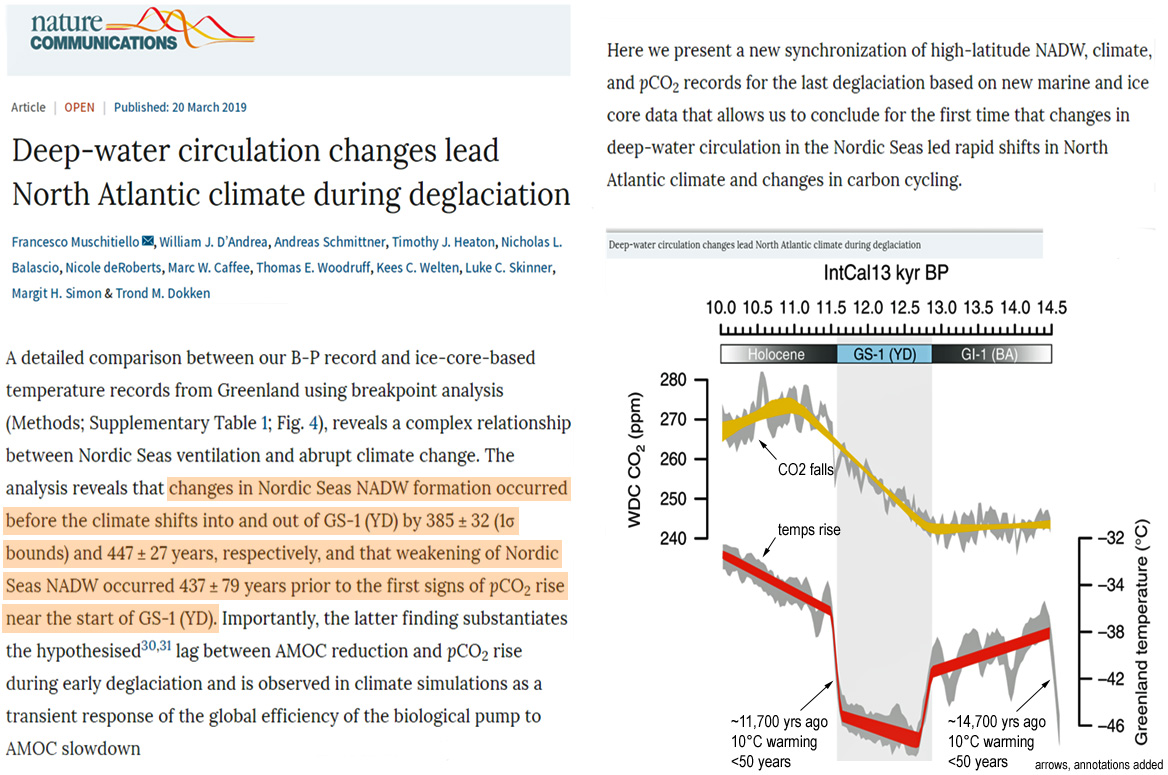
Image Source: Muschitiello et al., 2019
The honey bee-sized magnitude of CO2’s influence during the last deglaciation
There are many adherents to the Shakun et al. (2012)-endorsed position that “increasing CO2 concentrations is an explanation for much of the temperature change at the end of the most recent ice age.”
And yet one has to wonder how this conclusion could have been reached when the explosive warmings of degrees-per-decade occurred without any clearly detectable changes in CO2.
Not only that, but as Ellis and Palmer (2016) point out, Dr. James Hansen’s calculations of CO2’s radiative influence during the ~5,000 years of the Pleistocene-to-Holocene 5-6°C deglaciation suggest a 0.006 Wm² per decade CO2 forcing during this period, which is “about a third of the energy required to power a honey bee in flight.”
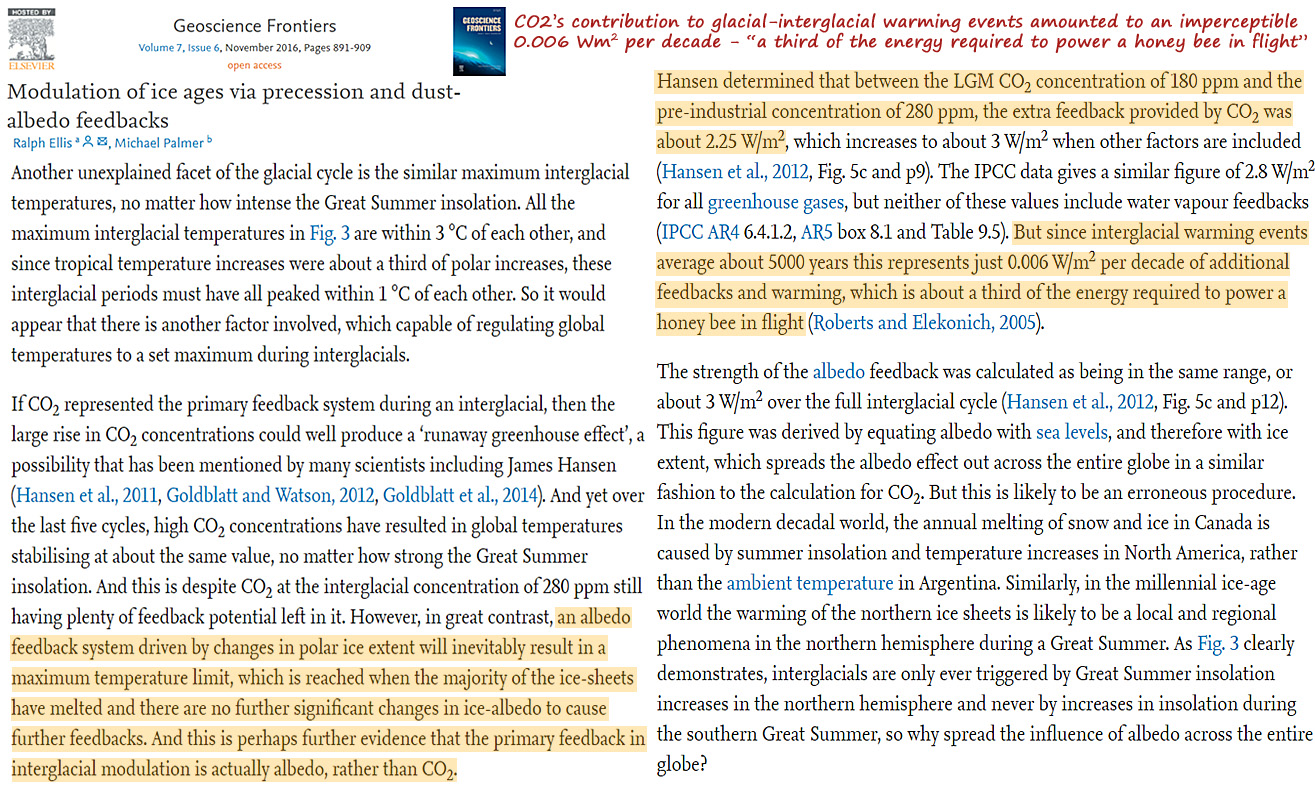
Image Source: Ellis and Palmer, 2016
With this vanishingly small forcing magnitude, why is it nonetheless thought that CO2 is a macro-level driver of Earth’s temperatures and a determinant of deglaciation transitions?
via NoTricksZone
April 18, 2019 at 11:21AM
 Iowa Climate Science Education


