

Some recent reports note a disturbing trend in large and influential corporations. Having worked in and for some of these, I believe the incidents show a dangerous virus is mutating from academia to the workplace. The import of these developments is not good for free enterprise or for individual freedoms.
Warning bells in the past concerned mistreatment of some employees daring to question punative efforts to silence those with discomforting opinions. For example James Damore was fired by Google for saying that staffing with the most competent techies is more important than gender hiring quotas. Now it appears such events are not atypical, but reflect a systemic takeover of corporate cultures.
Rod Dreher writes at American Conservative Woke Capitalism Is Our Enemy. Excerpts in italics with my bolds.
Pro tip: whenever you hear a management type talk about “diversity” and “inclusion,” you may be certain that you are about to hear a rationale for creating a more ideologically uniform and ideologically exclusive community.
A reader has sent me internal documents from a leading global corporation having to do with its employee program to create a Diverse and Inclusive culture. I am not allowed to quote from the documents, or to identify the company, so I’m going to be delicate here in what I describe, to honor the reader’s request to protect privacy. The reader said:
It confirms what you have been saying all along. You are absolutely correct about the “soft totalitarianism” that is coming. It’s already happening, and it’s picking up speed.
The documents are pretty shocking to my eyes, because I know what I’m looking at. It is 100 percent, pure, uncut Human Resources Department cant. What’s so amazing about it — truly amazing — is that it is all about coercing people into accepting and participating in a cultural revolution by redefining the revolution’s goals and methods as good for business, and a chance for employees to exercise virtue.
This particular company’s program is far more sophisticated and thorough than anything I’ve seen before. It is totalitarian in the sense that it encompasses nearly every aspect of life in the company. From reading these documents, you would think that the purpose of this company is to shape the cultural politics and behavior of its employees. I’m not kidding you: it’s like a church organization trying to catechize and discipline its employees in true religion — and part of that discipline is urging them to police their own ranks for heretics. It even instructs employees to conduct struggle sessions within themselves to root out false beliefs that undermine Diversity and Inclusion.
Though it’s stated in happy-clappy HR jargon, it’s clear that the company is training its employees to monitor each other for signs of bias, and encouraging them to call out each other. Incredible. It’s the Stasification of the American workplace. And the program instructs employees to think and talk about Diversity and Inclusion all the time, in everything they do. Seriously, it does. If I were an employee there, I would find all this completely unnerving. I would wonder constantly if I were being monitored by my co-workers and judged for not showing enough commitment to Diversity and Inclusion. I would watch what I said, but also worry about what I did not say. It would make me a nervous wreck.

Again, I’m not going to name the company or give identifying details about the program. I am quite confident that what I’ve said here describes the internal culture many corporations are building. I’m sure many of you readers are thinking, “That sounds like where I work.” It is coercive, and it is totalitarian. It is going to create massive suspicion and mistrust within companies that do this, in part because it is going to empower members of particular groups to harass others in the workplace, to inform on others, and even to affect their salaries and impede their career advancement.
Get this: the way this particular program is set up, you don’t have to participate, but failing to do so will be noted, and it’s going to affect your pay. It’s not enough to sign up for the program in a pro forma way, and then simply be quiet about it. You are expected to be an active, vocal advocate of its principles. From what I can tell, it appears that they have the rudiments of a Chinese-style Social Credit System structure to monitor employee enthusiasm.
You might be a first-rate maker of widgets for this corporation, or a superb sales executive, manager, whatever, and you may be a diligent employee who is honest and works well with others. But if you are not 100 percent aboard the Party’s company’s ideological campaign for cultural revolution, it will go down in your employee record, and it will affect your future at the company.
When you see these documents, and realize that this is how it is inside one of the world’s leading corporations, you know perfectly well that this is quickly going to become normative in corporations, if it isn’t already. What kind of future do any of us deplorables (or our kids) have in corporate life when workplaces become communities of coerced wokeness?
Let me put it to you like this. If this were the US Government, and it pushed “patriotism” on its employees following the same platform and methods that this corporation is pushing “diversity and inclusion,” people would freak out at the coerciveness and invasion of privacy. And they would be right to! Imagine that you, a US government employee, were told to monitor yourself constantly to root out a lack of patriotism. How … Soviet would that feel? Well, that’s what this corporation is doing to its employees regarding diversity and inclusion.
The familiar left vs. right categories no longer serve as reliable guides to our cultural reality. The cultural left has captured the bureaucracies at American corporations. One thing we hear a lot from our friends on the left is that Big Business is conservative, and would never do anything that would hurt its bottom line. Wrong! I have seen personally how companies will do politically correct things that actually hurt their business model, but that win its management pats on the back among their social cohort. These documents I looked at today assert — assert, do not argue — that the total politicization of the company’s culture is critical to its business success … and then go on to describe a program that is almost certainly going to cause major problems with teamwork, cohesiveness, and conflict. These documents are a recipe for creating intense anxiety and suspicion within the company. It’s as clear as day. You cannot imagine why any sensible company would embrace these principles and techniques, which can only hurt its ability to compete. But there it is, in black and white.
Woke capitalism is a vanguard of unfreedom. It’s happening. We have to be prepared to resist.
My Comment
I have done consulting with enough HR departments to know that they are not power centers in companies, but are seen rather as administrative overhead. The line operations make or break the bottom line, and there the credo of middle managers still holds: “Whatever interests my boss, thrills the hell out of me.” Thus in any company where HR is going viral with social justice, diversity inclusion and the rest of it, it only happens if HR is carrying water for the CEO and everyone knows it.
That appears to be the case, as described by Nick Dedeke in his article at Real Clear Poliitcs Is Corporate Vigilantism a Threat to Democracy? Excerpts in italicss with my bolds.
A serious issue has gained prominence in modern society the last few years: The executives and/or founders of large companies increasingly consider it their civic and moral duty to use the influences and powers of their businesses to censor or suppress political and/or inconvenient ideas they do not support or find offensive. This mindset is reflected in the following statement from PayPal CEO Daniel Schulman: “Businesses need to be a force for good in those values and issues that they believe in.” Taken in isolation, this is a very good philosophy. However, one needs to also examine the implications of it in practice.
Recently, PayPal decided to stop processing financial transactions for customers it deemed to have hateful political views. Not long ago, MasterCard and Visa refused to process any donations to David Horowitz’s Freedom Center, a conservative nonprofit. The crime? Horowitz had personal and/or political views that were judged by the credit card companies to be hateful. YouTube has banned some Prager University (PragerU) videos (PragerU is not a higher learning institution, but a nonprofit that promulgates conservative views.) Selected content from conservatives, Christian and some liberal-leaning groups has also been removed from social media and the accounts of the targets were deleted or deactivated.
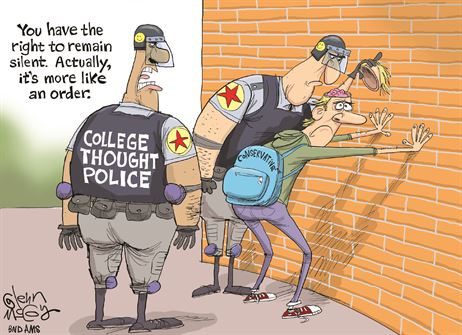
The motivation for these actions is the desire of the executives of these companies to be “good” by punishing the “bad.” These executives, and their supporters, declare that their actions are protected by the laws of the United States of America, which they claim permit them to run their private businesses any way they deem fit.
Two questions need to be asked. First, does a private business have a boundary? If so, where is it? These are critical questions that need to be answered. Without defining the boundary of the modern business, we are likely going to alter, in negative ways, the civic foundations of our society. I do agree that a business should be allowed to have maximum freedom to be run as its founder sees fit. However, I also believe that the boundary of a business has to be limited to its business charter. PayPal has a charter to process payments for society; it does not have a charter to make society “good.”
I argue that many of the well-intentioned actions taken by executives of large corporations fall under what one could call corporate vigilantism. In a notable academic analysis, Les Johnston identified six criteria that are common to most vigilantism. (1) there is planning and premeditation by those engaged in such actions; (2) the actors are private citizens acting voluntarily; (3) the actors view their actions as “autonomous citizenship”; (4) the actors use or threaten to use force and pressure against targets; (5) the actors go into action to protect an established or new order from actual, potential or imputed transgressions; (6) the actors aim to control crime or other social infractions.

It should be noted that vigilantism is not new. It is likely the most popular form of justice in countries in which there are no mature civil institutions. However, vigilantism is a danger wherever it is found. There are three reasons for this. First is that it violates a basic organizing principle of society — namely, that institutions are only allowed to perform duties for which they have a societal mandate. There is no known societal law or mandate that empowers a corporate executive to be the vanguard of moral actions, choices and speech in society.
Second, vigilantism violates the essential principle of separation of powers, which is so essential to the norms of justice. In most vigilante processes, the same institution or group of people constitutes the judge, jury and executioner. Hence, the vigilante system has, by design, inherent, embedded and systemic biases.
Third, the vigilante process is not equipped to recognize its own biases. When asked about how PayPal, in collaboration with the controversial Southern Poverty Law Center, determines when to decline services to customers, Schulman told the Wall Street Journal: “We don’t always agree. We have our debates with [SPLC]. We are very respectful with everyone coming in. We will do the examination carefully. We’ll talk when we don’t agree with a finding: We understand why you think that way, but it still goes into the realm of free speech for us.” Despite this claim of evenhandedness, however, the majority of blocked customers are right-leaning groups and individuals.
A common protest is raised when one questions corporate vigilantism. People often respond by asking, “But, it is their business, isn’t it?” Yes, it is. But, society still has a role to play if and when the pursuit of private business’s self-interest is in conflict with major interests of its customers or the public. That is why regulations were enacted when we realized that private businesses were polluting rivers and other water resources. That is why the new, and stricter, European General Data Protection Regulation was enacted. That is why there is a process whereby new drugs have to be vetted and approved by a neutral party, such as the Food and Drug Administration, before they can be sold to the public. What do these actions have in common? They all involve the establishment of mechanisms that limit the authority of large organizations to exercise their freedom at the expense of the freedoms of others.

There is no debate that an executive of a company could support a political candidate or give money to any cause she/he pleases to do. The executive can also hire and fire anyone that she/he pleases. But this is quite different from what we see in corporate vigilantism. We hear about an executive of a corporation threatening to withdraw its businesses from a state because of perceived political and/or moral transgressions by people there. Or we read about an executive threatening to abandon or exclude a state from its expansion plans if and when a political organ of the state votes for the “wrong” cause or the “wrong” policy. These are some of the most dangerous kinds of politicization that can occur in a society. There is little difference between such corporate vigilantism and what we call corruption. What would you say if a politician promised to give voters money — if they vote a certain way? What would you think of a company that threatened to punish voters if they dared to vote a certain way?
We have had no laws curbing corporate vigilantism in the United States. This is because most business founders knew and/or believed that one should not mix politics and business. Unfortunately, things have changed. For a large corporation today, there is little or no penalty for using one’s near-monopolistic position to shut down the freedoms of others.
The spirit of vigilantism that makes a restaurant owner eject a customer who holds different political views is the same mindset that prompts executives of some large corporations to punish opinions, choices and actions that they do not like. The only difference is in the type and scope of harm done. Vigilantism corrupts free democratic societies, sooner or later, if action is not taken to curb it.
Nick Dedeke teaches information management courses at Northeastern University.

via Science Matters
May 4, 2019 at 12:48PM
 Iowa Climate Science Education