
By Paul Homewood
h/t Willie Soon
Today’s dose of drivel from the BBC is about wicked western countries making third world nations poorer because of climate change:

Temperatures may be rising globally, but not all of us feel the impact in the same way.
Over the past half century, climate change has increased inequality between countries, dragging down growth in the poorest nations whilst likely boosting prosperity in some of the richest, a new study says.
The gap between the world’s poorest and richest countries is about 25% larger today than it would have been without global warming, according to Stanford University researchers in California.
African countries in tropical latitudes have been the hardest hit, with the GDP per capita of Mauritania and Niger more than 40% lower than they would have been without the rising temperatures.
The gap between the world’s poorest and richest countries is about 25% larger today than it would have been without global warming
India – which the IMF says will become the world’s fifth largest economy this year – had a GDP per capita 31% lower in 2010 because of global warming, says the study. The figure for Brazil – the world’s ninth largest economy – is 25%.
On the other hand, according to the study published in the Proceedings of the National Academy of Sciences journal, global warming has likely contributed to the GDP per capita of several rich nations, including some of the world’s biggest emitters of greenhouse gases.
Warming penalty
Co-author Professor Marshall Burke, from the Department of Earth System Science at Stanford University, spent several years analysing the relationship between temperature and economic fluctuations in 165 countries between 1961 and 2010.
The study used more than 20 climate models to determine how much each country has warmed due to climate change attributable to humans. Then it calculated 20,000 versions of what their annual growth rate would be without temperature increase.
Burke demonstrated that growth accelerated in cool countries in years which were warmer than average, while in hot nations it slowed down.
"The historical data clearly show that crops are more productive, people are healthier and we are more productive at work when temperatures are neither too hot nor too cold," he said.
He argues that cold countries have reaped "warming benefits" from rising mercury, while hot countries have been given a "warming penalty" by being pushed further away from their optimum temperature.
There is evidence that labour productivity declines at high temperatures, that cognitive performance declines at high temperatures, interpersonal conflict increases at high temperatures.
"There are a number of pathways by which the building blocks of aggregate economic activity are influenced by temperature," says lead researcher Noah Diffenbaugh.
"For example, agriculture. Cold countries have a very limited growing season because of the winter. On the other hand we have substantial evidence that crop yields declined sharply at high temperatures," Diffenbaugh says.
"Likewise, there is evidence that labour productivity declines at high temperatures, that cognitive performance declines at high temperatures, interpersonal conflict increases at high temperatures."
For richer and poorer?
The researchers say while there is some uncertainty regarding the benefits reaped by colder, richer countries, the impact on warmer countries over history has been unequivocal.
In fact, if they were to consider global warming since the beginning of the Industrial Revolution, they say the observed effects would be larger.
"The findings of this study are consistent with what has been known for years, that climate change acts as a threat multiplier, and takes existing vulnerabilities and makes them worse," says Happy Khambule, senior political advisor at Greenpeace Africa.
"This means that the poorest and most vulnerable are on the frontlines of climate change, and developing countries have to deal with the increasingly extreme climate impacts at the expense of their own development."
http://www.bbc.com/capital/story/20190502-how-global-warming-has-made-the-rich-richer
If only the west had not started the industrial revolution, just think how much better off the rest of the world would have been by now!
So where is the actual evidence for this Marxist drivel? It won’t come as a surprise to learn that there is none at all. It is all derived from GIGO computer models, programmed to say that climate change has made poor countries poorer.
But what do the real facts tell us?
Let’s look at the case of India, which figures prominently in the report. The graphs below are all from Wikipedia:
GDP started to rise sharply in the 1980s, both in total and per capita terms:

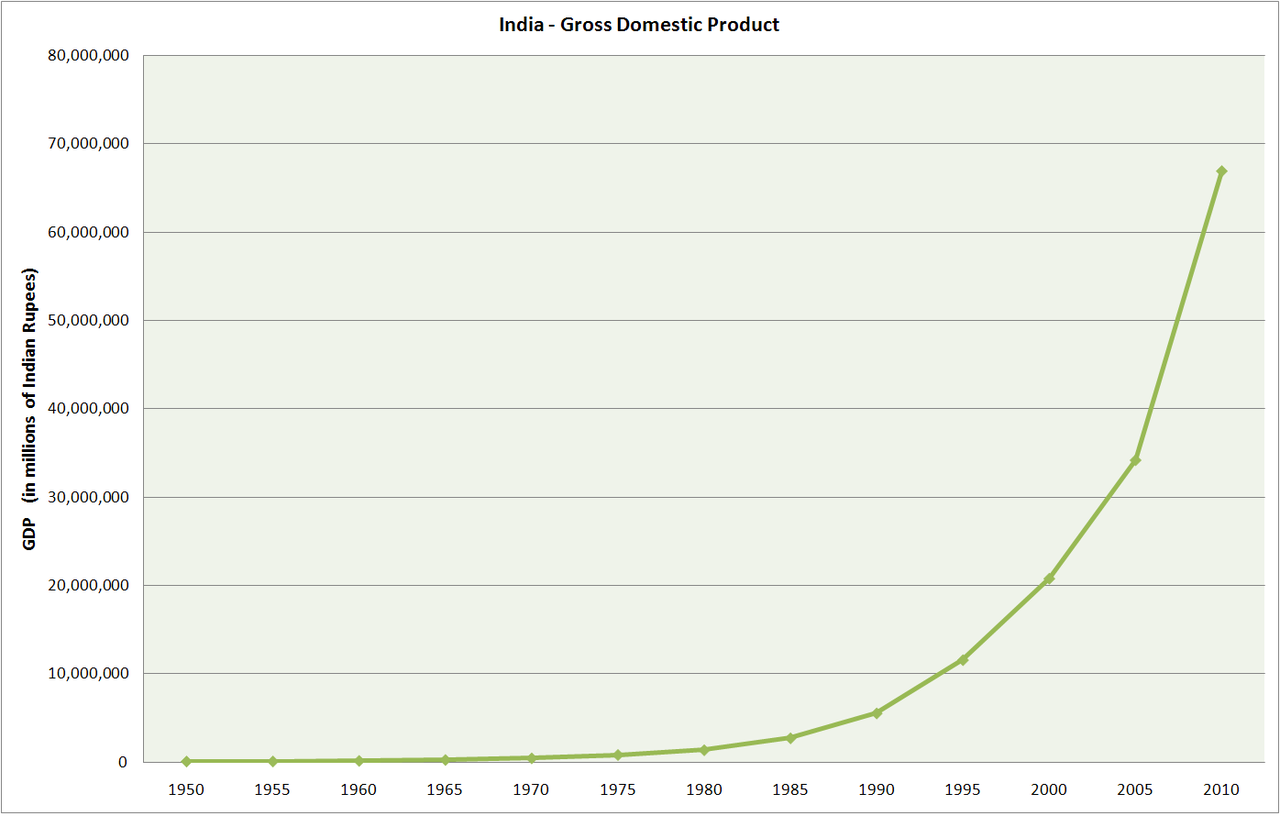
The share of agriculture is a quarter of what it was in 1950. This does not mean that the value of agriculture has fallen, simply that the rest of the economy has grown much faster.
In short, India is no longer the sort of predominantly subsistence economy it used to be:

As for food, this is what the UN has to say:

http://www.fao.org/countryprofiles/index/en/?iso3=IND
In short, India is much better off and its people far better fed than could ever have been imagined just a few short decades ago.
None of this has happened in isolation, and it certainly has not not happened despite global warming.
India’s new found prosperity is inextricably linked to the growth of the world economy, only made possible by the availability of cheap, abundant energy.
via NOT A LOT OF PEOPLE KNOW THAT
May 12, 2019 at 04:30AM
 Iowa Climate Science Education