
By Jonathan Amos BBC Science Correspondent 14 May 2019
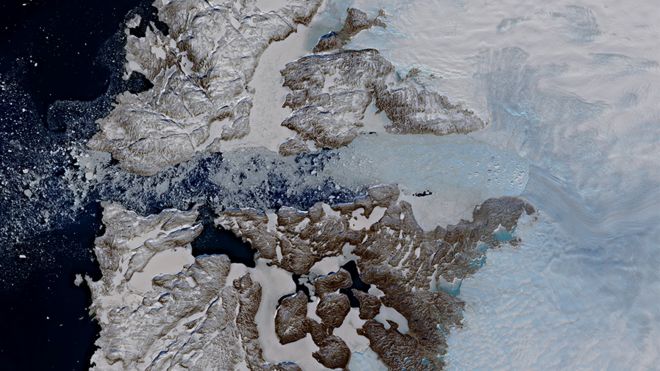
Image copyright Copernicus Sentinel data (2019)/Esa Image caption Jakobshavn in April this year: The glacier is an important drainage outlet for the Greenland Ice Sheet
European satellites have detailed the abrupt change in behaviour of one of Greenland’s most important glaciers.
In the 2000s, Jakobshavn Isbrae was the fastest flowing ice stream on the island, travelling at 17km a year.
As it sped to the ocean, its front end also retreated and thinned, dropping in height by as much as 20m year.
But now it’s all change. Jakobshavn is travelling much more slowly, and its trunk has even begun to thicken and lengthen.
“It’s a complete reversal in behaviour and it wasn’t predicted,” said Dr Anna Hogg from Leeds University and the UK Centre for Polar Observation and Modelling (CPOM).
“The question now is: what’s next for Jakobshavn? Is this just a pause, or is it a switch-off of the dynamic thinning we’ve seen previously?”
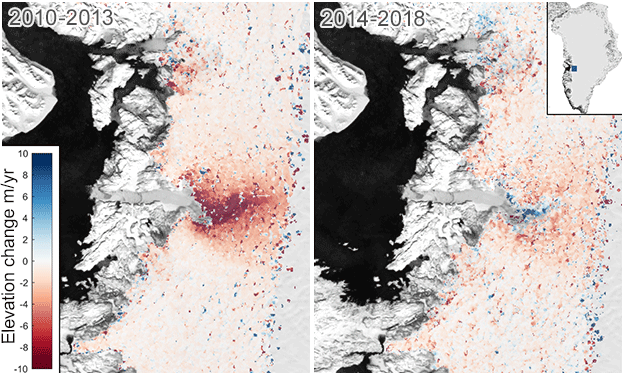
Image copyright CPOM–A. E. Hogg Image caption Change in height: There was a marked change after 2013
The glacier is sited in southwest Greenland. It’s famous for its spectacular production of icebergs – colossal blocks calve from its terminus and drift down its fjord, out into Disko Bay and onwards to the North Atlantic.
More than likely, it was Jakobshavn that spawned the iceberg that sank the Titanic.
Scientists’ interest in the glacier lies in its role as a drainage outlet for the Greenland Ice Sheet. It’s a key channel for the export of ice that can then raise global sea levels.
via Watts Up With That?
May 15, 2019 at 04:10AM
 Iowa Climate Science Education