

This post is dedicated to Silicon Valley nouveau rich and their Cyber-Space Cadets now in the streets demanding that adults fix the climate, and fix it now! Their thinking is fatally flawed by the simplistic transfer of tactics from cyber world to the real physical world.
Mark P. Mills writes at City Journal Want an Energy Revolution? It won’t come from renewables—which can never supply all the power we need—but from foundational scientific discoveries. Excerpts in italics with my bolds.
Throughout history, some 60 percent to 90 percent of every nation’s economy has been consumed by food and fuel costs. Hydrocarbons changed the way that humans organize their productive capacity. The coal age, followed by the oil age, and now by the ascendant age of natural gas, has (at least for developed nations) driven the share of GDP devoted to acquiring food and fuel down to around 10 percent. That transformation constitutes one of the great pivots for civilization.
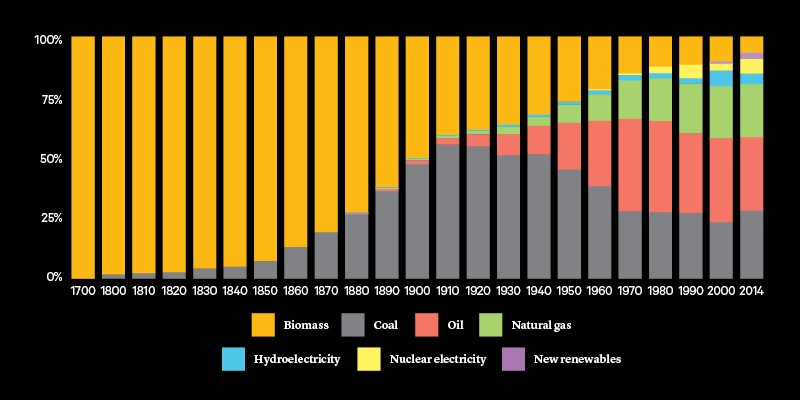
Many analysts claim that yet another such consequential energy revolution is upon us: “clean energy,” in the form of wind turbines, solar arrays, and batteries, they say, is about to become incredibly cheap, making it possible to create a “new energy economy.” Polls show that nearly 80 percent of voters believe that America is “capable of creating a new electricity system.”
We can thank Silicon Valley for popularizing “exponential change” and “disruptive innovations.” The computing and communications revolutions that have transformed many industries have also shaped both expectations and rhetoric about how other technologies evolve. We hear claims, as one Stanford professor put it, that clean tech will follow digital technology in a “10x exponential process which will wipe fossil fuels off the market in about a decade.” Or, as the International Monetary Fund recently summarized, “smartphone substitution seemed no more imminent in the early 2000s than large-scale energy substitution seems today.” The mavens at Singularity University tell us that with clean tech, we’re “on the verge of a new, radically different point in history.” Solar, wind, and batteries are “on a path to disrupt” the old order dominated by fossil fuels.
Never mind that wind and solar—the focus of all “new energy economy” aspirations, including its latest incarnation in the Green New Deal—supply just 2 percent of global energy, despite hundreds of billions of dollars in subsidies. After all, it wasn’t long ago that only 2 percent of the world owned a pocket-sized computer. “New energy economy” visionaries believe that a digital-like energy disruption is not just possible, but imminent. One professor predicts that we will see an “Apple of clean energy.”
A similar transformation in how energy is produced or stored isn’t just unlikely: it’s impossible. Drawing an analogy between information production and energy production is a fundamental category error. They entail different laws of physics. Logic engines don’t produce physical action or energy; they manipulate the idea of the numbers one and zero. Silicon logic is rooted in simply knowing and storing the position of a binary switch—on or off.
But the energy needed to move a ton of people, heat a ton of steel or silicon, or grow a ton of food is determined by properties of nature, whose boundaries are set by laws of gravity, inertia, friction, and thermodynamics—not clever software or marketing. Indeed, the differences between the physical and virtual are best illustrated by the fact that, using mathematical magic, one can do things like “compress” information to reduce the energy needed to transport that information. But in the world of humans and objects with mass, comparable “compression” options exist only in Star Trek.
Spending $1 million on wind or solar hardware in order to capture nature’s diffuse wind and sunlight will yield about 50 million kilowatt-hours of electricity over a 30-year period. Meantime, the same money spent on a shale well yields enough natural gas over 30 years to produce 300 million kilowatt-hours. That difference is anchored in the far higher, physics-based energy density of hydrocarbons. Subsidies can’t change that fact.
And then batteries are needed, and widely promoted, as the way to convert wind or solar into useable on-demand power. While the physical chemistry of batteries is indeed nearly magical in storing tiny quantities of energy, it doesn’t scale up efficiently. When it comes to storing energy at country scales, or for cargo ships, cars and aircraft, engineers start with a simple fact: the maximum potential energy contained in hydrocarbon molecules is about 1,500 percent greater, pound for pound, than the maximum theoretical lithium chemistries. That’s why the cost to store a unit of energy in a battery is 200 times more than storing the same amount of energy as natural gas. And why, today, it would take $60 million worth of Tesla batteries—weighing five times as much as the entire aircraft—to hold the same energy as is held in a transatlantic plane’s onboard fuel tanks.
For a practical example of the physics-anchored gap between aspiration and reality, consider Florida Power & Light’s (FPL) recently announced plan to replace an old gas-fired power station with the world’s biggest battery project—promised to be four times bigger than the current number one, a system Tesla installed, to much fanfare, last year in South Australia. The monster FPL battery “farm” will be able to store just two minutes of Florida’s electricity needs. That’s not going to change the world, or even Florida.
Moreover, it takes the energy equivalent of about 100 barrels of oil to manufacture a battery that can store the energy equal to one oil barrel. That means that batteries fabricated in China (most already are) by its predominantly coal-powered grid result in more carbon-dioxide emissions than those batteries, coupled with wind/solar, can eliminate. It’s true that wind turbines, solar cells, and batteries will get better, but so, too, will drilling rigs and combustion engines. The idea that “old” hydrocarbon technologies are about to be displaced wholesale by a digital-like, clean-tech energy revolution is a fantasy.
If we want a disruption to the energy status quo, we will need new, foundational discoveries in the sciences. As Bill Gates has put it, the challenge calls for scientific “miracles.” Any hoped-for technological breakthroughs won’t emerge from subsidizing yesterday’s technologies, including wind and solar. The Internet didn’t emerge from subsidizing the dial-up phone, or the transistor from subsidizing vacuum tubes, or the automobile from subsidizing railroads. If policymakers were serious about the pursuit of the next energy revolution, they’d be talking a lot more about reinvigorating support for basic science.
It bears noting that over the past decade, U.S. production of oil and natural gas has increased by 2,000 percent more than the combined growth of (subsidized) wind and solar. Shale technology has utterly transformed the global energy landscape. After a half-century of hand-wringing about import dependencies, America is now a major exporter. Now that’s a revolution.
via Science Matters
May 16, 2019 at 06:20PM
 Iowa Climate Science Education