
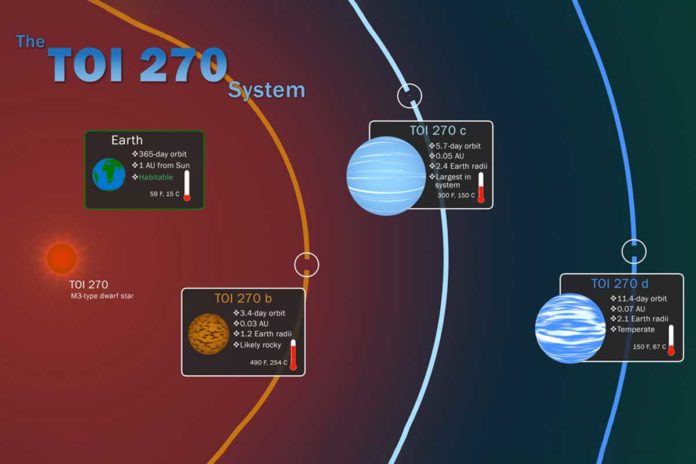
Credit: NASA’s Goddard Space Flight Center / Scott Wiessinger
Quoting from the abstract of the study in Nature Astronomy:
‘The planets orbit close to a mean-motion resonant chain, with periods (3.36 days, 5.66 days and 11.38 days, respectively) near ratios of small integers (5:3 and 2:1).’
One of the astronomers said: “For TOI-270, these planets line up like pearls on a string. That’s a very interesting thing because it lets us study their dynamical behavior. And you can almost expect, if there are more planets, the next one would be somewhere further out, at another integer ratio.”
“There is a good possibility that the system hosts other planets, further out from planet d, that might well lie within the habitable zone. Planet d, with an 11-day orbit, is about 10 million kilometers out from the star.”
In fact the distance-to-star ratios of the planets (named b,c and d) are very similar:
b:c = 1:1.542 and c:d = 1:1.553 (for comparison Earth:Mars is 1:1.524).
NASA’s Transiting Exoplanet Survey Satellite, or TESS, has discovered three new planets that are among the smallest, nearest exoplanets known to date, reports Tech Explorist.
The planets circle a star only 73 light-years away and incorporate a small, rough super-Earth and two sub-Neptunes — planets about a large portion of the size of our own icy giant.
The sub-Neptune farthest out from the star seems, by all accounts, to be inside a temperate zone, implying that the highest point of the planet’s atmosphere is inside a temperature extend that could support a few types of life.
In any case, scientists state the planet’s atmosphere is likely a thick, ultradense heat trap that renders the planet’s surface too hot to even consider hosting water or life.
Scientists dubbed this new planetary system as TOI-270, proving to have other interesting qualities such as they appear to be of similar size.
Moreover, TOI-270 appears to host two intermediate planets: both are sub-Neptunes and smaller than our own Neptune and not much larger than the rocky planet in the system.
According to astronomers, TOI-270 might be a ‘missing link’ in planetary formation, as they are of intermediate size and could help researchers determine whether small, rocky planets like Earth and more massive, icy worlds like Neptune follow the same formation path or evolve separately.
Full article here.
via Tallbloke’s Talkshop
July 30, 2019 at 04:45AM
 Iowa Climate Science Education