
Hmmmm….bolding mine~ctm
31 July 2019
Posted by larryohanlon
By Mary Caperton Morton
Melting Himalayan glaciers are releasing decades of accumulated pollutants into downstream ecosystems, according to a new study.
The new research in AGU’s Journal of Geophysical Research: Atmospheres finds chemicals used in pesticides that have been accumulating in glaciers and ice sheets around the world since the 1940s are being released as Himalayan glaciers melt as a result of climate change.
These pollutants are winding up in Himalayan lakes, potentially impacting aquatic life and bioaccumulating in fish at levels that may be toxic for human consumption.
The new study shows that even the most remote areas of the planet can be repositories for pollutants and sheds light on how pollutants travel around the globe, according to the study’s authors.
The Himalayan glaciers contain even higher levels of atmospheric pollutants than glaciers in other parts of the world “because of their proximity to south Asian countries that are some of the most polluted regions of the world,” said Xiaoping Wang, a geochemist at the Chinese Academy of Sciences in Beijing and an author on the new study.
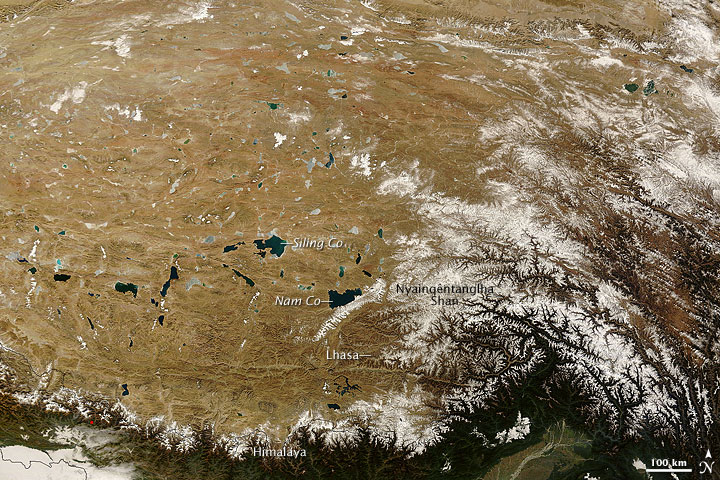
The high mountain glaciers of the Tibetan Plateau feed thousands of alpine lakes that form the headwaters of many of Asia’s major rivers. Credit: NASA image courtesy Jeff Schmaltz, MODIS Rapid Response Team, Goddard Space Flight Center.
For pollutants, there is no away
Pollutants can travel long distances through the atmosphere on dust particles and water molecules. Previous studies have shown that Arctic and Antarctic ice sheets contain high levels of pollutants that traveled thousands of kilometers before dropping onto ice and being incorporated into glaciers. This phenomenon of high levels of contamination far from sources of pollution, known as the Arctic paradox, is also seen in high mountain glaciers like those in the Himalaya.
via Watts Up With That?
August 1, 2019 at 12:31PM
 Iowa Climate Science Education
Reblogged this on Climate- Science.
LikeLike