
Guest [fill in the blank] by David Middleton
Am I really a scientist?
BY NESSA CARSON 15 AUGUST 2019Whether in a lab, an office or on a stage, we are no strangers to wrestling with self-identity
Citizen science projects are a high-impact way to engage people with real, scientific research. Anecdotally, untrained participants are not only lucky enough to learn about and contribute to science, but also experience increased feelings of confidence and empowerment, as well as feelings that science is ‘for them’.
It’s frustrating that despite citizen scientists making leaps and bounds in their scientific self-confidence, this is still one of the factors that new researchers at the start of their formal scientific journeys struggle with most. This particularly goes for students and researchers from minority and non-traditional backgrounds, who sometimes feel like they don’t fit into the monolithic lab environment. Many report either deliberate or unintentional exclusion leading them to experience the converse of the citizen scientists: decreased sense of belonging, and intrusive thoughts of not truly being a scientist, regardless of ability and expertise.
Looking wider and more objectively than this impostor syndrome, the idea of who is and isn’t a scientist is a constant source of argument.Positions range from the hyper-inclusive ‘all children are naturally scientists’, to ‘the word scientist (or something nominally similar) must be in your job title to be considered one’. Some students claim that they can’t be scientists yet – they have to get a job first – even if their work bears many similarities to an employed postdoc or industry researcher. My friends who have left bench science for editorial or science communication positions are sometimes the most conflicted. After dedicating years to meticulous training in research, they have left the lab, while still using many of their honed research skills every day. I can’t offer any advice beyond that if they want to be called a scientist, they’ve certainly earned it. How people perceive themselves has powerful effects on confidence and personality, and using one neat, descriptive word greatly simplifies the thinking.
[…]
I certainly identify as a scientist, and that’s partly because I also identify as a nerd. But I don’t end up feeling pigeonholed. I work in a very diverse role – some days I now wonder whether I’m actually an engineer, or a seriously untrained computer scientist.
[…]
Ultimately, the debate over who can call themselves a scientist pops up every couple of years, and with no clear-cut definition of who is and isn’t, it’s essentially moot and irrelevant. The results we accomplish are more important. What matters is when we identify ourselves as scientists in public, where listeners may not know any scientists. We end up representing scientists as a whole, whether we would like to or not.
Since a large proportion of people expect scientists to always be old, white men with wild hair, perhaps more of us who don’t fit that profile should proudly identify as scientists wherever we can!
If you have to ask, the answer is: No.
You might be a scientist…
- If you have a college level degree in a science.
- If you are professionally employed as a scientist.
While it’s certainly possible that people with no scientific education or professional experience are capable of achieving Einstein-ian scientific prowess, are they scientists? Let’s ask the National Science Board:
Chapter 3. Science and Engineering Labor Force
Definition of the S&E Workforce
Because there is no standard definition of S&E workers, this section presents multiple categorizations for measuring the size of the S&E workforce.[i] In general, this section defines the S&E workforce to include people who either work in S&E occupations or hold S&E degrees. However, the application of S&E knowledge and skills is not limited to jobs classified as S&E; the number of workers reporting that their jobs require at least a bachelor’s degree level of knowledge in one or more S&E fields exceeds the number of jobs in the economy with a formal S&E label. Therefore, this section also presents data on the use of S&E technical expertise on the job to provide an estimate of the S&E workforce. The estimated number of scientists and engineers varies based on the criteria applied to define the S&E workforce.
U.S. federal occupation data classify workers by the activities or tasks they primarily perform in their jobs. The NSF and Census Bureau occupational data in this chapter come from federal statistical surveys in which individuals or household members provide information about job titles and work activities. This information is used to classify jobs into standard occupational categories based on the Standard Occupational Classification (SOC) system.[ii] In contrast, the BLS-administered OES survey relies on employers to classify their workers using SOC definitions. Differences between employer- and individual-provided information can affect the content of occupational data.
NSF has developed a widely used set of SOC categories that it calls S&E occupations. Very broadly, these occupations include life scientists, computer and mathematical scientists, physical scientists, social scientists, and engineers. NSF also includes postsecondary teachers of these fields in S&E occupations. A second category of occupations, S&E-related occupations, includes health-related occupations, S&E managers, S&E technicians and technologists, architects, actuaries, S&E precollege teachers, and postsecondary teachers in S&E-related fields. The S&E occupations are generally assumed to require at least a bachelor’s degree level of education in an S&E field. The vast majority of S&E-related occupations also require S&E knowledge or training, but an S&E bachelor’s degree may not be a required credential for employment in some of these occupations. Examples include health technicians and computer network managers. Other occupations, although classified as non-S&E occupations, may include individuals who use S&E technical expertise in their work. Examples include technical writers who edit scientific publications and salespeople who sell specialized research equipment to chemists and biologists. The NSF occupational classification of S&E, S&E-related, and non-S&E occupations appears in Table 3-2 along with the NSF educational classification of S&E, S&E-related, and non-S&E degree fields.
Clear as mud! Let’s look at Table 3-2…

Was that better?
It may be easier just to identify who isn’t a scientist. I’m fairly certain that none of these people are scientists:
They’d probably be shocked to learn that this is a science:
Since its founding in 1917, the American Association of Petroleum Geologists has been a pillar of the worldwide scientific community. The original purpose of AAPG, to foster scientific research, to advance the science of geology, to promote technology, and to inspire high professional conduct, still guides the Association today.
[…]
The purposes of this Association are to:
*advance the science of geology, especially as it relates to petroleum, natural gas, other subsurface fluids, and mineral resources;
*to promote the technology of exploring for, finding, and producing these materials in an economically and environmentally sound manner;
*to foster the spirit of scientific research throughout its membership;
to disseminate information relating to the geology and the associated technology of petroleum, natural gas, other subsurface fluids, and mineral resources;*to inspire and maintain a high standard of professional conduct on the part of its members;
*to provide the public with means to recognize adequately trained and professionally responsible geologists; and
*to advance the professional well-being of its members.
AAPG must have failed on this one: “to provide the public with means to recognize adequately trained and professionally responsible geologists.” My experience is that “the public” generally lacks the means to differentiate Bill Nye from a scientist, much less “recognize adequately trained and professionally responsible geologists”.
“Are you a scientist?”
It should be a simple question to answer but scientists are genuinely uncomfortable taking credit for the title. Their response is usually some form of “I’m not a real scientist…” followed by an unnecessarily precise job description that serves to disqualify their niche of expertise. This is understood as professional humility amongst peers but sounds oddly evasive and confusing to non-scientists. Nowhere else do people so vehemently deny the categorical hierarchy of their pursuits.
“What do you do?”
I don’t have any discomfort about answering these questions:
“Are you a scientist?” Yes.
“What do you do?” I’m a geologist.
Although, this is often followed up by:
“What’s a geologist?” It’s actually very difficult to explain what a geologist is when the person asking the question doesn’t know what geology is. Back when my business card said “geophysicist,” I would usually answer, “geologist,” because explaining what a geophysicist does is even more difficult.
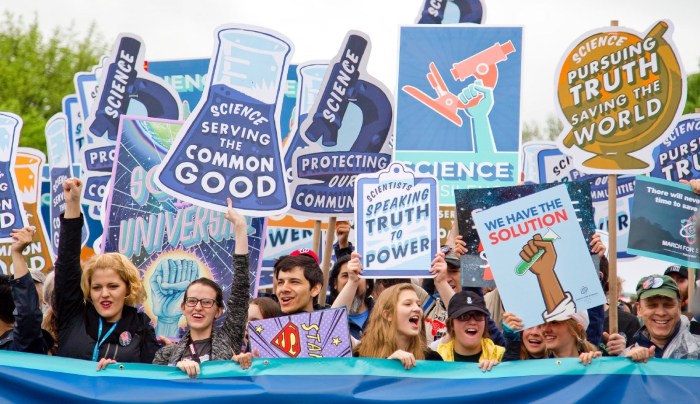
I’d bet a good bottle of wine that most of the science marchers in the photo above don’t know that petroleum geology is a science. They probably learned this on TV.
The result of real science

The result of fake science

Reference
Taso, Leon & Weller, Tom. (1986). “Science Made Stupid: How to Discomprehend the World around Us”. Leonardo. 19. 263. 10.2307/1578252.
Science Made Stupid: How to Discomprehend the World Around Us is a 1985 book written and illustrated by Tom Weller. The winner of the 1986 Hugo Award for Best Non-Fiction Book, it is a parody of a junior high or high school-level science textbook. Though now out of print, high-resolution scans are available online, as well as an abridged transcription, both of which have been endorsed by Weller [1]. Highlights of the book include a satirical account of the creationism vs. evolution debate and Weller’s drawings of fictional prehistoric animals (e.g., the duck-billed mastodon.)
Thomas Dolby – She Blinded Me With Science from Mad Hatter on Vimeo.
via Watts Up With That?
August 21, 2019 at 06:55AM
 Iowa Climate Science Education