
By Paul Homewood
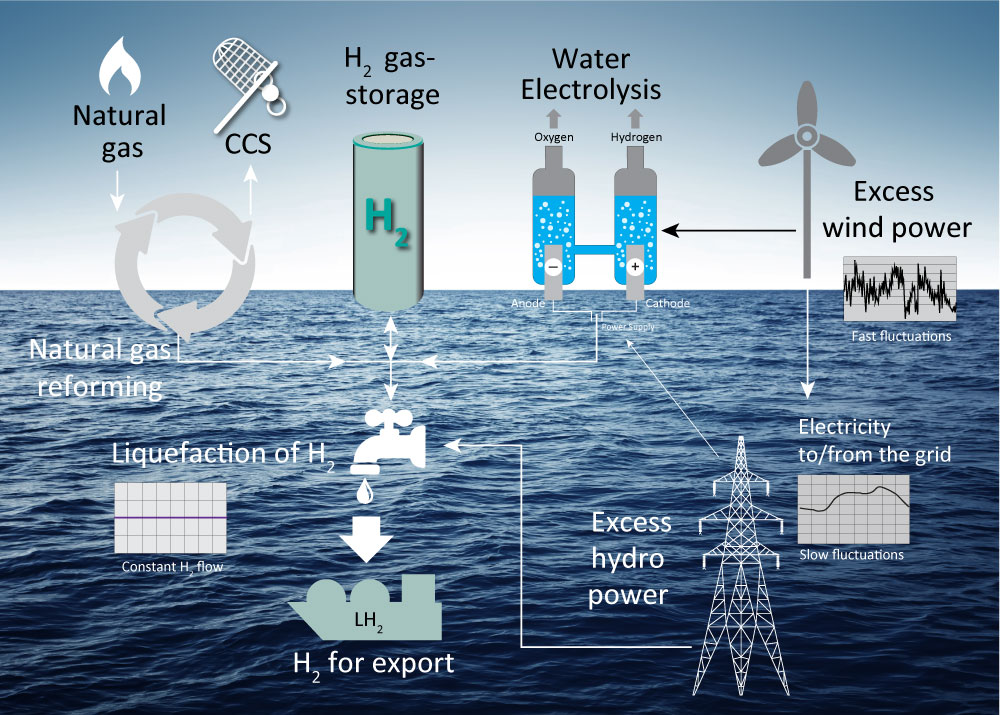
There has been some useful discussions about the potential role of hydrogen in our energy mix. It is often regarded as a panacea, providing clean, carbon dioxide free energy for all our needs, power, transport and heating. Things, however, are not quite that simple!
It is therefore worth looking at what the Committee on Climate Change had to say in their Net Zero report.
There are two principal ways to produce hydrogen:
1) Steam or gas reforming – in this process, an energy source such as methane reacts with steam to produce a mixture of hydrogen, carbon monoxide and some carbon dioxide. It is currently the predominant means of producing hydrogen in the chemical process industries, because of its relatively low cost and scalability.
2) Electrolysis – the process of using electricity to split water into hydrogen and oxygen. Although small scale and more expensive, electrolysis has the advantage that no carbon dioxide is produced.
The CCC have clearly come down on the side of gas reforming as the only practical solution, with electrolysis playing only a niche role. (Although hydrogen production is expressed in TWh, the numbers don’t refer to electricity output, merely the energy equivalent).


https://www.theccc.org.uk/publication/net-zero-technical-report/
In terms of actual costs, hydrogen production is expected to cost £44/MWh by 2025 (at today’s prices), using steam reforming. Natural gas, by comparison, currently costs 46p per therm, which equates to £15/MWh.
Again, I would stress this is the cost of producing hydrogen, and not the cost of electricity. It is the equivalent, in other words, to the wholesale cost of natural gas.
The cost also excludes storage and distribution costs.

https://www.theccc.org.uk/publication/net-zero-the-uks-contribution-to-stopping-global-warming/
According to the CCC, the cost of electrolysis would be double that of reforming.

The CCC reckon that electrolysis could only be competitive with a power price of £10/MWh, which clearly is not going to happen.
The argument for electrolysis is that it could mop up unused solar and wind power, ie effectively “free” in terms of marginal cost.
The trouble with this is that costings for power from wind and solar assume that all of the electricity produced is sold. If some of the surplus is sold “for free”, it means that the rest actually costs a lot more.
Either way, intermittent renewables are not an economically viable solution.
via NOT A LOT OF PEOPLE KNOW THAT
August 26, 2019 at 08:12AM
 Iowa Climate Science Education
Reblogged this on Climate- Science.press.
LikeLike