
Guest cheer leading by David Middleton
Florida has led the nation in the addition of natural gas-fired electricity generation capacity over the past decade, by a very wide margin.
SEPTEMBER 9, 2019
Natural gas-fired power generation has grown in Florida, displacing coalFlorida added nearly 16 gigawatts (GW) of utility-scale natural gas-fired electric generation between 2008 and 2018, about one-quarter (24%) of all U.S. natural gas installations during this time and the most of any state. During the same period, electric utility net generation in Florida grew about 15%, increasing natural gas’s share of the in-state generation fuel mix from nearly half (47%) to three-fourths (72%) of the total. EIA expects natural gas-fired generation capacity to continue to grow, displacing more emissions-intensive and less cost-competitive generation fuel sources such as coal and petroleum liquids.
Florida’s electric power sector includes nearly 50 operating utility-scale natural gas-fired electric generation facilities with a total nameplate capacity of 42 GW. About 40% of the existing natural gas generation capacity was constructed between 2008 and 2018. Natural gas-fired capacity additions totaled 15.7 GW between 2008 and 2018, nearly all of which were natural gas combined-cycle units. These electric utility additions have more than offset retirements of petroleum liquids-fired units (5.1 GW), conventional coal-fired units (2.8 GW), less-efficient natural gas-fired units (3.3 GW), and other retirements (0.9 GW).
[…]
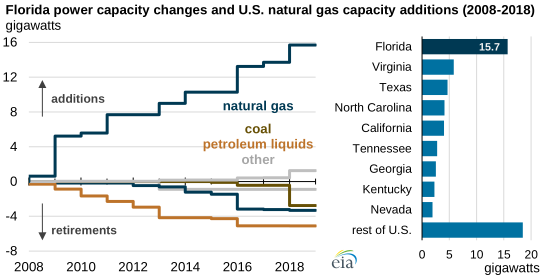
While gas is kicking @$$ in the Sunshine State, solar is harder to spot than Waldo…
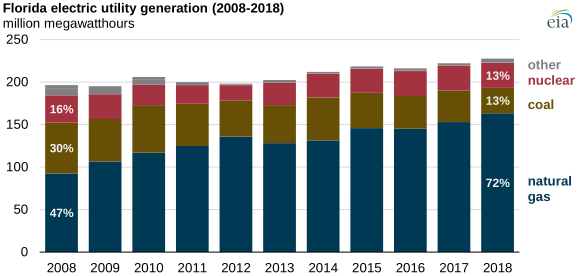
Note: Other includes petroleum liquids.)
One of the reasons natural gas is booming in the Sunshine State, is the fact that they’ve allowed for the growth of pipeline infrastructure.
Additions to natural gas pipeline capacity have kept pace with new natural gas-fired electricity generation in Florida. According to EIA’s Natural Gas Pipeline State-to-State Capacity database, natural gas pipeline delivery capacity to Florida increased from 4.1 billion cubic feet per day (Bcf/d) in 2008 to 6.2 Bcf/d in 2018, up 50%.
Most recently, in 2017, the 515-mile, 0.81 Bcf/d Sabal Trail pipeline entered into service. The pipeline delivers natural gas to power plants owned by Florida Power and Light (FP&L) and Duke Energy of Florida. Construction is underway on Phase II of the Sabal Trail to deliver an additional 0.17 Bcf/d of natural gas to Florida in 2020. Other projects are planned to serve Florida, including Phase III of the Sabal Trail pipeline (0.08 Bcf/d) and an expansion of the Gulfstream Natural Gas System (0.08 Bcf/d), which will allow deliveries to the converted Big Bend Power Plant in Tampa, Florida.
Now, if the folks in Tallahassee would just stop opposing the exploitation of the Eastern Gulf of Mexico Outer Continental Shelf (EGOM, OCS), in a few years there could be a natural gas production boom, right in their own backyard. The 20-year decline in Gulf of Mexico natural gas production is about to turn around, thanks to the associated gas that will be produced from large new oil discoveries currently coming online.
NOVEMBER 26, 2018
New projects expected to reverse Gulf of Mexico natural gas production declines[…]
Natural gas production in the U.S. Federal Gulf of Mexico (GOM) has been declining for nearly two decades. However, 10 new natural gas production fields are expected to start producing natural gas in 2018 and another 8 are expected to start producing in 2019, according to information reported to the U.S. Department of Interior’s Bureau of Safety and Environmental Enforcement. These new field starts may slow or reverse the long-term decline in GOM production. The 16 projects starting in 2018 and 2019 have a combined natural gas resource estimate of about 836 billion cubic feet.
[…]

Much of the Jurassic Norphlet and almost all of the Jurassic Smackover plays are currently off-limits in the EGOM.

About the Author
David Middleton has been a proud member of the Climate Wrecking Industry since 1981, actively engaged in Gulf of Mexico oil & gas exploration and exploitation since 1988. He is a member of the Society of Exploration Geophysicists, American Association of Petroleum Geologists and Houston Geological Society. He only speaks in the third person when he writes “about the author” bits or tries to impersonate Bob Dole… however, no one can do a Bob Dole better than Norm Macdonald.
via Watts Up With That?
September 24, 2019 at 04:15AM
 Iowa Climate Science Education
