
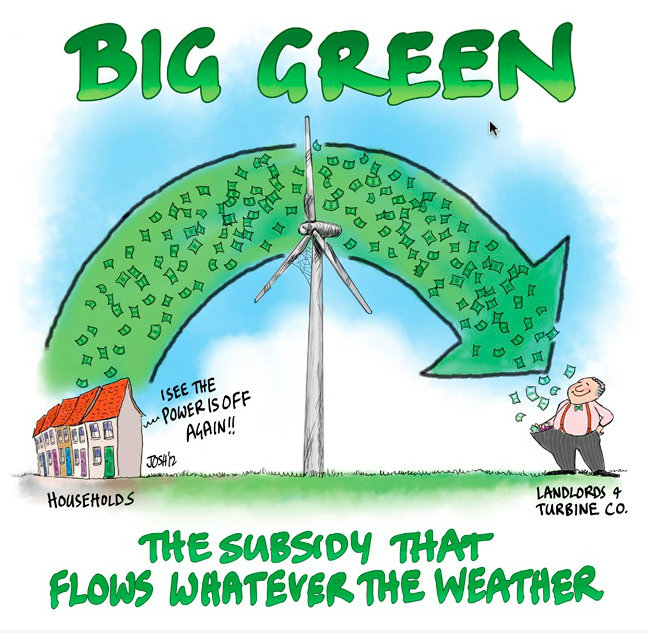
Looking past the smoke and mirrors game, we find the true financial pain being inflicted on UK electricity customers in the name of climate ideology aka the Climate Change Act.
The total annual renewables subsidy impact on UK household cost of living is £9 billion — which comes to £340 per year per household, says The Global Warming Policy Forum (GWPF).
The low and much-publicised offshore wind bids for Feed-in Tariffs with Contracts for Difference (FiTs CfDs) continue to confuse many analysts, even those from whom one might expect clear-eyed caution.
A writer for CapX (“What is the point of Corbyn’s nationalised wind farms?”), to select an example almost at random, quite correctly takes issue with the Labour Party’s reckless plans for major public investment in further offshore wind, but does so on the mistaken ground that “offshore wind is a big success story […] delivering ever more clean energy, at ever lower prices, for a fraction of the price of Labour’s plan”.
However, and as a matter of fact, none of the low-bidding wind farms have actually been built, and the 8.5 GW of operational offshore wind capacity which is “delivering” is without exception very heavily subsidised.
Indeed, the most recently commissioned offshore wind farm, the giant 588 MW Beatrice of the North East coast of Scotland, which only became fully operational in the summer of 2019, has a CfD strike price of £140/MWh now worth £158.73/MWh, roughly three times the wholesale price, and indeed about three times the almost certainly unrealistic strike prices bid in the most recent CfD auctions.
It is obviously premature to say that the observed fall in CfD prices bid is a “success story”.
The CfD contracts are very far from firmly binding, and the penalty for abrogration is trivial. It seems likely, bordering on certain, that they are a sly and low risk publicity gambit, intended to secure a market position, and inhibit competition, in the hope of obtaining a better price by whatever means at a later date.
And of course the cost of electricity from existing offshore wind power has most certainly not fallen; it continues to be very high, like all the other renewable generators in the UK fleet.
Perhaps it is worth reminding ourselves just how much that subsidy currently amounts to and how much it is costing British households.
Continued here.
via Tallbloke’s Talkshop
October 14, 2019 at 05:00AM
 Iowa Climate Science Education