
Guest “how can he write this with straight face?” by David Middleton
Even 50-year-old climate models correctly predicted global warming
By Warren Cornwall Dec. 4, 2019Climate change doubters have a favorite target: climate models. They claim that computer simulations conducted decades ago didn’t accurately predict current warming, so the public should be wary of the predictive power of newer models. Now, the most sweeping evaluation of these older models—some half a century old—shows most of them were indeed accurate.
“How much warming we are having today is pretty much right on where models have predicted,” says the study’s lead author, Zeke Hausfather, a graduate student at the University of California, Berkeley.
[…]
Most of the models accurately predicted recent global surface temperatures, which have risen approximately 0.9°C since 1970. For 10 forecasts, there was no statistically significant difference between their output and historic observations, the team reports today in Geophysical Research Letters.
[…]
Seven older models missed the mark by as much as 0.1°C per decade. But the accuracy of five of those forecasts improved enough to match observations when the scientists adjusted a key input to the models: how much climate-changing pollution humans have emitted over the years.
[…]
To take one example, Hausfather points to a famous 1988 model overseen by then–NASA scientist James Hansen. The model predicted that if climate pollution kept rising at an even pace, average global temperatures today would be approximately 0.3°C warmer than they actually are. That has helped make Hansen’s work a popular target for critics of climate science.
[…]
The accuracy of the failed models improved when they adjusted them to fit the observations… Shocking.
The AGU and Wiley currently allow limited access to Hausfather et al., 2019. Of particular note are figures 2 and 3. I won’t post the images here due to the fact that it is a protected limited access document.
Figure 2: Model Failure
Figure 2 has two panels. The upper panel depicts comparisons of the rates of temperature change of the observations vs the models, with error bars that presumably represent 2σ (2 standard deviations). According to my Mark I Eyeball Analysis, of the 17 model scenarios depicted, 6 were above the observations’ 2σ (off the chart too much warming), 4 were near the top of the observations’ 2σ (too much warming), 2 were below the observations’ 2σ (off the chart too little warming), 2 were near the bottom of the observations’ 2σ (too little warming), and 3 were within 1σ (in the ballpark) of the observations.

The lower panel depicted the implied transient climate response (TCR) of the observations and the models. TCR is the direct warming that can be expected from a doubling of atmospheric carbon dioxide. It is an effectively instantaneous response. It is the only relevant climate sensitivity.

In the 3.5 °C ECS case, about 2.0 °C of warming occurs by the time of the doubling of atmospheric CO2. The remaining 1.5 °C of warming supposedly will occur over the subsequent 500 years. We’re constantly being told that we must hold warming by 2100 to no more than relative to pre-industrial temperatures (the coldest climate of the Holocene).

I digitized the lower panel to get the TCR values. Of the 14 sets of observations, the implied TCR ranged from 1.5-2.0 °C, averaging 1.79 °C, with a very small σ of 0.13 °C. Of the 17 model scenarios, 9 exceeded the observed TCR by more than 1σ, 6 were more than 1σ below the observed TCR. Only 2 scenarios were within 1σ of the observed TCR (1.79 °C).

A cross plot of the model TCR vs. observed TCR yields a random scatter…

Atmospheric CO2 is on track to reach that doubling around the end of this century.

An exponential trend function applied to the MLO data indicates that the doubling will occur around the year 2100. If the TCR is 1.79 °C, we will stay below the 2 °C and be barely above the “extremely low emissions” scenario on the Vox graph (figure 3). However, most recent observation-based place the TCR below 1.79 °C. Christy & McNider, 2017 concluded that the TCR was only about 1.1 °C, less than half of the model-derived value.
Putting Climate Change Claims to the Test
Date: 18/06/19Dr John Christy
This is a full transcript of a talk given by Dr John Christy to the GWPF on Wednesday 8th May.When I grew up in the world of science, science was understood as a method of finding information. You would make a claim or a hypothesis, and then test that claim against independent data. If it failed, you rejected your claim and you went back and started over again. What I’ve found today is that if someone makes a claim about the climate, and someone like me falsifies that claim, rather than rejecting it, that person tends to just yell louder that their claim is right. They don’t look at what the contrary information might say.
OK, so what are we talking about? We’re talking about how the climate responds to the emission of additional greenhouse gases caused by our combustion of fossil fuels.
[…]
So here’s the deal. We have a change in temperature from the deep atmosphere over 37.5 years, we know how much forcing there was upon the atmosphere, so we can relate these two with this little ratio, and multiply it by the ratio of the 2x CO2 forcing. So the transient climate response is to say, what will the temperature be like if you double CO2– if you increase at 1% per year, which is roughly what the whole greenhouse effect is, and which is achieved in about 70 years. Our result is that the transient climate response in the troposphere is 1.1 °C. Not a very alarming number at all for a doubling of CO2. When we performed the same calculation using the climate models, the number was 2.31°C. Clearly, and significantly different. The models’ response to the forcing – their ∆t here, was over 2 times greater than what has happened in the real world.
[…]
There is one model that’s not too bad, it’s the Russian model. You don’t go to the White House today and say, “the Russian model works best”. You don’t say that at all! But the fact is they have a very low sensitivity to their climate model. When you look at the Russian model integrated out to 2100, you don’t see anything to get worried about. When you look at 120 years out from 1980, we already have 1/3 of the period done – if you’re looking out to 2100. These models are already falsified, you can’t trust them out to 2100, no way in the world would a legitimate scientist do that. If an engineer built an aeroplane and said it could fly 600 miles and the thing ran out of fuel at 200 and crashed, he might say: “I was only off by a factor of three”. No, we don’t do that in engineering and real science! A factor of three is huge in the energy balance system. Yet that’s what we see in the climate models.
[…]
I have three conclusions for my talk:
Theoretical climate modelling is deficient for describing past variations. Climate models fail for past variations, where we already know the answer. They’ve failed hypothesis tests and that means they’re highly questionable for giving us accurate information about how the relatively tiny forcing, and that’s that little guy right there, will affect the climate of the future.
The weather we really care about isn’t changing, and Mother Nature has many ways on her own to cause her climate to experience considerable variations in cycles. If you think about how many degrees of freedom are in the climate system, what a chaotic nonlinear, dynamical system can do with all those degrees of freedom, you will always have record highs, record lows, tremendous storms and so on. That’s the way that system is.
And lastly, carbon is the world’s dominant source of energy today, because it is affordable and directly leads to poverty eradication as well as the lengthening and quality enhancement of human life. Because of these massive benefits, usage is rising around the world, despite calls for its limitation.
And with that I thank you very much for having me.
Dr. Christy’s presentation is well-worth reading in its entirety. This is from the presentation:

Figure 2: Hansen Revisionism
Figure 3 was yet another feeble effort to resuscitate Hansen et al., 1988.

Hansen’s own temperature data, GISTEMP, tracked Scenario C (the one in which we undiscovered fire) up until 2010, only crossing paths with Scenario B during the recent El Niño…

According to Hausfather et al., 2019, Scenario B was actually “business as usual”…
H88’s “most plausible” scenario B overestimated warming experienced subsequent to publication by around 54% (Figure 3). However, much of this mismatch was due to overestimating future external forcing – particularly from CH4 and halocarbons.
Hausfather et al., 2019
I think it might be impossible to not overestimate the warming effect of CH4, because it doesn’t seem to be present in the geologic record. The highest atmospheric CH4 concentrations of the entire Phanerozoic Eon occurred during the Late Carboniferous (Pennsylvanian) and Early Permian Periods, the only time that Earth has been as cold as the Quaternary Period.

The fact is that the observations are behaving as if we have already enacted much of the Green New Deal Cultural Revolution (¡viva Che AOC!)…

Models Have Not Improved in 50 Years
This is one of the alleged #ExxonKnew models…

“Same as it ever was”…

“Same as it ever was”…
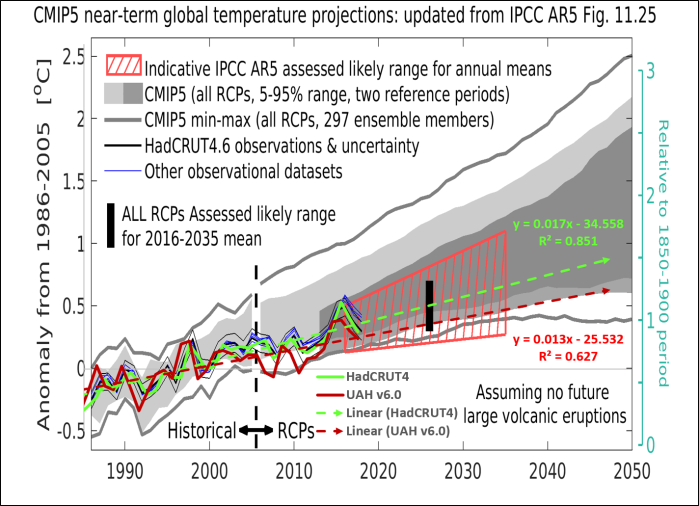
If the oil & gas industry defined accurate predictions in the same manner as climate “scientists,” Macondo (Deepwater Horizon) would have been the only failed prediction in the past 30 years… because the rig blowing up and sinking wasn’t within the 5% to 95% range of outcomes in the pre-drill prognosis.
References
Bartdorff, O., Wallmann, K., Latif, M., and Semenov, V. ( 2008), Phanerozoic evolution of atmospheric methane, Global Biogeochem. Cycles, 22, GB1008, doi:10.1029/2007GB002985.
Berner, R.A. and Z. Kothavala, 2001. “GEOCARB III: A Revised Model of Atmospheric CO2 over Phanerozoic Time”. American Journal of Science, v.301, pp.182-204, February 2001.
Christy, J. R., & McNider, R. T. (2017). “Satellite bulk tropospheric temperatures as a metric for climate sensitivity”. Asia‐Pacific Journal of Atmospheric Sciences, 53(4), 511–518. https://doi.org/10.1007/s13143‐017‐0070‐z
Hansen, J., I. Fung, A. Lacis, D. Rind, S. Lebedeff, R. Ruedy, G. Russell, and P. Stone, 1988. “Global climate changes as forecast by Goddard Institute for Space Studies three-dimensional model”. J. Geophys. Res., 93, 9341-9364, doi:10.1029/JD093iD08p09341
Hausfather, Z., Drake, H. F., Abbott, T., & Schmidt, G. A. ( 2019). “Evaluating the performance of past climate model projections”. Geophysical Research Letters, 46. https://doi.org/10.1029/2019GL085378
Royer, D. L., R. A. Berner, I. P. Montanez, N. J. Tabor and D. J. Beerling. “CO2 as a primary driver of Phanerozoic climate”. GSA Today, Vol. 14, No. 3. (2004), pp. 4-10
via Watts Up With That?
December 6, 2019 at 04:32PM
 Iowa Climate Science Education