|
When anyone builds a house or a road in our drainage board district, that person has to pay some money to the drainage board. If it is a big enough housing estate that money will pay for the widening of a dyke, or drain, to the nearest pumping station, so ensuring that we can always take the water away in wet times.
Are the pumps big enough? I know they are because my Uncle, Ray Pick OBE, chairman of our local drainage board, installed some really big pumps in 1967 and not all of them have been used at the same time this summer. This means we have plenty of pumping capacity for the 80,000 acres (126sq.miles) we look after.
https://www.vinehousefarm.co.uk/blog/
Nicholas Watts makes two telling comments:
- Extremely wet weather used to be much more common in the past, notably in 1880
- The disgraceful neglect of drainage systems by the Environment Agency – criminal neglect he describes it.
His claims about historical rainfall trends are borne out by Met Office data.
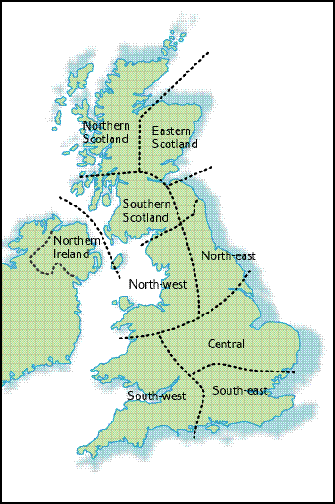
Sadly the local rainfall records he talks about are not published, but we do have the regional data, which goes back to 1873. The Central area most closely corresponds to the area affected by the recent floods, including Lincs, Notts and S Yorks:
Using the meteorological year data, as obviously we don’t have December’s figures yet, we can see that year ranks 9th wettest. The wettest were 1877 and 1912, tied at 864.5mm.
Noticeable is the predominance of wet years from 1875 to 1883, four of which were wetter than this year.
As the series starts in 1873, we have no figures for 1872, which nationally was the wettest since 1766, on the England & Wales series. It is highly likely that 1872 would also be one of the wettest in Central England.

https://www.metoffice.gov.uk/hadobs/hadukp/
As for autumn rainfall alone, the pattern is not dissimilar. Again, we find a run of exceptionally wet autumns from 1875 to 1885.
1875, 2000 and 1960 are ranked higher than this autumn.

As Nicholas says, “clearly we are getting less extreme events”.
|


 Iowa Climate Science Education