
By Paul Homewood
h/t Adrian Kerton
From the “We’re all going to drown” department:

Greenland is losing ice seven times faster than it was in the 1990s.
The assessment comes from an international team of polar scientists who’ve reviewed all the satellite observations over a 26-year period.
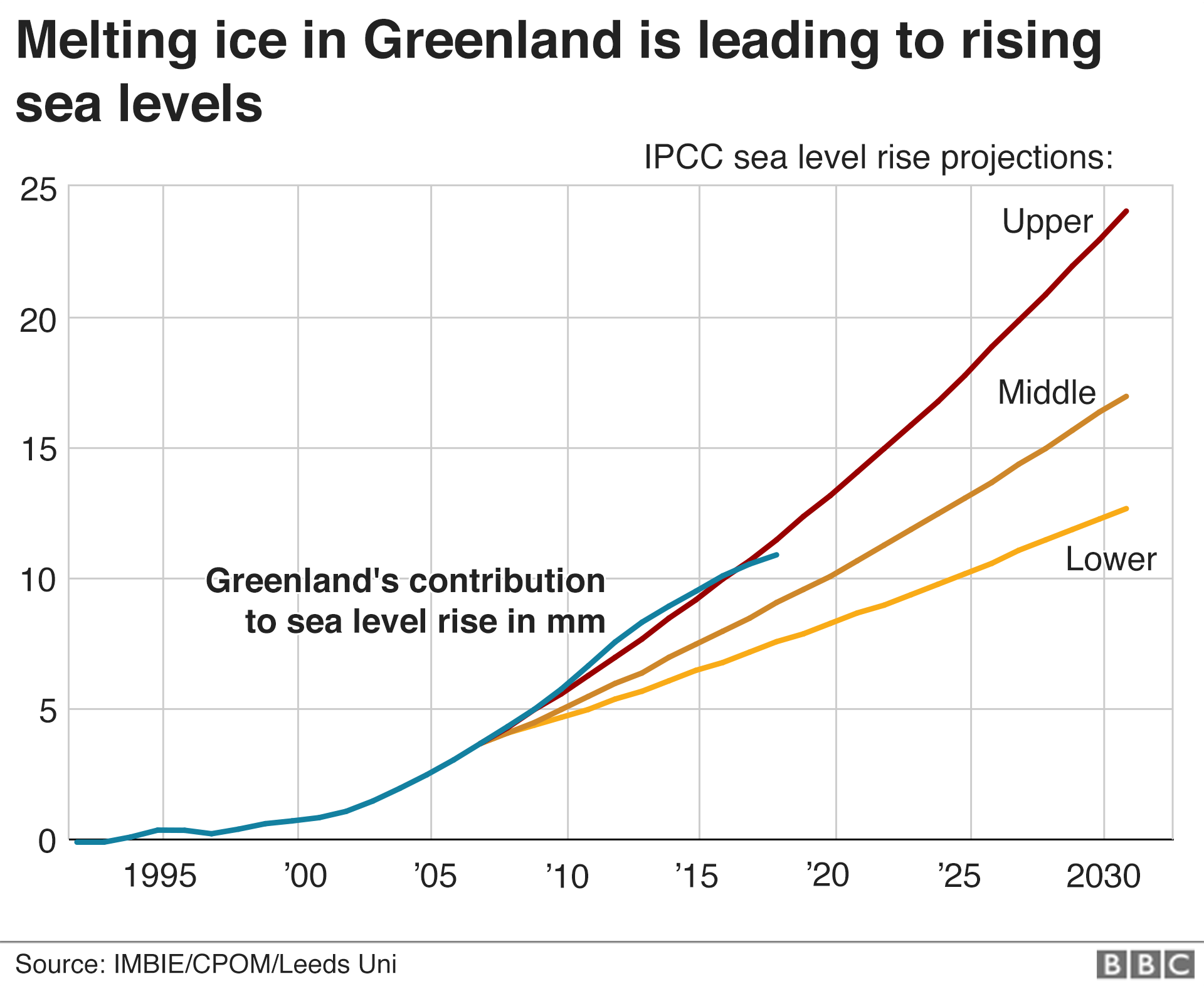
They say Greenland’s contribution to sea-level rise is currently tracking what had been regarded as a pessimistic projection of the future.
It means an additional 7cm of ocean rise could now be expected by the end of the century from Greenland alone.
This threatens to put many millions more people in low-lying coastal regions at risk of flooding.
It’s estimated roughly a billion live today less than 10m above current high-tide lines, including 250 million below 1m.
"Storms, if they happen against a baseline of higher seas – they will break flood defences," said Prof Andy Shepherd, of Leeds University.
"The simple formula is that around the planet, six million people are brought into a flooding situation for every centimetre of sea-level rise. So, when you hear about a centimetre rise, it does have impacts," he told BBC News.
What emerges is the most comprehensive picture yet of how Greenland is reacting to the Arctic’s rapid warming. This is a part of the globe that has seen a 0.75C temperature rise in just the past decade.
The Imbie assessment shows the island to have lost 3.8 trillion tonnes of ice to the ocean since the start of the study period. This mass is the equivalent of 10.6mm of sea-level rise. What is more, the team finds an acceleration in the data.
Whereas in the early 90s, the rate of loss was equivalent to about 1mm per decade, it is now running at roughly 7mm per decade.
Imbie team-member Dr Ruth Mottram is affiliated to the Danish Meteorological Institute.
She said: "Greenland is losing ice in two main ways – one is by surface melting and that water runs off into the ocean; and the other is by the calving of icebergs and then melting where the ice is in contact with the ocean. The long-term contribution from these two processes is roughly half and half."
In an average year now, Greenland sheds about 250 billion tonnes of ice. This year, however, has been exceptional for its warmth. In the coastal town of Ilulissat, not far from where the mighty Jakobshavn Glacier enters the ocean, temperatures reached into the high 20s Celsius. And even in the ice sheet interior, at its highest point, temperatures got to about zero.
"The ice loss this year was more like 370 billion tonnes," said Dr Mottram.
https://www.bbc.co.uk/news/science-environment-48387030
Wow! That’s really scary!
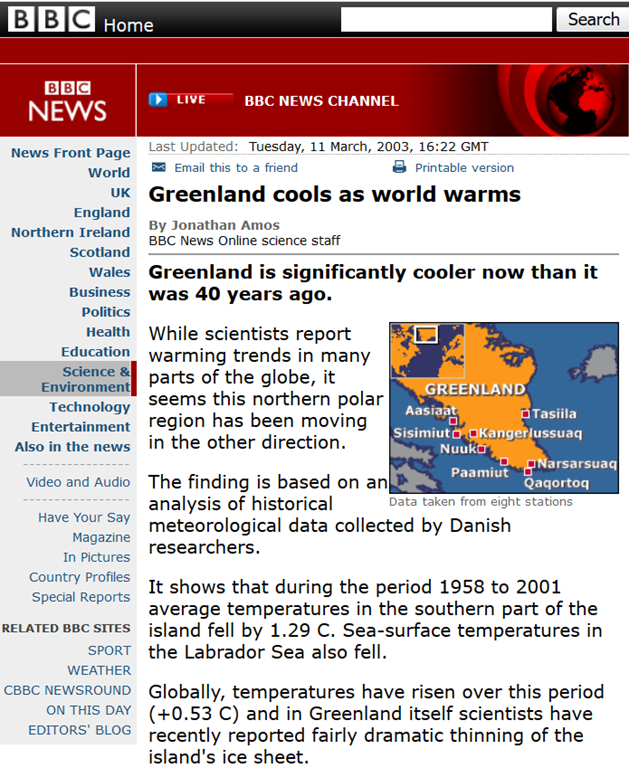
Only one slight problem though. Back in 2003, the same Jonathan Amos reported that Greenland had experienced significant cooling over the previous 40 years:
http://news.bbc.co.uk/1/hi/sci/tech/2840137.stm
So, temperatures fell by 1.29C between 1958 and 2001, and have recovered by 0.75C in the past decade. Does not sound like apocalypse to me! Neither will this come as any surprise to regular readers of this blog, who are fully aware that temperatures in Greenland are no higher now than in the 1930s and 40s.
For those not familiar the temperature graph is at the bottom of this page.
But it gets worse (well at least for the BBC). Amos went on to report back in 2003 that this warming and cooling were part of a natural cycle, linked to the NAO:
But Dr Edward Hanna, from the Institute of Marine Studies at the University of Plymouth, UK, said that, as with all climate science, a fuller picture emerges when long-term data are taken into account.
Climate phenomenon
"It really depends on what timescale you are looking at," he told BBC News Online.
"Certainly in the late 1990s, there was some warming but that’s just over a very short period. There are a lot of natural cycles in regional climate and if you take a longer trend over the last 40 or 50 years then there has been a statistically significant cooling, particularly in south-western coastal Greenland."
Dr Hanna together with Dr John Cappelen, of the Danish Meteorological Institute in Copenhagen, present their Greenland analysis in the journal Geophysical Review Letters.
It looks at data collected at eight stations. The cooling trend, they believe, is associated with an increased phase of the North Atlantic Oscillation (NAO) that has been observed over the past 35 years.
The NAO is a natural and recurring pressure pattern that has a profound impact on the weather experienced in the North Atlantic region – at the moment bringing milder, wetter winters to Northern Europe.
Hanna and Cappelen believe the NAO is likely linked with temperature reductions along the Greenland coast and is responsible for slowing the island’s ice melting rate, in contrast to evidence of global warming.
In other words, we can fully expect to see the cooling trend return to Greenland soon, and it will likely last 30 years or so, linked of course to the Atlantic Multidecadal Oscillation.
As Amos correctly noted in the original report, this will slow the ice melt there.
To compare ice melt rates now, during the warm phase of the cycle, with those from the cool phase, and then claim the rate is accelerating, is clearly grossly misleading as well as being statistically indefensible.
To then use the latest rate to forecast sea level rise up to 2100 fakery of the worst sort.
Finally let’s take a closer look at that graph.
Far from showing acceleration, it is pretty clear that the rate of melt has slowed since 2012. Factor in 30 years of virtually zero melt, and the wild projections up to the end of the century are simply rubbish.

Annual temperature anomalies for Merged SW Greenland Series from DMI
https://notalotofpeopleknowthat.files.wordpress.com/2019/04/greenland-yemps-1.pdf
via NOT A LOT OF PEOPLE KNOW THAT
December 13, 2019 at 04:30AM
 Iowa Climate Science Education