
By Paul Homewood
A useful recap from Roger Pielke Jr at Forbes, (and more shenanigans from the Lancet!)

Data recently published in The Lancet tells an amazing story about weather-related disasters worldwide over the past three decades. As people around the world have become wealthier, the fraction of that wealth that is destroyed by extreme weather has gone down. This trend holds for rich and poor nations, and remarkably across all types of weather phenomena. It also helps us to understand why the focus on extreme weather among climate advocates is badly misguided.
The new data was published earlier this month in the scientific journal The Lancet, in its annual review of climate change and health. The data comes from the German reinsurance company Munich Re, which tabulates global disaster costs on an annual basis. The authors of The Lancet assessment presented weather-related disasters losses from 1990 to 2016 (2017 and 2018 are included but are not adjusted to a common base year) as a proportion of overall GDP for four different country groupings, ranging from the lowest income to the highest.
The figure below shows disasters losses as a percentage of GDP for each country grouping. You can see that the decrease in losses as a fraction of overall GDP is the greatest for the poorest countries. This is great news, as it means that as the world has become wealthier, weather disasters are costing relatively less.
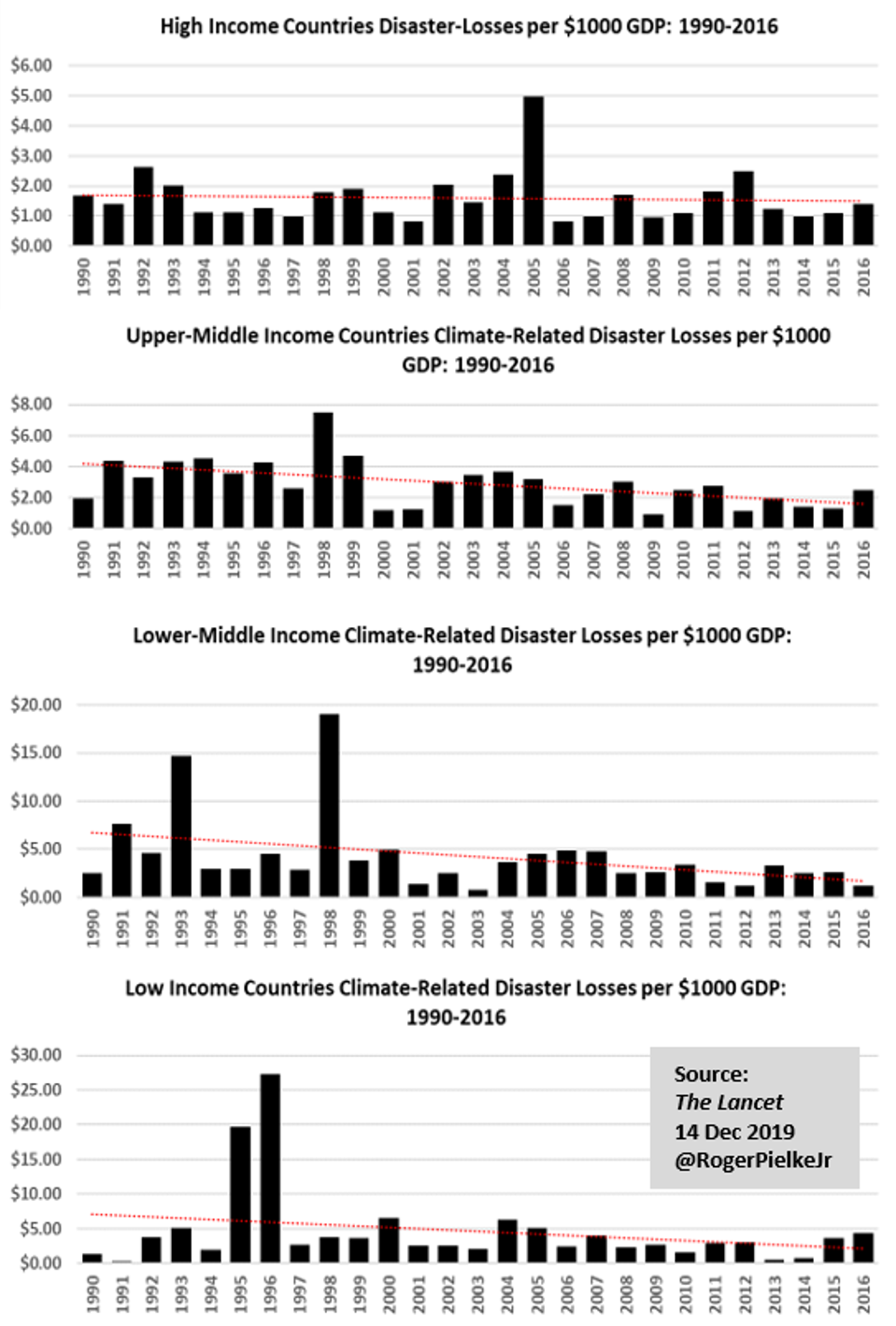
Disaster losses as a percentage of GDP for four different country regions. Source: The Lancet,
The regional trends are consistent with the overall global trend that I have recently documented in decreasing overall and weather-related disaster losses as a proportion of global GDP. The United Nations, under its indicator framework associated with its Sustainable Development Goals has identified a reduction in disaster losses as a proportion of GDP as a key indicator of progress.
In an era where gloom and doom dominate our discussions of the environment, the remarkable progress in reducing the relative impact of disasters on society stands out as good news. Given today’s zeitgeist, it is perhaps not at all surprising that The Lancet article buried its disaster data deep in an appendix and in the main text displayed a misleading figure with only a small subset of the data.
Many people I speak to and hear from on social media are surprised, shocked even, to learn that in recent decades disaster losses have actually decreased as a proportion of GDP. A big part of this surprise is surely due to hyperbolic media reporting of disasters and climate change. But journalists share responsibility for such hype with some in the scientific community who have also been seduced by the siren song of apocalyptic visions.
Full post here.
Roger makes a particular about the Lancet keeping this information hidden away and choosing to highlight a highly misleading subset, and does not hold back:

https://twitter.com/RogerPielkeJr/status/1195043159610253313?s=20
This is the full graph from the Lancet report:

Figure 20Economic losses from climate-related events relative to GDP
https://www.thelancet.com/journals/lancet/article/PIIS0140-6736(19)32596-6/fulltext
Note that the series begins in 2011, whereas the full dataset, provided within the report and which Roger uses for his graphs, begins in 1990. Needless to say, if the Lancet graph started in 1990, it would show the opposite of what they show now.
To make matters worse, the losses for 2017 are inflated by Hurricane Harvey, which cannot be used for trend purposes, given that it is an obvious and significant outlier, and has no climatic significance.
In any event, no serious statistician would use such a short period as 8 years to claim any significant trends.
Unfortunately, we are only too familiar with this sort of shoddy behaviour from the Lancet.
via NOT A LOT OF PEOPLE KNOW THAT
December 18, 2019 at 11:36AM
 Iowa Climate Science Education