
By Paul Homewood
Following all of the apocalyptic hype about the Australian bushfires, it is worth revisiting this Guardian piece from 2016:
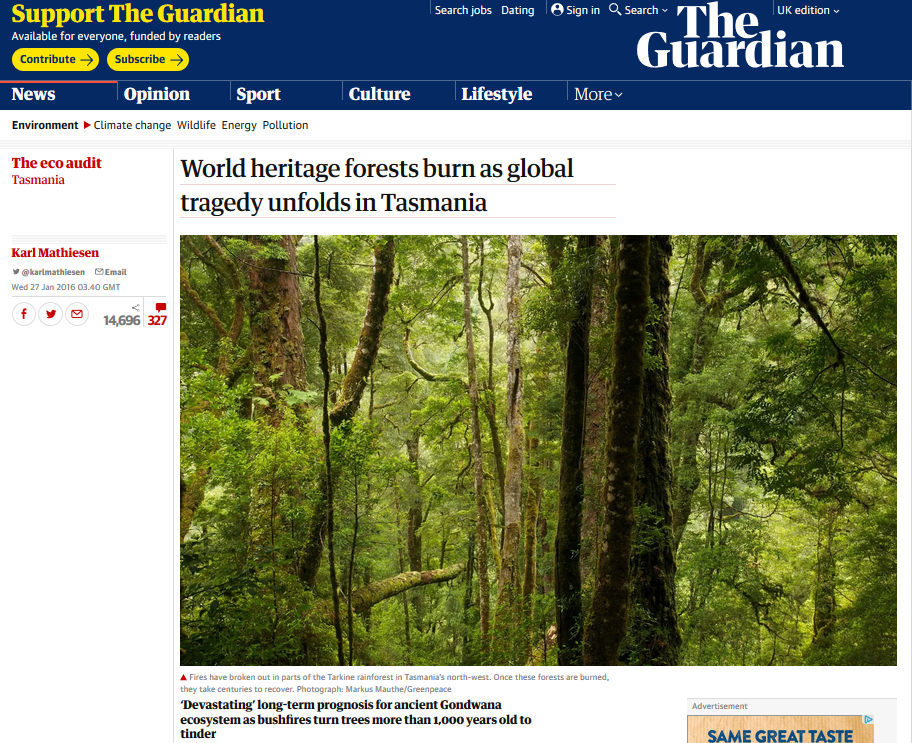
A global tragedy is unfolding in Tasmania. World heritage forests are burning; 1,000-year-old trees and the hoary peat beneath are reduced to char.
Fires have already taken stands of king billy and pencil pine – the last remaining fragments of an ecosystem that once spread across the supercontinent of Gondwana. Pockets of Australia’s only winter deciduous tree, the beloved nothofagus – whose direct kin shade the sides of the South American Andes – are now just a wind change away from eternity.
Unlike Australia’s eucalyptus forests, which use fire to regenerate, these plants have not evolved to live within the natural cycle of conflagration and renewal. If burned, they die.
To avoid this fate, they grow high up on the central plateau where it is too wet for the flames to take hold. But a desiccating spring and summer has turned even the wettest rainforest dells and high-altitude bogs into tinder. Last week a huge and uncharacteristically dry electrical storm flashed its way across the state, igniting the land.
While these events have occurred in the past, says David Bowman, a professor of environmental change biology at the University of Tasmania, they were extremely rare, happening perhaps once in a millennium.
“It’s killing trees that are over 1,000 years old; it’s burning up soil that takes over 1,000 years to accumulate,” he says.
If this truly were a once-in-1,000-year event, says Bowman, then to be alive when it occurs is like “winning TattsLotto” for a fire scientist. But we no longer live in the same world.
“We are in a new place,” he says. “We just have to accept that we’ve crossed a threshold, I suspect. This is what climate change looks like.”

It is full of the usual sort of trigger words, so beloved by the Guardian BBC – devastating, global tragedy, heritage, 1000 year event, and of course it’s all linked to climate change.
Well, just how did things work out?
The Tasmania Fire Service chief officer Gavin Freeman claimed little harm was done to the heritage areas stating that 18,000 ha of heritage area as being the area affected out of a total of 95,000 ha burnt on the island. This is 1.2% of the heritage zone. The Tourism Council put the damage even lower, at 11,000 ha.
While that is the worst seen in recent years, it pales into insignificance alongside the fires of 1966/67, when 265,000 ha were destroyed in Tasmania, though that mainly affected the south east corner around Hobart. Other fires, such as 1897 and 1933 have affected the western part of the state, where the heritage forests are:

https://ro.uow.edu.au/cgi/viewcontent.cgi?article=1003&context=scipapers
The idea that Tasmania is relatively immune to wildfire was debunked more than 200 years ago:

Tasmania forms part of the driest and most fire-hazardous continent in the world and our fire seasons are very irregular in intensity. Higher rainfalls in certain areas and the fertility of the soil contribute heavier concentrations of ground fuels than in other parts of Australia. When the right conditions prevail, fires can become uncontrollable and large conflagrations occur.
Tasmania has faced a series of devastating fires from early settlement in 1803. The new settlers were not used to the summer conditions which caused fire to spread quickly. As early as 1854 a Bush Fires Act aimed ‘to guard against damage by fire in certain months of the year’, by preventing fires being lit and escaping on to another person’s property. This was the result of a large fire which caused havoc when it ‘ravaged’ the outskirts of Hobart early that year.
Despite the Act, Tasmania has faced many devastating fires since 1854. The worst were in 1854, 1897–98, 1913–15, 1926–27, 1933–34, 1940–42, 1960–61 and 1967. In 1895 eleven houses were destroyed at Dundas on the west coast, and in 1897–98 an area almost the same as the 1967 fires was burnt when the ‘Black Friday’ fire spread rapidly through the south, destroying farms and forests. It covered the area from the lower Midlands and the Channel District to Port Arthur (destroying part of the Penitentiary), the Derwent and Huon Valleys, as far as Esperance and Cygnet. The fire in late December 1933 to January 1934 threatened the whole of the Derwent Valley and 300 volunteers were rushed to fight it. Perhaps the most devastating were the bushfires of 1967, a disaster of enormous magnitude in southern Tasmania, the blackest day in the history of the state.
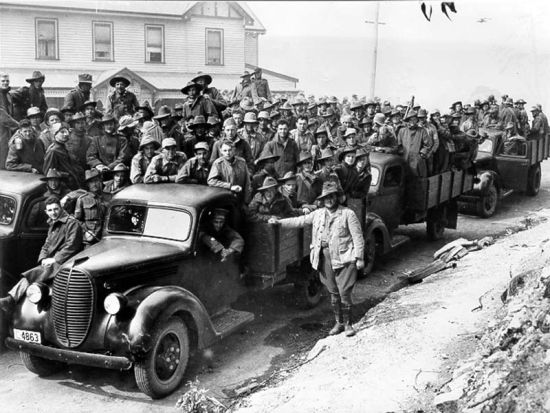
Men from the Second AIF about to fight bushfires at Fern Tree in 1940 (AOT, PH30/1/3039)
Before the 1930s there was very little organisation to fight bush fires in Tasmania. The dangers from bush fires were well recognised but nothing much had been done to form an organisation capable of fighting them. However, the 1967 disaster led to the formation of the Rural Fires Board and eventually the Tasmania Fire Service, a splendid fire-fighting organisation.
https://www.utas.edu.au/library/companion_to_tasmanian_history/B/Bushfires.htm
I have mentioned the fires of 1966/67, but note the comment that the bushfires in 1897/98 affected almost as large an area, though there are no specific numbers. In those days of course nobody had the time, resources or inclination to go around measuring fires – they had far more urgent things to do! This would be even more the case in uninhabited areas, such as the heritage forests, which would just have been allowed to burn.
We do know more about the 1966/67 fires though:
The bushfires which attacked Hobart and adjacent areas of Southern Tasmania in the summer of 1966–67, peaking on 7 February, produced one of the most damaging natural disasters ever experienced in Australia. Such a disaster is a social event resulting from the impact of a disaster agent on a settled community. In this case some 653,000 acres of Southern Tasmania burned. In the short space of four or five hours on that ‘Black Tuesday’, the burning caused the deaths of 62 people, destroyed about 1,400 buildings (mostly homes, but also factories, schools, hotels, post offices, churches and halls), savagely disrupted communications and power facilities, and destroyed about 1,500 cars and trucks. The fires also did massive damage to surrounding farms, pastures and livestock, and total monetary damage was assessed at about $40 million (at 1967 values).
Ironically, but also in common with many other world disaster situations, this disaster produced an economic boon, with an estimated $34 million injected into the state’s economy in quick time, mostly from resulting commonwealth grants and loans (14.5m), insurance recoveries (over $10m – at that time, the biggest payout in Australian history), and distributions from a public relief fund ($5.1m) and a number of other private (church, service club, etc) relief funds.
In the social reconstruction after the burning, a number of the ’emergent groups’ familiar in the disaster literature were active. In particular, the Fire Victims’ Welfare Organisation assisted many thousands of people whose lives had been disrupted, and the social work experience acquired in the Tasmanian disaster carried over to the Brisbane flooding of January 1974 and Darwin’s Cyclone Tracy disaster of December 1974. The Tasmanian firestorm was one of four major disasters hitting Australian urban settlements in the short space of seven years (the other was the strike of Cyclone Althea in Townsville in 1972), and this conjunction produced a strong movement for the improvement of national disaster management machinery.
https://www.utas.edu.au/library/companion_to_tasmanian_history/B/Bushfires%201967.htm
[Note the comment in the final paragraph about the four disasters hitting Australia between 1967 and 1974. I suspect climate scientists would be all over that if it happened now, blaming them on global warming!]
The Guardian article talks of a “dessicating spring and summer” in 2015/16, and it was certainly the driest spring on record in Tasmania in 2015, if only slightly drier than 1915.
However there is no evidence of springs becoming drier over the period as a whole since 1900.

As for summer rainfall, 2015/16 was not unusual at all. Again, there have been no unusually dry summers in the last couple of decades:

As for temperatures, although the spring of 2015 and 2017 stand out as the hottest, other years are in line with many previous springs.
The same applies to summer temperatures, with the hottest on record back in 1960:


In short, the wildfires of 2016 did not do the catastrophic damage claimed by the Guardian. Nor is there any evidence that bushfires are worse now in Tasmania than they used to be.
Neither is there any evidence that climate change will make them worse in years to come.
FOOTNOTE
Wikipedia describe the causes of the 1966/67 fires:
The late winter and early spring of 1966 had been wet over southeastern Tasmania, resulting in a large amount of vegetation growth by November. However, in November, Tasmania began its driest eight-month period since 1885, and by the end of January 1967 the luxuriant growth in the area had dried off. Though January was a cool month, hot weather began early in February, so that in the days leading up to 7 February 1967, several bush fires were burning uncontrolled in the areas concerned. Some of these fires had been deliberately lit for burning off, despite the extremely dry conditions at the time.
Reports into the causes of the fire stated that only 22 of the 110 fires were started accidentally.
Shortly before midday on the 7th, a combination of extremely high temperatures, (the maximum was 39 °C (102 °F)), very low humidity and very strong winds from the northwest led to disaster.
Although this fire was by far the worst in loss of life and property in Tasmanian history, the meteorological conditions are common. McArthur’s report on the fire notes that "very similar conditions have occurred on three or four occasions during the past 70 years."[6]
https://en.wikipedia.org/wiki/1967_Tasmanian_fires
This shows that it is not always a simple case of long spells of drought causing fires. In this instance, as we often see, wet weather in winter and spring can encourage vegetation growth, which just needs a few weeks of hot, dry weather to turn into very combustible fuel load.
via NOT A LOT OF PEOPLE KNOW THAT
January 14, 2020 at 12:42PM
 Iowa Climate Science Education