Guest “déjà vu all over again” by David Middleton

Will The Permian Peak This Year?
By Anes Alic – Jan 16, 2020
Ticker: Just a few years back, the U.S. shale industry was drowning in a sea of hubris, with pompous experts making outrageous claims such as the Permian Shale is a near-infinite resource thanks to the basin’s explosive production growth in the latter half of the last decade.
[…]
To be fair, Mr. Waterous seems to have vested interests in the shale saga considering that his PE firm has been picking up distressed energy assets on the cheap.
[…]
Certainly not everyone shares Waterous’ “Peak Permian in 2020” view, with BloombergNEF analyst Tai Liu saying the shale oil pessimism is overdone.
Indeed, the general consensus is that the US shale industry still has some room to run, with production in the current year expected to continue to rise, albeit at a slower pace.
Nevertheless, it’s also noteworthy that Waterous is hardly alone in his gloomy shale outlook.
[…]
Anes Alic is a veteran investigative journalist and writer whose work in everything from anti-terrorism and high-level politics, to industry, investing and IT has won him international accolades. He is the former director of ISA Intel global due diligence operations. He is based in the United States.
The article was mostly a rehash of last week’s Peak Permian prediction; but at least included some contrary commentary.
Before reading the contrary commentary, I was all set to mercilessly ridicule this intrepid investigative journalist for this mindbogglingly idiotic comment:
Just a few years back, the U.S. shale industry was drowning in a sea of hubris, with pompous experts making outrageous claims such as the Permian Shale is a near-infinite resource thanks to the basin’s explosive production growth in the latter half of the last decade.
Instead of mercilessly ridiculing the intrepid investigative journalist, I’ll just explain, at great length, why his comment was mindbogglingly idiotic
He is referring to a 2017 Mark Perry AEI blog post about a Forbes interview of Drilling Info’s Allen Gilmer. The “near-infinite resource” comment had nothing to to with “the basin’s explosive production growth in the latter half of the last decade.” At the time it was written, the Permian Basin was producing 2.5 million barrels of oil per day (bbl/d), up from 1 million bbl/d in 2011. As of January 2020, it’s producing over 4.8 million bbl/d. Most of the “explosive production growth” occurred after Mr. Gilmer described the Permian Basin as a “near infinite resource”… because that’s what it is.
“We should view the Permian Basin as a permanent resource,” he says, “The Permian is best viewed as a near infinite resource – we will never produce the last drop of economic oil from the Basin.”
According to EIA estimates, the Permian Basin is now producing more than 2.5 million barrels of oil per day (see top chart), which is an annual rate of nearly 1 billion barrels of oil. If Gilmer’s estimate is correct that the Permian Basin holds an additional half a trillion barrels of recoverable oil, that would be a 500-year supply of oil at the current production level, and at 2 trillion barrels, a 2,000 year supply! And if that’s an accurate forecast of Permian Basin reserves, Gilmer’s description of the Permian Basin as a “permanent, near infinite resource” makes perfect sense because the probability is pretty close to zero that we’ll be using fossil fuels even 100 years from now, much less 500 years or 2,000 years in the future.
Mark Perry, AEI
Investor sentiment has nothing to do with the vastness of the Permian Basin resource… Nor does it have anything to do with whether or not the growth of Permian Basin oil production slows, plateaus or even briefly declines in 2020. This is exclusively driven by oil prices, geology and technology. The geology and technology present no barriers to Permian Basin oil production rising to 9 million bbl/d over the next few years.
The only thing that can slow this down is a persistently low oil price.
This Texas area is expected to double oil output to 8 million barrels in just four years, boosting US exports
PUBLISHED FRI, MAR 8 2019
Patti Domm[…]
“There’s a lot of shale capacity being prepared. There’s a lot of pipeline capacity. We’re going to triple pipelines going into the market from 3 to 9 million in three years, from last year to late 2021,” said Francisco Blanch, head of commodities and derivatives at Bank of America Merrill Lynch.
[…]
Citigroup energy analyst Eric Lee said Permian output at just under 4 million barrels a day is up about 1 million barrels from a year ago and should be a million more, or 5 million a day, a year from now, in early 2020. The Permian has benefited from consistent improvements in technology, which increasingly have been capable of extracting more oil from the shale formation.
“We’re happy to look out to 2023, when it gets to 8 million. … They figured out how to access it at very low break-evens, like $30/$40. … There are more layers below it. It’s hard to know what those are going to mean, break-even-wise,” said Lee. His estimates depend on the price of crude and world oil demand. Breakeven is the price a producer of a barrel of oil needs to recover expenses, or where a producer breaks even.
[…]
The Permian Basin is fracking YUGE!
- The Permian Basin is often mistakenly referred to as an oil field. It is home to more than 7,000 oil fields.
- The Permian Basin is compared to other “shale” oil plays, like the Eagle Ford. However, it is home to more than a dozen oil plays. These are often stacked. The Permian Basin is like a dozen Eagle Ford plays or a dozen Bakken plays stacked on top of one another.
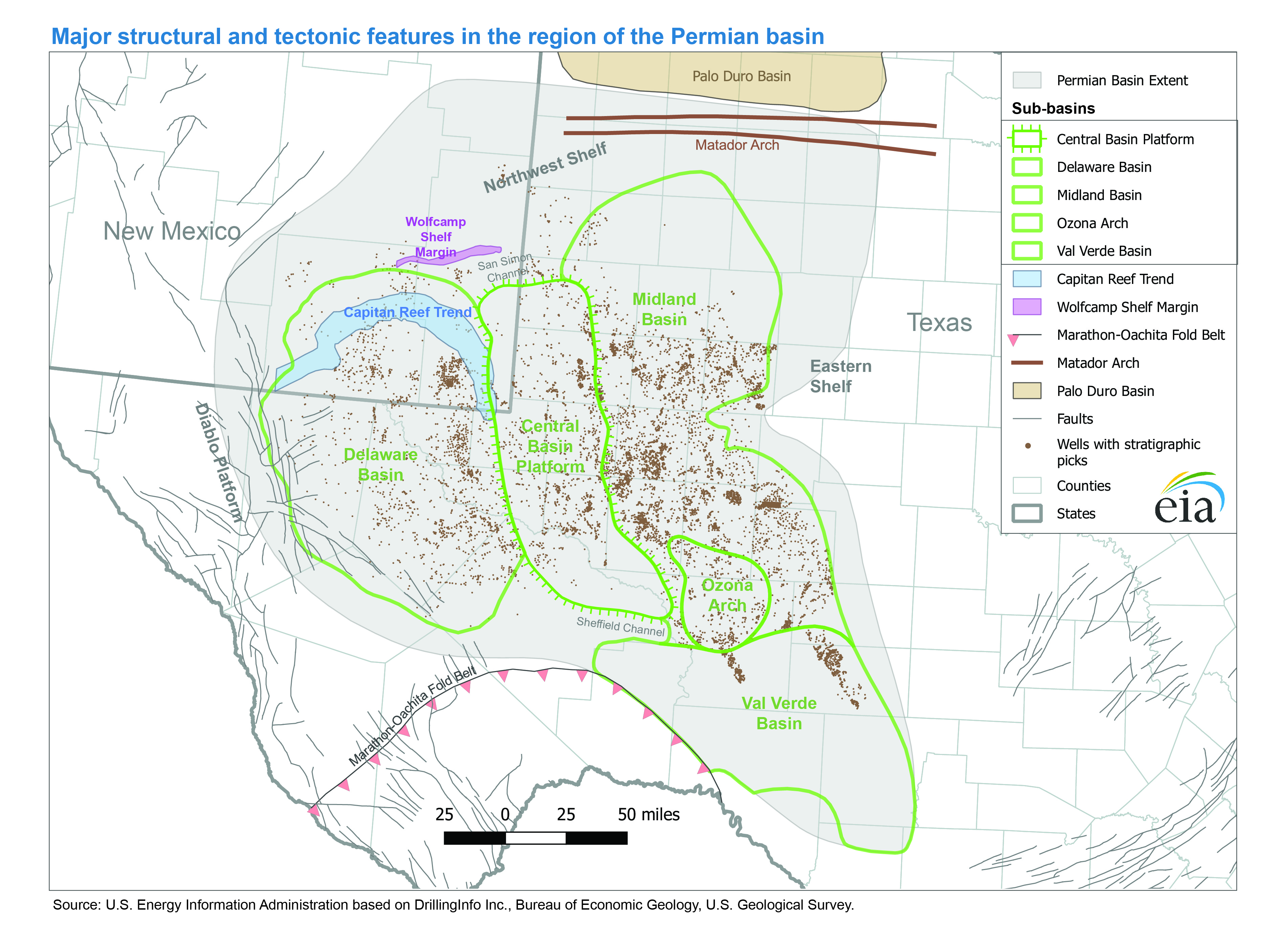
- The Permian Basin is actually a collection of three basins (Delaware, Midland and Val Verde) and several other major tectonic features. It is a Super Basin.


The major plays of the Permian Basin are “stacked.” Finding stacked pay is like getting a pony for Christmas. Finding stacked plays is like getting herd of Unicorn ponies for Christmas.

The three major tectonic features from west to east are:
- Delaware Basin
- Central Basin Platform
- Midland Basin

Why “Peak Permian” is almost an oxymoron
As I mentioned earlier, the Permian Basin is akin to a dozen Eagle Fords or Bakkens. The Wolfcamp/Bone Spring play, by itself, is bigger than the Eagle Ford and Bakken/Three Forks combined… And the Permian Basin is still growing.
This is from the EIA’s 2018 proved reserves report, published in December 2019:


Year-end 2018:
| Million Barrels | ||
| 2018 Production | 2018 Proved Reserves | |
| Wolfcamp/Bone Spring | 922 | 11,096 |
| Bakken/Three Forks | 458 | 5,862 |
| Eagle Ford | 449 | 4,734 |
| Bakken + Eagle Ford | 907 | 10,596 |
The Eagle Ford may have hit peak production in 2015, although production has somewhat recovered from the 2014-2016 price crash.


While it’s quite possible that higher oil prices might lead to Eagle Ford production exceeding its 2015 peak at some point in the future, let’s assume that 2015 was the Eagle Ford’s Hubbert peak. The Eagle Ford climbed from about 100,000 bbl/d to nearly 1.8 million bbl/d in just four years. The Permian Basin climbed from 1 million bbl/d to nearly 5 million bbl/d in nine years.


| Million Barrels | |
| 2018 Proved Reserves | |
| Permian Basin (approx.) | 16,816 |
| Eagle Ford | 4,734 |
The 2018 proved reserves of the Permian Basin were 3.5 times that of the Eagle Ford. Assuming a similar Hubbert-like curve for the Permian Basin, it should take about 14 years for the Permian to reach peak production. This is very much inline with reaching 8-9 million bbl/d over the next 5 years. Of course, this assumes that we don’t find something that we didn’t even know to look for yesterday and that there are no major technological breakthroughs. If the Permian Basin is actually 12 times the size of the Eagle Ford, Peak Permian won’t occur until about 2050… It might as well be an infinite resource. Peak oil is simply the maximum production rate achieved in a reservoir, field, play, basin, etc. It’s a real thing and it’s pretty well irrelevant.
Peak Permian is the the truth in the X-Files. It’s “out there” somewhere.
There must be a pony in there somewhere!
The Pony Joke.
“Over lunch today I asked Ed Meese about one of Reagan’s favorite jokes. ‘The pony joke?’ Meese replied. ‘Sure I remember it. If I heard him tell it once, I heard him tell it a thousand times.’”
“The joke concerns twin boys of five or six. Worried that the boys had developed extreme personalities – one was a total pessimist, the other a total optimist – their parents took them to a psychiatrist.”
“First the psychiatrist treated the pessimist. Trying to brighten his outlook, the psychiatrist took him to a room piled to the ceiling with brand-new toys. But instead of yelping with delight, the little boy burst into tears. ‘What’s the matter?’ the psychiatrist asked, baffled. ‘Don’t you want to play with any of the toys?’ ‘Yes,’ the little boy bawled, ‘but if I did I’d only break them.’”
“Next the psychiatrist treated the optimist. Trying to dampen his out look, the psychiatrist took him to a room piled to the ceiling with horse manure. But instead of wrinkling his nose in disgust, the optimist emitted just the yelp of delight the psychiatrist had been hoping to hear from his brother, the pessimist. Then he clambered to the top of the pile, dropped to his knees, and began gleefully digging out scoop after scoop with his bare hands. ‘What do you think you’re doing?’ the psychiatrist asked, just as baffled by the optimist as he had been by the pessimist. ‘With all this manure,’ the little boy replied, beaming, ‘there must be a pony in here somewhere!’”
– excerpted from How Ronald Reagan Changed My Life by Peter Robinson
The version of the joke I remember, or maybe just made up, is that little Johnny (if it isn’t Boudreaux & Thibodeaux, it’s always little Johnny) was an eternal optimist (destined to become a petroleum geologist). Despite the fact that he lost his father and his mother married a mean old SOB, he remained an eternal optimist. The mean old SOB stepfather, Joe Biden if I remember correctly, hated little Johnny’s eternal optimism… So one Christmas Eve, he dumped a YUGE pile of horst schist under the tree. The next morning, Joe was shocked to see little Johnny gleefully dive into the pile of horst schist as if he was digging for treasure. Joe said, “What the hell are you so happy about?” Johnny replied, “With all of this horst schist, there must be a pony in there somewhere!”
One of my favorite things to do is to tear apart old oil fields, looking for what the previous operators missed. Whenever, I have been assigned an old field that seemed to be on its last legs, I always say, “There must be a pony in there somewhere!” And there usually is.
About the author of this WUWT post
In case you don’t already know, or haven’t figured it out, I have been a geologist/geophysicist in the oil & gas industry since 1981.
via Watts Up With That?
January 29, 2020 at 08:57PM
 Iowa Climate Science Education