
By Paul Homewood
h/t Joe Public

The government has published the latest summary of air pollution.
Emissions of nitrogen oxides and sulphur dioxide continue to fall rapidly, but PMs have levelled off:
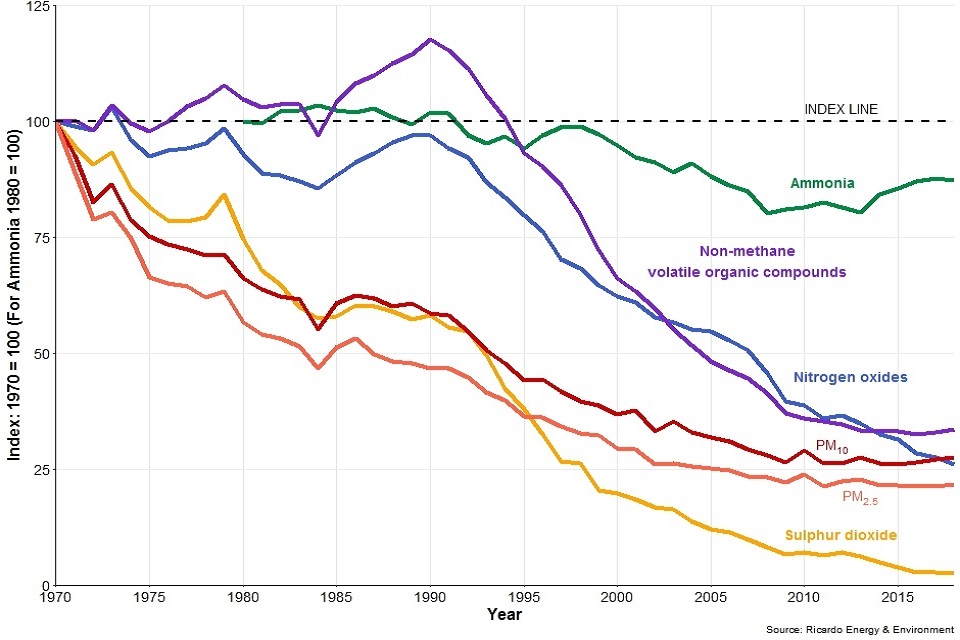
There has been a long term decrease in the emissions of all of the air pollutants covered by this statistical release (ammonia, nitrogen oxides, non-methane volatile organic compounds, particulate matter (PM10, PM2.5) and sulphur dioxide). The UK has met current international ceilings for emissions of air pollutants since they were introduced in 2010. The 2010 emissions total for nitrogen oxides exceeded the emissions ceilings, but the UK was allowed to apply an adjustment to the national total which brought the adjusted total under the emissions ceiling. Adjustments are allowed where non-compliance with the ceilings results from applying improved emission inventory methods updated in accordance with scientific knowledge. Compliance with national ceilings is then assessed by reference to the adjusted totals.
A large number of factors are responsible for the long-term decrease in emissions of air pollutants:
-
The reduction in use of coal for domestic heating and power generation has been a major factor in reducing emissions of particulate matter, although burning of other solid fuels for domestic heating and industry has increased in recent years.
-
The move away from using coal to gas for power generation and fitting flue gas desulphurisation equipment to existing coal-fired power stations has been responsible for long-term decreases in emissions of sulphur dioxide and nitrogen oxides.
-
Stricter emissions regulation for road transport has also led to significant emissions reductions for nitrogen oxides and non-methane volatile organic compounds (NMVOCs).
-
Stricter emissions limits placed on industry has significantly reduced emissions from solvents, which particularly affected emissions of NMVOCs.
-
Emissions of ammonia were largely influenced by changes to herd sizes and farming practices, as emissions from agriculture form a large majority of emissions of ammonia.
4. Recent trends in emissions of air pollutants
Trends in annual emissions of particulate matter (PM10 and PM2.5), nitrogen oxides, ammonia, non-methane volatile organic compounds, and sulphur dioxide, 2008-2018
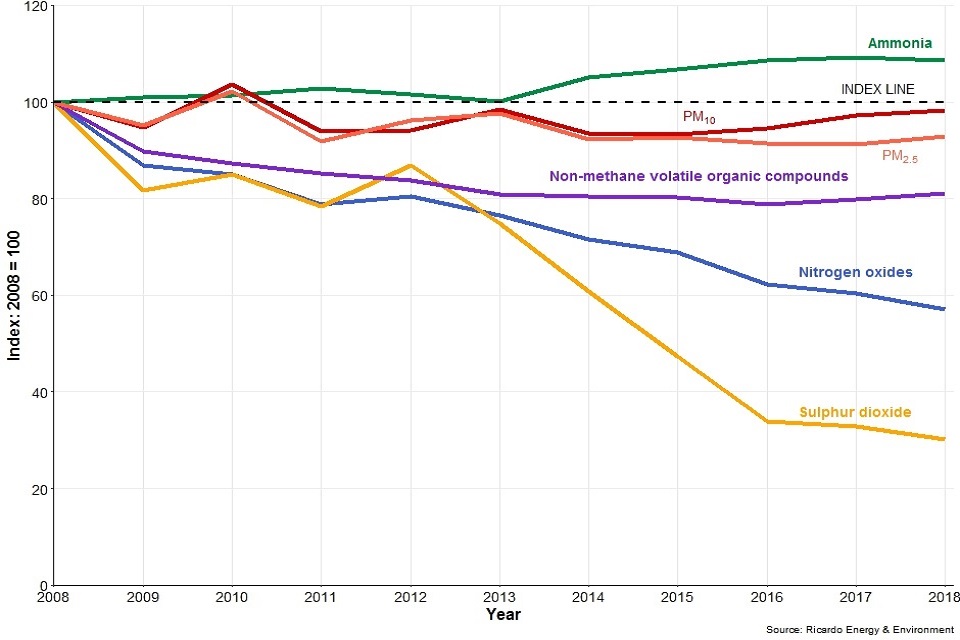
In the most recent ten-year period of emissions estimates, there has been mixed progress in reducing emissions of air pollutants:
-
For sulphur dioxide and nitrogen oxides, emissions have continued to fall in line with the long-term trend with much of the reduction as a result of the decreasing dependence on coal for energy generation (emissions of sulphur dioxide and nitrogen oxides from energy industries has fallen by 83 and 57 per cent respectively between 2008 and 2018).
-
Emissions of nitrogen oxides and non-methane volatile organic compounds from road transport also decreased by 47 per cent and 77 per cent respectively between 2008 and 2018. This is largely as a result of tighter emissions standards being introduced for petrol and diesel cars.
-
For particulate matter decreases in emissions from many sources have been partially offset by increases in emissions from residential burning (domestic combustion; emissions of PM2.5 from this source increased by 33 per cent between 2008 and 2018). This reflects the increasing popularity of solid fuel appliances in the home such as wood-burning stoves.
-
Emissions of non-methane volatile organic compounds have changed little since 2008 across most sources, and annual emissions of ammonia increased by 8.7 per cent between 2008 and 2018. This is largely due to increased fertiliser spreading.
With emissions falling rapidly, the case for banning petrol/diesel cars for pollution reasons becomes ever weaker.
via NOT A LOT OF PEOPLE KNOW THAT
February 27, 2020 at 04:55AM
 Iowa Climate Science Education